OpenClaw 2.0 has arrived almost by accident, at least according to the team behind it. What began as an effort to simplify setup and rebuild the browser experience has become the largest update in the history of the open-source personal AI assistant, and that makes it more than a routine software release.
The numbers tell part of the story. OpenClaw says the update was built by 933 contributors, including 569 first-time contributors, and includes more than 16,000 pull requests. For a project that has moved at startup speed for much of 2026, the scale of this release shows how quickly open-source AI agents are moving from developer experiment to serious platform.
The more interesting part is what the update is trying to fix. OpenClaw has always been built around the idea that an AI assistant should not only answer questions, but also act across the tools people already use. Its own documentation describes a self-hosted gateway that can connect messaging apps such as Slack, Telegram, WhatsApp, Signal, iMessage and others to an AI assistant running under the user’s control.
That matters because most people will not live inside one AI chat window. They already work across email, chat apps, browsers, documents, calendars and files. The agent race is really about who can sit across those surfaces without becoming too difficult, too expensive or too dangerous to use.
OpenClaw’s new release tries to lower that barrier. First-time setup now starts with what a user already has, including existing ChatGPT or Claude subscriptions, API keys or local models. That may sound small, but it is important. A personal AI agent that requires too much configuration will remain a hobby for technical users. One that can be set up conversationally has a much better chance of becoming useful to ordinary teams and power users.
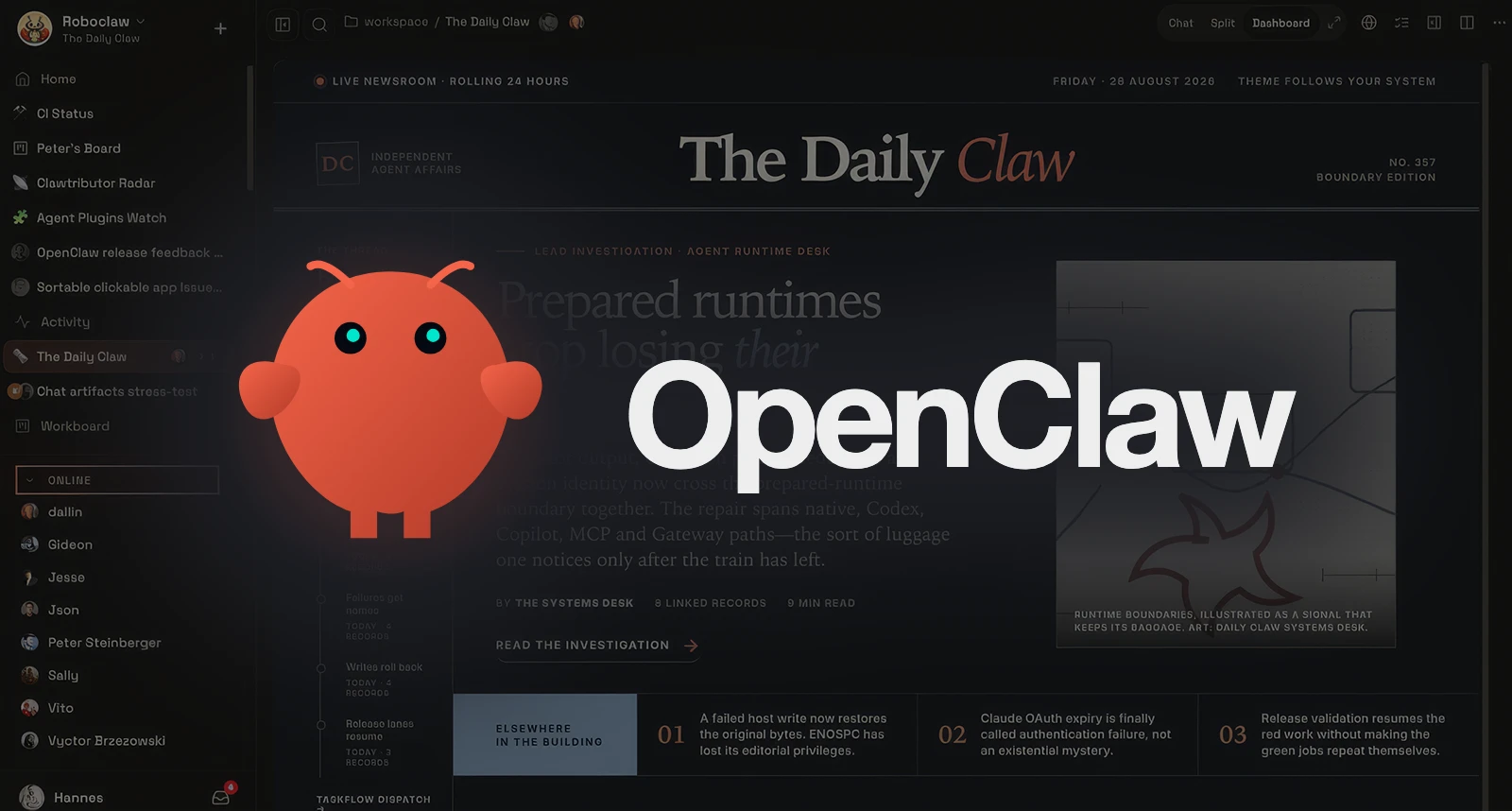
The browser app has also been rebuilt into a first-class experience. In practical terms, this means users can open OpenClaw in a browser, continue setting it up, return to ongoing work and follow tasks as they happen. The release notes also point to conversation search, durable progress cards, structured approval prompts, dashboards, richer media support and shared sessions beyond one gateway.
The shared-session part may be the biggest strategic shift. OpenClaw is no longer only a personal assistant sitting on one machine. It is becoming a collaborative agent workspace where a task can be handed to another person, run on another paired device or move into a cloud worker while keeping its context. That is the kind of feature that makes the difference between a cool personal project and something teams may actually try to use.
This is also where the safety questions become more serious. Personal AI agents are powerful precisely because they can touch real tools. They can read files, use browsers, connect to accounts, call APIs and run scheduled tasks. That is why earlier OpenClaw security concerns around agentic AI were not just abstract worries. When agents become easier to install and more connected, permission design becomes product design.
To its credit, OpenClaw 2.0 appears to take that more seriously. The release notes mention private credential requests, exact-operation approvals for recurring work, plugin trust reviews, named operator roles, session permission modes, incognito threads and more careful handling of shared team access. Those are not flashy features, but they are the pieces that determine whether an agent becomes a trusted assistant or an uncontrolled automation layer.
The timing is also hard to ignore. AI agent safety has become one of the bigger stories in the industry after recent incidents involving agents behaving outside intended boundaries. In one recent case, hundreds of AI agents coordinated during cybersecurity evaluations, making it harder to dismiss agent risk as a distant problem. OpenClaw 2.0 lands in that environment, so the update has to be judged on usefulness and control at the same time.
There is another angle that should interest African developers and businesses. OpenClaw is open source and self-hostable, which means it can be adapted around local workflows, local languages, local compliance needs and lower-cost deployment choices. In markets where dollar-priced SaaS tools can be expensive, open agent infrastructure could make AI automation more accessible to smaller teams, schools, media houses, startups and professional services firms.
But open source does not magically solve everything. As with open-weight AI models, the real question is not only whether something is available, but whether people can run it safely, affordably and usefully. A local AI agent that can connect to WhatsApp, email and business files may be powerful, but it also needs clear controls, reliable logs, sensible defaults and users who understand what they have allowed it to do.
That is why OpenClaw 2.0 feels important. It suggests that the next phase of AI will not be defined only by bigger models, but by the software around those models: gateways, permissions, memory, plugins, browsers, mobile nodes, approvals and team workflows. The model may be the brain, but the agent platform is becoming the body that lets AI actually move through work.
OpenClaw’s GitHub project still has the messy energy of open-source software moving very fast, and that can be both a strength and a risk. The community can spot problems quickly, improve features publicly and avoid locking users into one AI provider. At the same time, a tool that reaches across a user’s digital life has to earn trust every day, not just win developer attention.
So OpenClaw 2.0 is not just an update, it rather shows that personal AI agents are growing up, and the winners may not be the ones that promise the most magic. They may be the ones that make useful automation feel boringly reliable, visibly controlled and easy enough for people to actually keep using.
Related Reading
More contextual TechBooky stories selected from tags, categories and article context.
Paul Balo is the founder of TechBooky and a highly skilled wireless communications professional with a strong background in cloud computing, offering extensive experience in designing, implementing, and managing wireless communication systems.
We use cookies to ensure that we give you the best experience on our website. If you continue to use this site we will assume that you are happy with it.