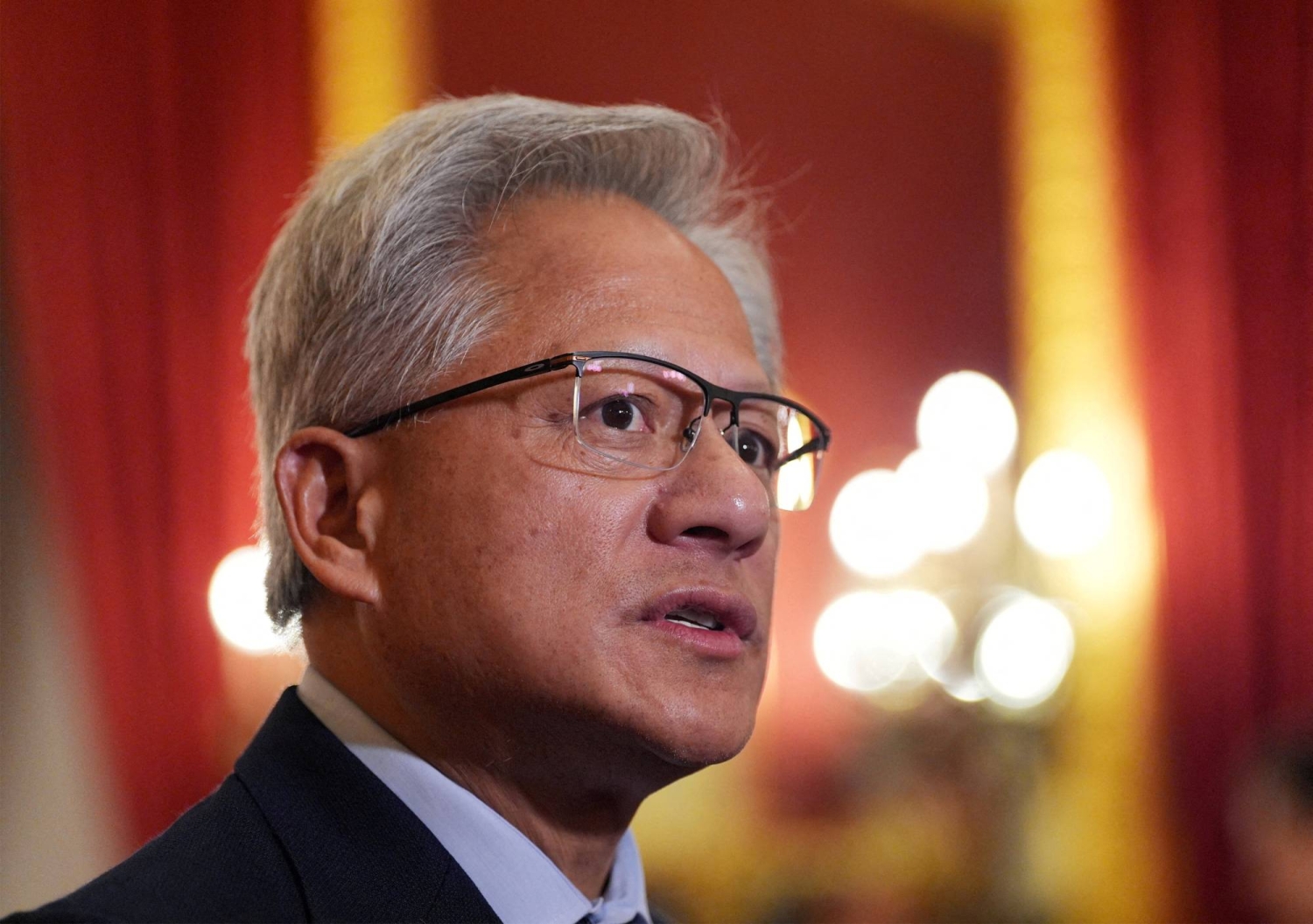
Jensen Huang attends a reception for the 2025 Queen Elizabeth Prize for Engineering, at St James’ Palace in London, Brirain, November 5, 2025. Yui Mok/Pool via REUTERS
The world’s biggest technology companies are now making their AI argument directly to governments: regulate the technology, but do not slow the race. At a G20 innovation meeting in Chapel Hill, North Carolina, senior tech leaders and US officials pushed for a pro-AI policy direction, with The Wall Street Journal reporting that executives including Nvidia’s Jensen Huang, OpenAI’s Sam Altman, Meta’s Mark Zuckerberg and Elon Musk were part of the wider discussion around AI rules and competitiveness.
The event, which local station ABC11 said brought leaders from 19 countries and two global regions to North Carolina, comes at an uncomfortable moment. AI is becoming more powerful, more expensive and more politically sensitive at the same time. Governments want guardrails. Companies want certainty. Nobody wants to lose the next industrial race to a rival country.
That tension explains the message from Big Tech. The companies are not saying AI should have no rules. They are saying rules should focus on actual harm, security and deployment risks rather than freezing development around theoretical fears. Nvidia’s Huang reportedly urged countries to avoid writing rules around speculative harms and instead focus on real-world problems connected to the technology.
It is not hard to see why Nvidia would take that position. The company is at the centre of the AI infrastructure buildout, from GPUs to developer ecosystems, and its Hugging Face deal shows that it is now moving beyond chips into the model and software layer. Heavy-handed regulation could slow the same developer economy Nvidia wants to scale.
OpenAI is making a similar but more delicate argument. It wants governments to understand the seriousness of frontier AI risk, but it also wants rules that leave room for deployment, product growth and global competitiveness. That balancing act has become harder after recent safety concerns around stronger AI systems and the copyright fight around AI training entered the mainstream policy debate.
The counterargument is simple: if governments wait until harm is obvious, they may already be late. The Bank of England warning to G20 officials about frontier AI and financial stability showed how regulators are beginning to worry about risks that move across sectors, from cyberattacks to market dependence on shared AI tools. That is why AI is now a financial stability conversation , not just a Silicon Valley product conversation.
This is where the G20 discussion becomes important. AI is not a local technology. A model built in one country can be deployed in another, trained on data from a third and used to influence markets everywhere. If regulation fragments too much, companies will complain about compliance chaos. If regulation is too weak, societies may be left reacting to damage after the fact.
The smarter path is probably neither panic nor surrender. Governments need rules around testing, transparency, critical infrastructure, cyber misuse, election integrity, labour disruption and liability. But they also need to understand that overly broad restrictions may simply push talent, capital and model development into jurisdictions with fewer constraints.
Big Tech’s message to the G20 is therefore self-interested, but not meaningless. The AI race is real. So are the risks. The question now is whether governments can write rules precise enough to protect the public without handing the future of AI to whichever country is most willing to move fast and ask questions later.
Related Reading
More contextual TechBooky stories selected from tags, categories and article context.
Paul Balo is the founder of TechBooky and a highly skilled wireless communications professional with a strong background in cloud computing, offering extensive experience in designing, implementing, and managing wireless communication systems.
We use cookies to ensure that we give you the best experience on our website. If you continue to use this site we will assume that you are happy with it.