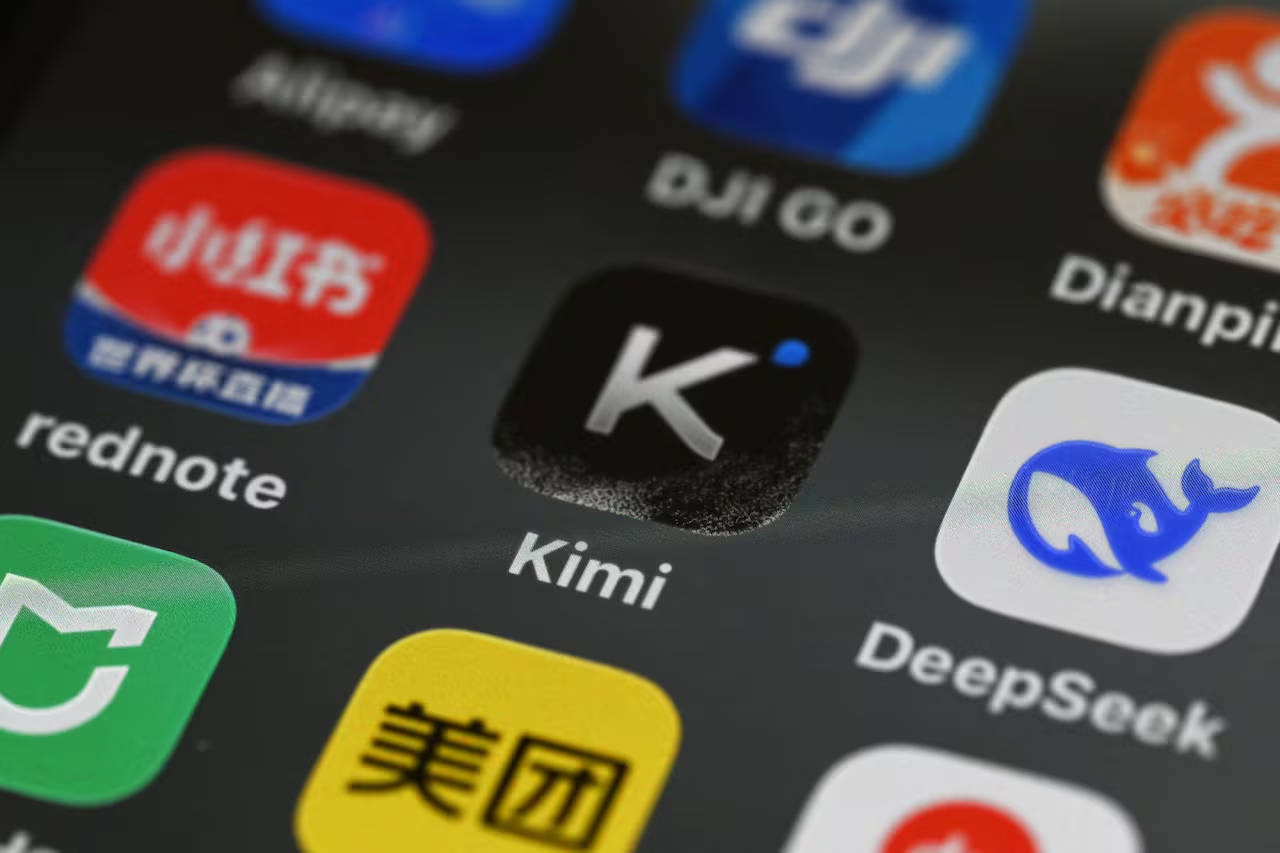
The fight over Moonshot AI’s Kimi K3 has moved from benchmark arguments into Washington’s sanctions vocabulary. U.S. Treasury Secretary Scott Bessent has warned that sanctions remain possible after White House officials accused the Chinese AI company of improperly distilling Anthropic’s Fable model.
TechCrunch reported that Bessent doubled down on the warning after Michael Kratsios, director of the White House Office of Science and Technology Policy, accused Moonshot of using a covert internal platform to distill U.S. models while avoiding detection. Moonshot has become a central name in the latest AI geopolitics debate because Kimi K3 is expected to be released with open weights and has been praised for strong performance.
Distillation itself is not always improper. It is a common technique where a smaller or newer model learns from the output of a more capable system. The issue is whether a company used another firm’s model at scale in ways that violated terms, hid behaviour or copied proprietary capability. That is why the language from Washington has become sharper.
Open Models Are Now A Policy Fight
The debate is bigger than one Chinese lab. U.S. officials are worried that open-weight Chinese models could spread quickly through startups, universities and enterprises before regulators know how to respond. At the same time, many developers argue that low-cost open models help smaller companies compete against the biggest American labs.
That tension is why the Kimi K3 story is getting so much attention. If the U.S. goes too far, it could push developers away from useful open tools. If it does nothing, Washington fears that American frontier models could quietly become training material for foreign competitors.
Business Insider reported that Anthropic supports the White House stance, while other industry voices, including Nvidia CEO Jensen Huang, have warned that banning Chinese open models could harm U.S. innovation. This is quickly becoming one of the most important AI policy debates of the year.
TechBooky recently looked at how U.S. officials were weighing restrictions on Chinese AI models. The latest Treasury comments make the issue more concrete. It is no longer just about whether Kimi K3 is good. It is about who gets to build with it, whether companies must disclose use of Chinese models, and how far the U.S. will go to protect AI intellectual property.
For the AI industry, this is a warning that model openness is no longer a purely technical or philosophical choice. It is now tied to sanctions, export controls, national security and the commercial power of the biggest labs.
Related Reading
More contextual TechBooky stories selected from tags, categories and article context.
Paul Femi Balo is the founder and publisher of TechBooky. He covers artificial intelligence, African technology, digital infrastructure, enterprise technology and the global digital economy.
We use cookies to ensure that we give you the best experience on our website. If you continue to use this site we will assume that you are happy with it.