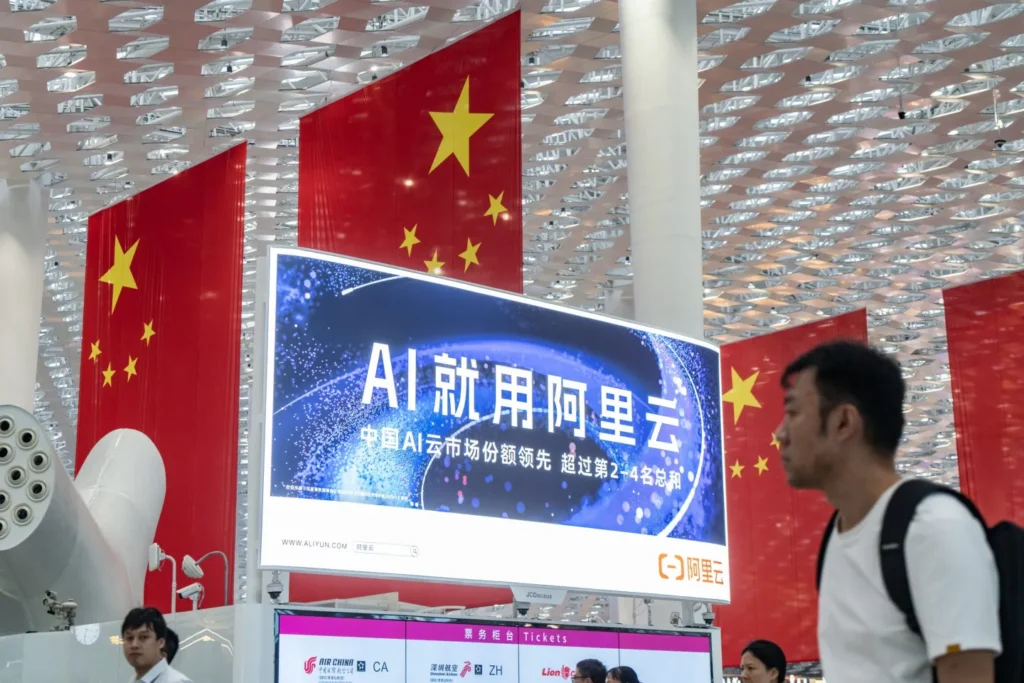
The fight over Chinese AI models has moved from market anxiety into possible sanctions territory. U.S. Treasury Secretary Scott Bessent says the Trump administration is looking into Chinese AI models over claims that they may have benefited from distillation or other forms of intellectual-property theft from American systems.
CNBC reported that Bessent said Washington could sanction Chinese AI companies if evidence supports the claim that U.S. model capabilities were copied or extracted. The timing is important: Chinese open-weight models are becoming more capable, cheaper to use and harder for U.S. frontier labs to dismiss as mere followers.
This follows fresh reporting that Beijing is also considering tighter controls on its own AI models and chip technologies. Reuters reported that Chinese regulators are discussing potential limits on advanced AI and semiconductor exports, including questions around training data leaving China and foreign access to model weights.
For most of the last two years, the U.S. AI strategy toward China focused heavily on chips. Washington restricted high-end Nvidia accelerators and advanced semiconductor tools because it wanted to slow China’s ability to train frontier models. But the newest anxiety is different. It is about model access itself.
Open-weight Chinese models such as Kimi K3 have changed the tone of the debate. They are not only cheaper; they are good enough to make Silicon Valley talk about business-model pressure, national-security risk and whether open models should be treated differently from closed ones.
A recent TechBooky piece on Kimi K3 and the anxiety around Chinese open-weight AI looked at this exact pressure point. Once a model is downloadable, customisable and affordable, restricting chips after the fact does not fully solve the competitive problem.
Distillation is one of those AI terms that has suddenly become geopolitical. In simple terms, a model can be trained to imitate the outputs or reasoning patterns of a stronger model. That can be legitimate when done with permission or through normal research practices, but U.S. officials worry that foreign actors may be systematically extracting value from American models at scale.
The difficult part is proof. If a Chinese model performs similarly to an American model, that does not automatically prove theft. Strong engineering, better data, cheaper infrastructure and different model-design choices can all explain progress. But if investigators find evidence of automated extraction, proxy accounts, jailbreak-heavy harvesting or copied proprietary outputs, sanctions become more plausible.
That is why the language from Washington matters. A sanctions threat changes the debate from technical suspicion to enforcement risk. It also gives American AI companies a political argument against rivals that compete aggressively on price and openness.
The Reuters report on possible Chinese export controls makes the story more complicated. Beijing has spent years presenting open-source and open-weight AI as part of its global technology influence. If China now limits some model exports or training-data movement, it suggests the government also sees frontier AI as strategic technology that should not move freely across borders.
That would create a strange symmetry. The U.S. may try to restrict Chinese models from entering its market, while China may restrict its best models and chip designs from leaving. The open AI era could become more regional, with model access shaped by export controls, sanctions, licensing and national-security reviews.
This is not good news for developers or businesses that hoped AI would become a global commodity layer. It suggests that the AI stack may begin to resemble the semiconductor stack: technically global, politically fragmented and increasingly hard to separate from state power.
Open-weight AI is supposed to broaden access. It lets smaller companies, researchers and countries run powerful models without depending entirely on U.S. cloud platforms. But if governments treat open weights as strategic exports, the openness becomes conditional.
That is the policy trap. Ban or sanction too aggressively and the U.S. may look like it is protecting OpenAI, Anthropic and Google from competition. Do nothing and policymakers fear that U.S. breakthroughs will be copied into cheaper foreign systems. China faces the mirror image; openness helps influence, but unrestricted access may help rivals.
The world is now entering a phase where AI competition is no longer only benchmark scores and product launches. It is sanctions, export controls, data rules and compute diplomacy. The companies building the models may want to move fast, but governments are beginning to decide where those models are allowed to go.
Related Reading
More contextual TechBooky stories selected from tags, categories and article context.
Paul Femi Balo is the founder and publisher of TechBooky. He covers artificial intelligence, African technology, digital infrastructure, enterprise technology and the global digital economy.
We use cookies to ensure that we give you the best experience on our website. If you continue to use this site we will assume that you are happy with it.