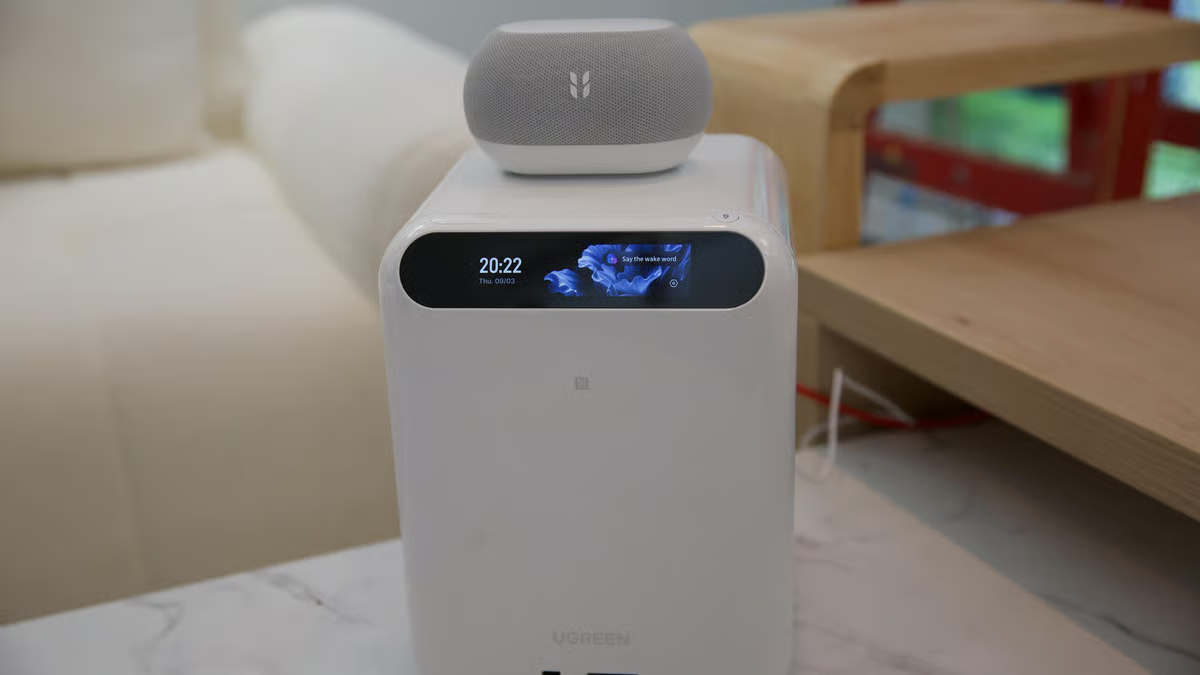
Ugreen is trying to make the smart home less dependent on the cloud. At IFA 2026, the company unveiled HomeAgent, a new platform that combines NAS storage, smart home control, security-camera recording and on-device AI inside one hub. The company is pitching it as a more private alternative to the cloud-heavy smart home model.
The system includes three hub models: HomeAgent HA100, HomeAgent HA100 Pro and MasterAgent MA100. The Verge reports that the top-end model uses Nvidia’s Jetson Thor T5000, while the platform supports smart home standards and connections including Matter, Thread, Zigbee and Wi-Fi. Ugreen is also adding cameras, a smart speaker for its Uliya voice assistant and an E Ink photo frame.
The interesting part is not just the hardware. It is the direction. For years, smart homes have depended heavily on remote servers. Voice commands, security footage, alerts and automations often move through cloud systems controlled by large platforms. Ugreen is betting that some users now want more of that intelligence to happen at home.
That makes HomeAgent part of a wider local-AI trend. Nvidia’s PAIR tries to turn idle home computers into local AI compute, while Ugreen wants the smart home hub itself to become an AI machine. The shared idea is that not every AI task has to travel to a distant data centre.
Privacy is the obvious selling point. If security-camera footage can be stored and analysed locally, users may feel less exposed. If a voice assistant can handle more commands at home, users may worry less about constant cloud processing. That does not remove every privacy risk, but it changes where the sensitive data lives.
There is also a cost argument. Cloud-connected smart home products often come with subscription fees for video storage, alerts or advanced features. A local NAS-style approach may cost more upfront, but it could appeal to users who prefer owning infrastructure instead of renting features forever.
The challenge is that local-first smart homes are harder to sell to ordinary users. They must be easy to set up, reliable, secure and compatible with enough devices. A privacy pitch will not save a product that is confusing or expensive. And with the top model reportedly priced near $9,999, HomeAgent may begin as a product for enthusiasts and businesses before it becomes mainstream.
Still, the timing is right. As AI demand puts more pressure on chips, memory and data centres, including the memory shortage affecting gadgets , companies are starting to rethink where intelligence should run. Ugreen’s HomeAgent is another sign that local AI is moving from developer workstations into ordinary household technology.
Related Reading
More contextual TechBooky stories selected from tags, categories and article context.
Paul Femi Balo is the founder and publisher of TechBooky. He covers artificial intelligence, African technology, digital infrastructure, enterprise technology and the global digital economy.
We use cookies to ensure that we give you the best experience on our website. If you continue to use this site we will assume that you are happy with it.