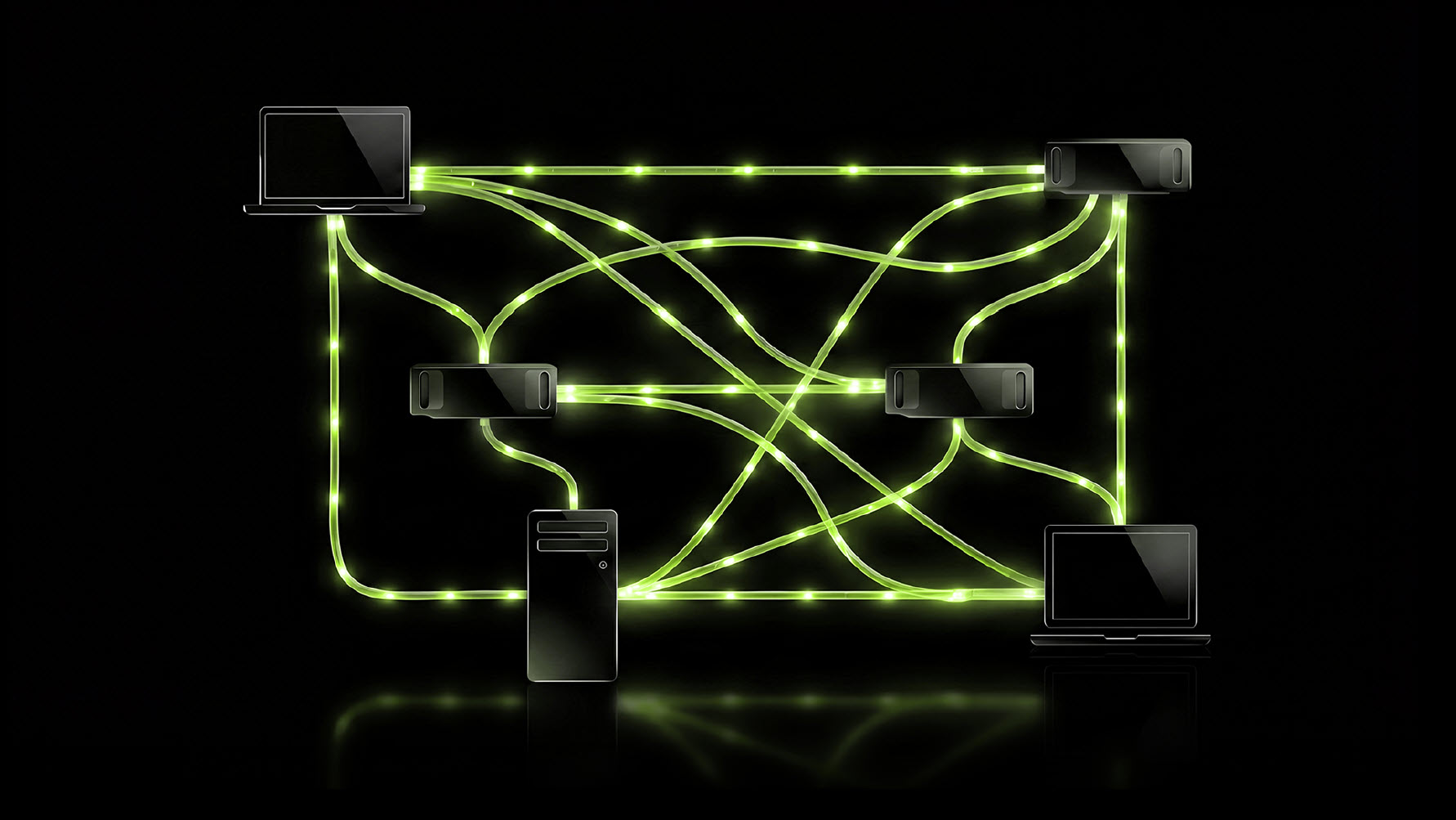
Nvidia has introduced PAIR, a free open-source tool that can link idle computers on a home or local network into what is essentially a personal AI data centre. The company describes PAIR as a Personal AI Router that sends local AI inference requests across compatible devices instead of pushing every task into the cloud.
The tool supports systems with Nvidia RTX GPUs and Apple M4 chips or later, and Nvidia says it can dynamically route workloads as devices join or leave the network. The company’s developer documentation frames PAIR as a virtual inference router for local AI workflows, especially multi-agent tasks that can be split across several machines.
That sounds technical, but the idea is easy to understand. Many households and small offices already have unused compute sitting inside gaming PCs, workstations, laptops and compact AI machines. PAIR tries to pool that power so local AI agents can run faster without depending entirely on a remote data centre.
The Verge reported that PAIR uses a six-digit pairing code and mutual TLS encryption, with support across Windows, Linux and macOS. The tool is still in beta, but the direction is interesting because it gives Nvidia a consumer-friendly answer to a question usually asked at data-centre scale: where will all this AI compute come from?
That question has been everywhere lately. Nvidia’s data-centre boom, Broadcom’s custom AI chip surge and the huge demand for AI servers show how much of the AI economy is being built around centralised infrastructure. PAIR points in another direction: smaller, local, private compute for users who already own powerful hardware.
The privacy angle may become just as important as performance. If sensitive files, personal documents or local agents can run on devices nearby, users may feel more comfortable experimenting with AI. The cloud will still be necessary for many advanced tasks, but local inference gives people and companies another option.
This also strengthens Nvidia’s broader ecosystem strategy. The company is not just selling chips. It is trying to make sure AI work, whether in data centres or on personal machines, runs naturally through Nvidia tools. That is why its Hugging Face deal and PAIR launch should be read together. Nvidia wants to sit under the AI developer economy wherever that work happens.
The limitation is obvious. PAIR will matter most to people who already own capable devices. It will not magically democratise AI for users with old laptops or weak connectivity. But it does show a more flexible future, where AI compute is not only something rented from a giant cloud provider. Some of it may already be sitting quietly under the desk.
Related Reading
More contextual TechBooky stories selected from tags, categories and article context.
Paul Femi Balo is the founder and publisher of TechBooky. He covers artificial intelligence, African technology, digital infrastructure, enterprise technology and the global digital economy.
We use cookies to ensure that we give you the best experience on our website. If you continue to use this site we will assume that you are happy with it.