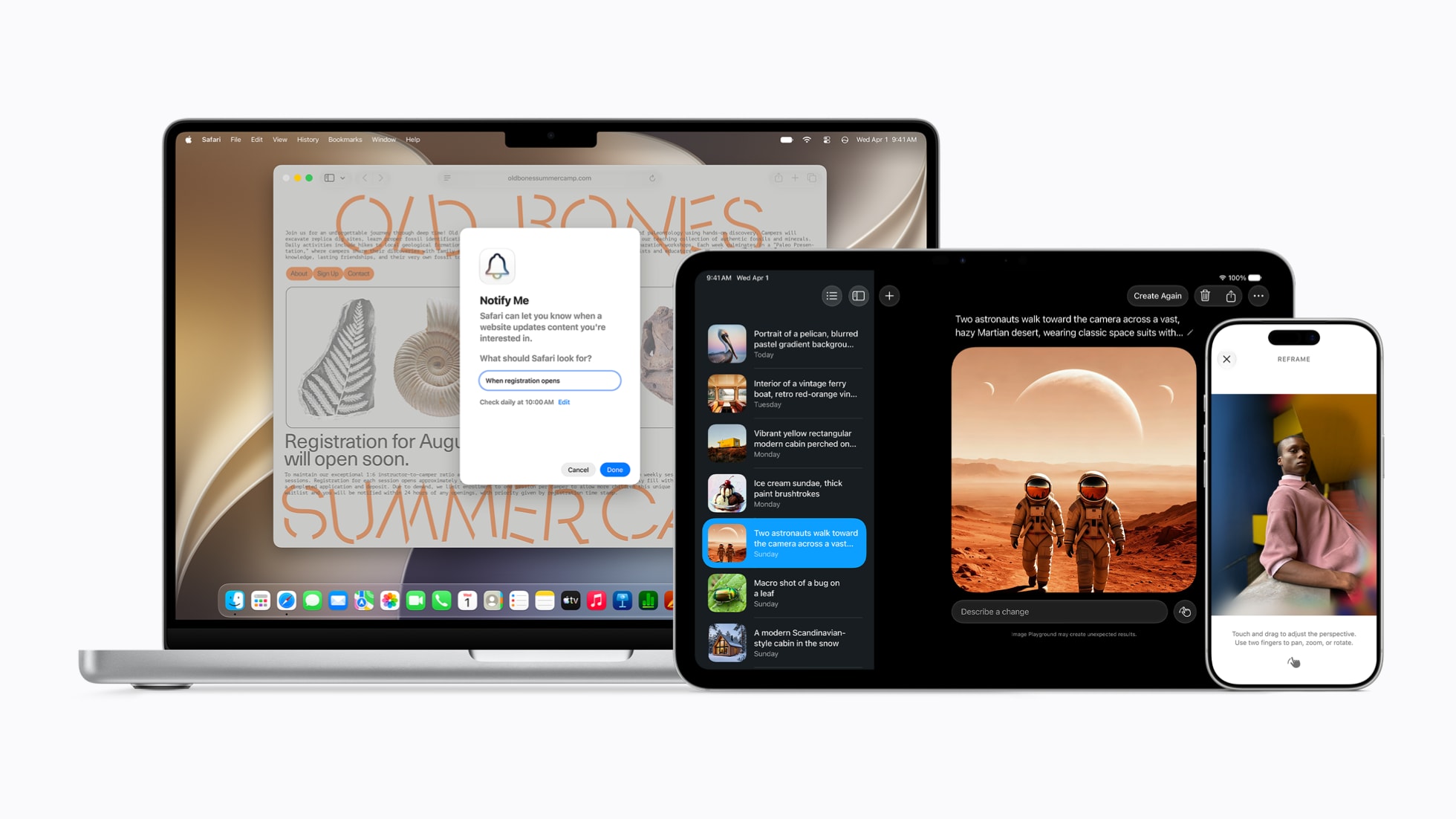
Apple has unveiled the next generation of Apple Intelligence, and the message is clear: the company no longer wants AI to feel like a separate chatbot sitting beside its products. It wants AI to disappear into the everyday experience of using an iPhone, iPad, Mac, Apple Watch, AirPods or Vision Pro.
Announced on June 8, the new Apple Intelligence architecture brings deeper AI capabilities across Apple’s platforms, including a more capable Siri, smarter photo editing, AI-powered Safari tools, automated password upgrades, improved Messages and Mail suggestions, more powerful Shortcuts, Home camera intelligence and a redesigned Image Playground capable of photorealistic generation. Apple says developer testing begins immediately, with the features rolling out to users this fall.
That approach is very Apple.
While rivals like OpenAI, Google and Anthropic have pushed AI forward through standalone assistants and powerful cloud models, Apple is taking a more integrated path. Instead of asking users to visit a chatbot, copy content or learn new workflows, the company is embedding intelligence directly into the apps people already use every day.
The most important part of the announcement may be Siri. Apple says the next generation of Apple Intelligence helps power Siri AI, a new version of its voice assistant that is more personal, conversational and capable. The upgraded Siri will be able to search across messages, emails, photos and other personal information, answer broader questions and take actions inside apps. It will also have a dedicated app and integrated writing and Visual Intelligence tools, with developer testing starting now and a user beta expected later this year.
That is a major reset for one of Apple’s most criticized products.
Siri helped define the voice assistant category when it launched, but it has fallen behind newer generative AI assistants in reasoning, context and usefulness. Apple’s challenge has always been different from OpenAI’s or Google’s: it does not just need Siri to answer questions; it needs Siri to operate safely across a user’s personal device, messages, calendar, apps, files and photos. That requires a different kind of AI one that is deeply contextual but also tightly controlled.
Apple is leaning heavily on privacy to make that case.
The company says the new Apple Intelligence architecture uses next-generation Apple Foundation Models that run both on-device and through Private Cloud Compute, its privacy-focused server system. Apple says when Private Cloud Compute handles requests, users’ personal data is not stored or made accessible to Apple or anyone else, and outside experts can continue verifying those privacy claims.
There is also a striking detail in the announcement: Apple says its latest Foundation Models were built in collaboration with Google and its Gemini models. That matters because it shows Apple is still willing to rely on outside AI expertise where necessary, even while presenting Apple Intelligence as a deeply Apple-controlled experience.
In Photos, Apple Intelligence is becoming more visually ambitious. A new feature called Spatial Reframing lets users adjust the composition of an image after it has been taken, using Apple’s spatial models to shift perspective as if the camera had been repositioned. Another tool, Extend, can expand the edges of an image to straighten horizons, adjust aspect ratios or create more space around a subject, while Clean Up gets stronger object-removal and infill capabilities. Apple says AI-adjusted Photos will include a hidden SynthID watermark to identify images edited with AI.
That watermarking detail is important. Apple is pushing more powerful generative image tools while trying to avoid the trust problems already facing AI-generated media. By embedding SynthID into edited or generated content, Apple is signaling that AI creativity must come with traceability.
Safari is also becoming more agentic. Apple says Safari can now organize tabs automatically into relevant topics, helping users manage messy browsing sessions. A new Notify Me feature lets users ask Safari to monitor a webpage for changes such as product restocks or price drops, then alert them when the change happens. Another feature, Describe an Extension, allows users to create custom Safari extensions simply by describing what they want, such as a toolbar button to save and rate recipes.
That is a subtle but important move.
Browsers are becoming one of the next major AI battlegrounds. Google is adding AI into Search and Chrome. Microsoft is building Copilot into Edge. Opera is integrating external assistants like ChatGPT and Claude. Apple’s answer is not to turn Safari into a chatbot, but to make it quietly perform tasks in the background organizing, watching, summarizing and creating tools on demand.
Passwords is getting one of the more practical upgrades. Apple says the Passwords app can now automatically fix eligible weak or compromised passwords with one tap, using Apple Intelligence and Safari to navigate websites, sign in and upgrade accounts to strong passwords on the user’s behalf.
That may be one of the clearest examples of where Apple’s AI strategy is going. The company is not just adding intelligence for novelty; it is trying to remove friction from tasks that users know they should do but often avoid. If Apple can make security actions automatic, it could improve real-world safety more effectively than simply warning users about compromised passwords.
Image Playground is also getting a major expansion. Apple says the app can now create photorealistic imagery using a new generative model that runs on Private Cloud Compute. Users can modify images by describing changes, tapping, circling or brushing over objects, and use generated images for Messages, Lock Screen wallpapers, Contact Posters and other formats. Generated images will also include hidden SynthID watermarking.
Across Mail and Messages, Apple Intelligence is becoming more proactive. Messages can now suggest actions based on conversation context, such as creating a reminder or note, or finding the right photos when someone asks for them. Smart Reply can draw on a user’s personalized writing style, while Mail suggestions can take action with third-party apps.
The Phone and Calendar apps are getting similar contextual intelligence. A new Call Context feature can surface useful information such as a reservation number or flight confirmation code when a user calls a business. Apple says this runs entirely on-device and looks at who the user is calling, not what they are saying. Calendar can also create or modify events when users describe them in natural language.
Shortcuts may become dramatically easier to use. With Describe a Shortcut, users can simply explain what automation they want, and the Shortcuts app will assemble the steps for them. If they want changes, they can describe those too. That could open Apple’s automation system to far more people, especially users who never learned how to manually build complex shortcuts.
The Home app is another major beneficiary. Apple Intelligence can now group related accessory notifications into a single ongoing activity, generate descriptions of HomeKit Secure Video clips, let users search through camera footage, and surface noteworthy clips at the top of search. For smart home users, that means Apple is trying to turn security camera footage from a passive archive into searchable, summarized context.
Accessibility is also getting a major AI boost. Apple says VoiceOver will provide richer image descriptions, Live Recognition will let users ask questions about their surroundings, Voice Control will become more intuitive, and Accessibility Reader will support more complex source material with on-demand summaries and translation.
Taken together, this is Apple’s clearest answer yet to the criticism that it has been slow in AI.
The company is not trying to win the AI race by building the loudest chatbot. It is trying to win by making AI feel native, private and useful across the operating system. That strategy may not generate the same spectacle as OpenAI’s latest model or Google’s multimodal demos, but it could prove powerful because Apple controls the device, the apps, the chips, the operating system and the user experience.
The rollout will begin with iOS 27, iPadOS 27, macOS 27, watchOS 27 and visionOS 27 this fall. Apple says the new features will be available on supported devices and languages, including iPhone 16 models or later, iPhone 15 Pro models, iPads and Macs with M1 or later, Apple Vision Pro, supported Apple Watch models and other compatible hardware. Some server-based features, including image generation, will have daily usage limits, with increased access available through most iCloud+ subscription plans.
That last point is worth watching.
Apple Intelligence may begin as a platform feature, but it is also becoming part of Apple’s services strategy. If higher AI usage becomes tied to iCloud+ plans, Apple could gradually turn AI into another reason users pay monthly to stay inside its ecosystem.
And that may be the real business story.
Apple does not need Apple Intelligence to become a standalone product. It needs it to make the iPhone, Mac, iPad, Watch, Vision Pro, Safari, Photos, Messages, Mail, Home and iCloud more valuable together.
That is how Apple has always won.
Not by being first to every trend, but by absorbing the trend into its ecosystem so thoroughly that users stop thinking about the technology and just experience the convenience.
With this Apple Intelligence update, the company is making its biggest AI bet yet. And this time, it is not asking users to go looking for AI. It is putting AI everywhere they already are.
Related Reading
More contextual TechBooky stories selected from tags, categories and article context.
Paul Balo is the founder of TechBooky and a highly skilled wireless communications professional with a strong background in cloud computing, offering extensive experience in designing, implementing, and managing wireless communication systems.
We use cookies to ensure that we give you the best experience on our website. If you continue to use this site we will assume that you are happy with it.