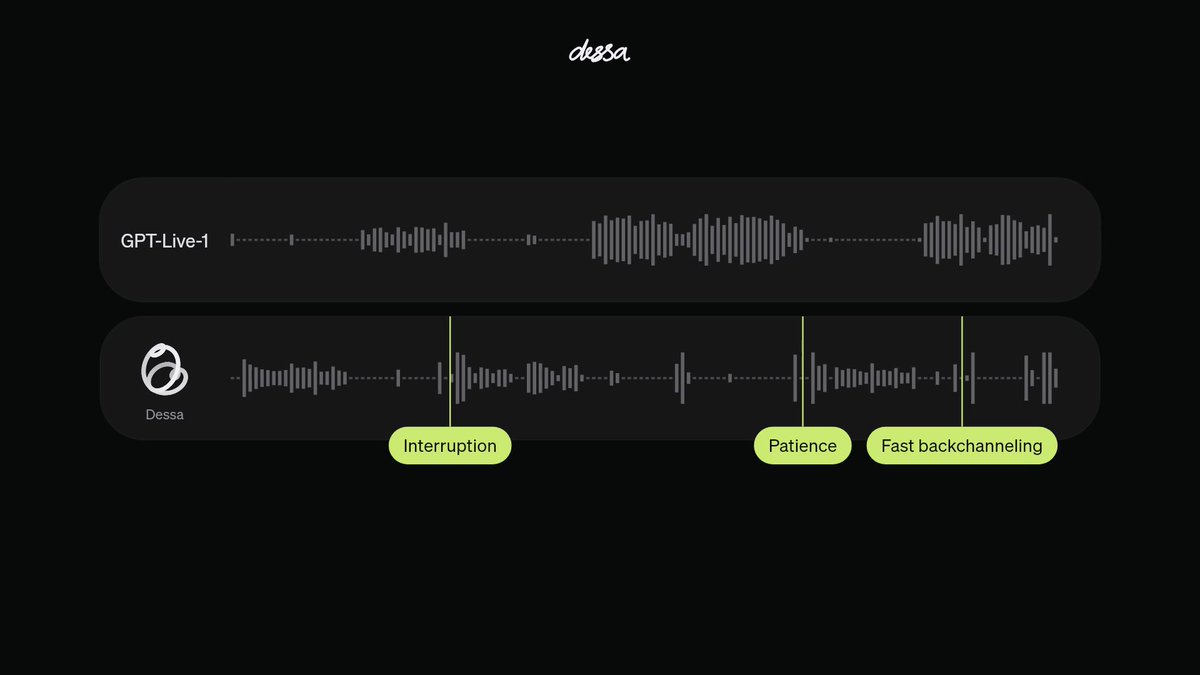
Block, the company behind Square and Cash App, has unveiled Dessa, a voice AI model designed to listen and speak at the same time. The research preview, introduced on 23 October, is striking for a simple reason. Instead of treating a conversation as a series of voice notes, Block says it can handle interruptions, pauses and brief acknowledgements while another person is still talking.
There is an important qualification. Dessa is not a public app or a new feature in Cash App. Block has shared recordings and is offering limited early access to AI safety researchers, but it has not announced a general release date, public API or download. What is available now is a demonstration of where conversational AI may be heading, not a tool readers can install today.
According to Block’s Dessa announcement, the model was trained from scratch on recordings of human conversation, without text data or a pretrained model. Its input and output are speech. That differs from the familiar chain in which an assistant transcribes a person’s words, processes text and then synthesises a reply. The text route can work well, but it risks losing the timing and vocal cues that make a conversation feel natural.
Block calls Dessa full-duplex, meaning it can listen while it speaks. In the recordings the company has released, the model makes the small responses that people use to show they are following along and can change course when interrupted. Those are not merely cosmetic flourishes. A useful voice assistant needs to know when to wait, when to respond and when a speaker has not finished a thought. TechBooky has covered Microsoft’s recent push into real-time voice models, another sign that speed and conversational flow are becoming competitive features.
Block says Dessa was trained using a single Nvidia GB200 NVL72 system and can run faster than real time on a MacBook Pro with an M4 Max chip or better. These are company claims, not independently verified performance figures. They are nonetheless significant to the pitch. If a capable voice model can run locally, future developers may have options that do not send every spoken exchange to a remote server. That could improve responsiveness and give users more control over sensitive conversations, depending on how an eventual product is built.
The public evidence remains limited. Block selected the conversations it published, and independent researchers have not yet had broad access to evaluate how Dessa performs across accents, noisy environments, difficult questions and long exchanges. The company has not disclosed pricing, a public release timetable or a standard benchmark comparison. It would be premature to declare it better than established voice assistants on the strength of launch clips alone.
There is also a safety question alongside the obvious appeal. A voice system that sounds more lifelike may make support services and accessibility tools easier to use, but convincing synthetic speech can also complicate identity checks and trust. As TechBooky noted in its report on proof-of-human checks in banking, a familiar voice by itself is no longer reliable evidence of who is speaking. That does not mean Dessa has been used for fraud. It means the risk deserves attention before models of this kind become widely available.
Block’s decision to invite a small group of AI safety researchers to examine Dessa first is therefore material, not a footnote. Their findings, and any technical details the company releases, will matter more than the most polished demonstration. For now, Dessa is a promising research preview that asks a serious question of the voice AI industry. How much more natural can an assistant become without making it harder for people to know when they are speaking to a machine?
Related Reading
More contextual TechBooky stories selected from tags, categories and article context.
Paul Femi Balo is the founder and publisher of TechBooky. He covers artificial intelligence, African technology, digital infrastructure, enterprise technology and the global digital economy.
We use cookies to ensure that we give you the best experience on our website. If you continue to use this site we will assume that you are happy with it.