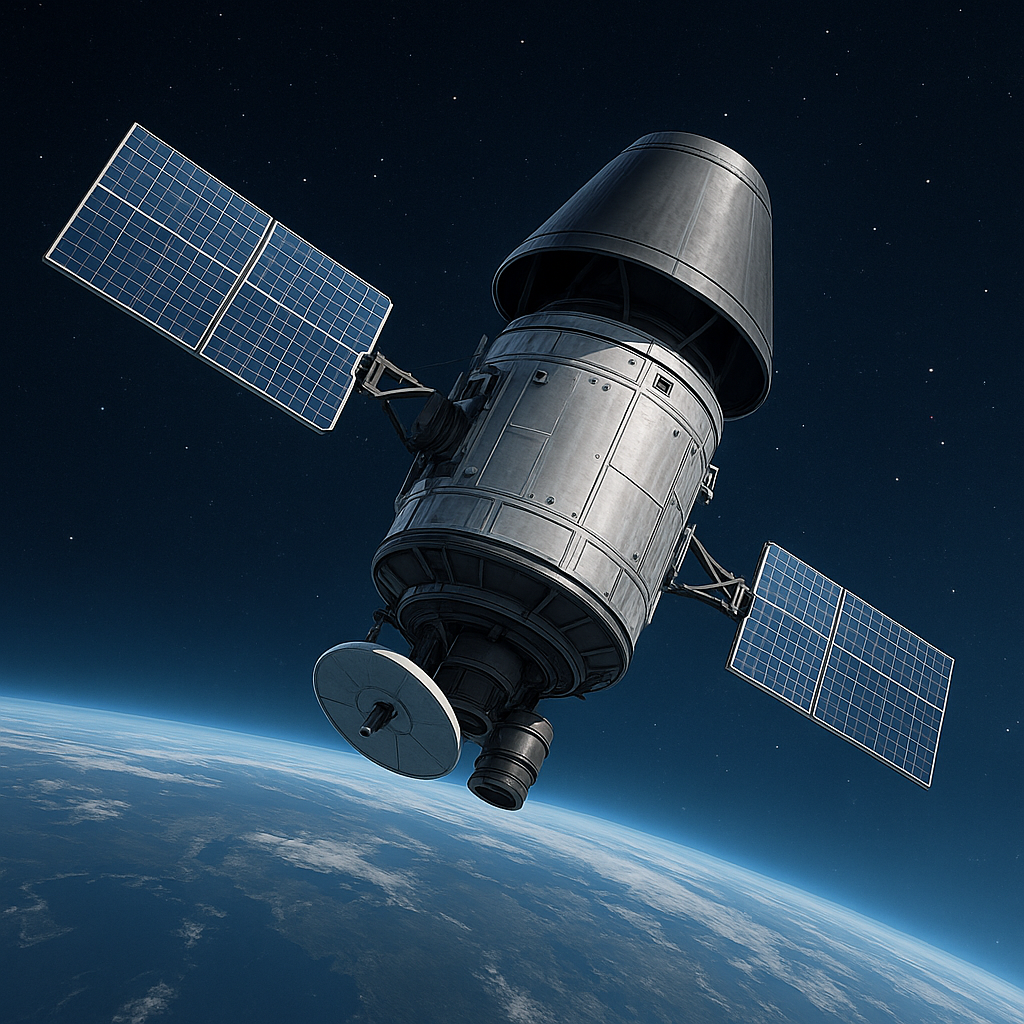
If reusable rockets turned the space-launch business on its head, Denver-based startup Lux Aeterna is betting that reusable satellites will do the same for everything that happens after a payload reaches orbit. Fresh out of stealth and backed by a ** $4 million pre-seed round led by Space Capital**, the company pulled the wraps off Delphi, a 200-kilogram demonstration craft designed to circle Earth, survive re-entry behind its own heat-shield, splash down (or touch down), get refitted with a new payload, and launch again in a matter of weeks.
Founder and CEO Brian Taylor knows the pain points first-hand: he spent years building Starlink buses at SpaceX and later worked on Amazon’s Kuiper constellation. In every case the economics were clear—the rocket came back, the satellite didn’t. Even small Earth-observation birds cost $500,000 to several million dollars each and become space junk or fiery debris after a single tour of duty. Lux Aeterna’s plan is to “close the loop,” refurbishing the bus much the way airlines overhaul jetliners between flights.
Engineers are cagey about exact hardware—patent filings are still in motion—but early diagrams show a folding bus tucked behind a ceramic-matrix heat shield, with steerable flaps for aerodynamic braking and a steer-to-land parachute for pinpoint recovery. The first flight is booked on a SpaceX Falcon 9 rideshare in 2027; a second, identical sortie will follow to prove that the same vehicle can repeat the feat.
Why Reusability Matters Beyond Cool Factor
Cost Compression – Launch may be cheaper thanks to Falcon 9, but satellite hardware still accounts for 60-plus percent of a mission’s bill. Turning that cap-ex into reusable “orbital hardware” could slash total cost per mission by a factor of five, according to Lux Aeterna’s investor deck.
Rapid Tech Upgrades – Today’s comm-sat modems and sensors freeze in time the moment a spacecraft leaves the pad. A fly-land-fly cycle means hardware can be swapped like server blades—critical for evolving 5G NTN payloads or tactical ISR sensors the Pentagon already says it wants.
Debris & Sustainability – Every Delphi that comes home is one less dead satellite in the ever-crowding LEO shell, a selling point as regulators tighten space-junk rules.
Flexible Business Models – Think “satellite leasing.” A weather-data startup could rent Delphi for a six-month climate campaign and return it, followed by a hyperspectral-imaging client that needs only three months on-orbit—a timeshare in space.
SpaceX proved reuse at the booster level, Rocket Lab is testing reusable second stages, and companies like Sierra Space plan shuttle-like cargo vehicles for orbital stations. Lux Aeterna slides neatly into that trend, offering a payload-level analog that could plug straight into the same launch cadence. The U.S. Department of Defense, already scouting rapid-revisit assets for LEO, has signalled early interest, and venture backers see a future where reusable satellites become the “white-label trucks” of a space-based supply chain.
None of this is trivial. Surviving orbital re-entry with sensitive electronics intact remains an unproven art; NASA’s small-sat re-entry demonstrators have only partly closed that gap, and Delphi must do it routinely. Insurance markets will demand actuarial data that simply doesn’t exist yet. Then there’s turnaround time: refurbishing a scorched interior in weeks, not months, is the difference between an airline and a museum piece.
Reusable satellites could push the price of space-borne broadband, Earth-observation imagery, even off-planet manufacturing down to a level where start-ups—and eventually consumers—see tangible benefits. Cheaper, faster-upgrade constellations mean denser rural coverage, higher-resolution climate data for disaster planning, and experiment-grade labs that ride to orbit for a season, come home for tweaks, and head back up. In other words, the next leap in “new space” economics doesn’t have to come from bigger rockets; it might come from spacecraft brave enough to boomerang back to Earth and do it all over again.
Lux Aeterna still has to prove Delphi can survive one flight, let alone become the Cessna 172 of orbit. But if it does, the phrase “single-use satellite” could soon sound as antiquated as “disposable airplane.”
Related Reading
More contextual TechBooky stories selected from tags, categories and article context.
Paul Balo is the founder of TechBooky and a highly skilled wireless communications professional with a strong background in cloud computing, offering extensive experience in designing, implementing, and managing wireless communication systems.
We use cookies to ensure that we give you the best experience on our website. If you continue to use this site we will assume that you are happy with it.