Nvidia is making one of its boldest moves yet beyond graphics cards and data centres, it is coming directly for the Windows PC.
Microsoft and Nvidia are debuting the first Windows PCs powered by Nvidia chips as the main processor, marking a major shift in the personal computer market and a direct challenge to Intel, AMD and Qualcomm. The first systems are expected from Microsoft’s Surface line as well as PC makers including Dell, according to earlier reports from Axios cited by Moneycontrol and Reuters-linked outlets.
That alone is historic.
For decades, Windows PCs have been dominated by x86 processors from Intel and AMD. Qualcomm has tried to disrupt that structure with Arm-based Snapdragon chips, especially through Microsoft’s Copilot+ PC push. But Nvidia entering the market with a full Windows PC chip changes the competitive landscape entirely because Nvidia is not just another processor company. It is the company currently defining the AI hardware era.
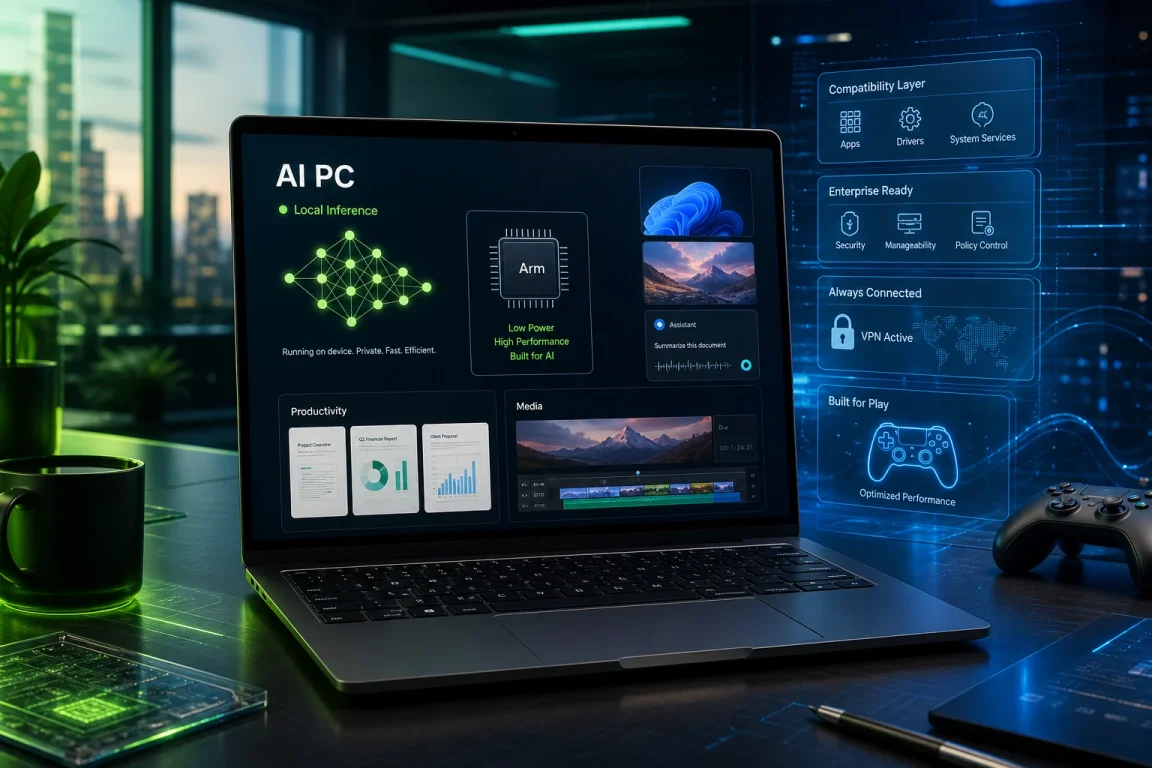
Nvidia’s new PC push is built around RTX Spark, a chip the company describes as a 1-petaflop “superchip” for personal AI computing. According to Nvidia’s announcement, RTX Spark brings together a powerful processor, RTX graphics, the CUDA ecosystem and Windows-native AI agents in one platform designed to make PCs capable of running serious AI workloads locally.
That is the real story here.
The PC industry is no longer just trying to sell thinner laptops, better battery life or sharper screens. It is trying to redefine the computer as a local AI machine, one that can run agents, coding assistants, creative tools, personal models and enterprise workflows directly on the device instead of sending everything to the cloud.
Nvidia CEO Jensen Huang framed the launch as a reinvention of the PC for the first time in decades, saying the new generation of machines will allow users to interact with computers in more natural, AI-driven ways. The Guardian reports that RTX Spark was developed in collaboration with MediaTek and combines a microprocessor and graphics chip to power AI agents locally, reducing reliance on cloud computing.
That matters because cloud AI is powerful but expensive. Every query sent to a large model consumes data centre compute, bandwidth and energy. As AI becomes part of everyday work summarising documents, writing code, editing media, managing files, searching local data and automating tasks — running more of that workload on-device becomes attractive for cost, speed and privacy.
Microsoft clearly sees the same future.
The companies are also expected to pair the Nvidia-powered hardware with new Windows software that enables AI agents to perform tasks locally on PCs, according to the Axios report cited by Reuters and Investing.com.
That points to a deeper Microsoft strategy. Windows is no longer just an operating system for apps. It is becoming a platform for AI agents that can interact with files, applications, calendars, browsers and enterprise tools. For that to work well, Microsoft needs hardware that can run advanced AI workloads without always depending on Azure.
Nvidia gives Microsoft a serious weapon in that fight.
The company’s advantage is not only silicon performance. It is the ecosystem. CUDA remains one of Nvidia’s strongest moats in AI, and bringing CUDA-class capabilities into Windows PCs could make these machines attractive to developers, creators, researchers and companies building local AI applications. Nvidia’s announcement explicitly highlights the full CUDA and RTX ecosystem as part of the Windows PC reinvention.
That could put pressure on Qualcomm in particular.
Qualcomm has spent the past two years pushing Snapdragon X chips as the centre of Microsoft’s Arm-based AI PC strategy, promising better efficiency and battery life for Windows laptops. But Nvidia’s entry creates a new kind of competition: Arm-based Windows PCs with far stronger graphics, AI acceleration and developer appeal.
It also complicates Intel and AMD’s position.
Both companies have been racing to add neural processing units and AI capabilities to PC chips, but Nvidia’s brand is now almost synonymous with AI performance. If consumers and enterprise buyers begin associating “AI PC” with Nvidia rather than Intel Inside, that could reshape decades of PC marketing.
The hardware specifications being reported are aggressive. Times of India, summarising the launch, says RTX Spark integrates a 20-core Arm CPU, a Blackwell GPU with 6,144 CUDA cores, up to 128GB of unified memory, RTX 5070-tier graphics and 1 petaflop of AI compute, with support for ultra-thin Windows laptops and mini PCs.
If those systems perform well in real-world use, they could blur the line between laptops, workstations and local AI servers.
That is important because the next wave of AI applications may not be simple chatbots. They may involve personal agents running in the background, local code execution, private document analysis, video editing, 3D creation, robotics simulation and small-model training. These are workloads that benefit from serious local compute.
The first Nvidia-powered Windows PCs are therefore not just another product launch.
They are a signal that the AI race is moving from data centres into personal devices.
For Nvidia, the timing is perfect. The company already dominates the AI data centre market through its GPUs. Moving into PCs allows it to extend that dominance closer to the user, turning laptops and desktops into another layer of the AI stack.
For Microsoft, it is a chance to make Windows feel relevant again in a world increasingly shaped by AI-native experiences. Apple has its own chips and ecosystem. Google is pushing Gemini through Android, Chrome and cloud services. Microsoft needs Windows to become the place where AI agents actually get work done.
For PC makers, it opens a premium category at a time when the traditional laptop market has been mature for years. A truly capable AI PC gives manufacturers a new reason to convince users and enterprises to upgrade.
But there are still questions.
Price, battery life, software compatibility, thermals and real-world AI performance will determine whether these machines become mainstream or remain expensive showcase devices. Windows on Arm has also had a mixed history, and while compatibility has improved, users will still expect these systems to run legacy Windows software without friction.
There is also the question of whether local AI will matter enough to ordinary users.
Most people do not buy laptops because of TOPS, petaflops or model inference benchmarks. They buy them because they are fast, reliable, affordable and useful. Nvidia and Microsoft will need to prove that on-device AI agents are not just impressive demos, but genuinely better ways to use a computer.
Still, the direction is clear.
The PC is being redesigned around AI, and Nvidia wants to be at the centre of that redesign.
For nearly 40 years, the Windows PC was defined by the CPU. Then gaming and creative work made the GPU more important. Now AI may collapse those worlds into one integrated computing platform and Nvidia is moving aggressively before anyone else can define it.
If the bet works, this could be the beginning of a new PC era. Not the personal computer as a machine you operate. But the personal computer as an AI system that works with you.
Related Reading
More contextual TechBooky stories selected from tags, categories and article context.
Paul Femi Balo is the founder and publisher of TechBooky. He covers artificial intelligence, African technology, digital infrastructure, enterprise technology and the global digital economy.
We use cookies to ensure that we give you the best experience on our website. If you continue to use this site we will assume that you are happy with it.