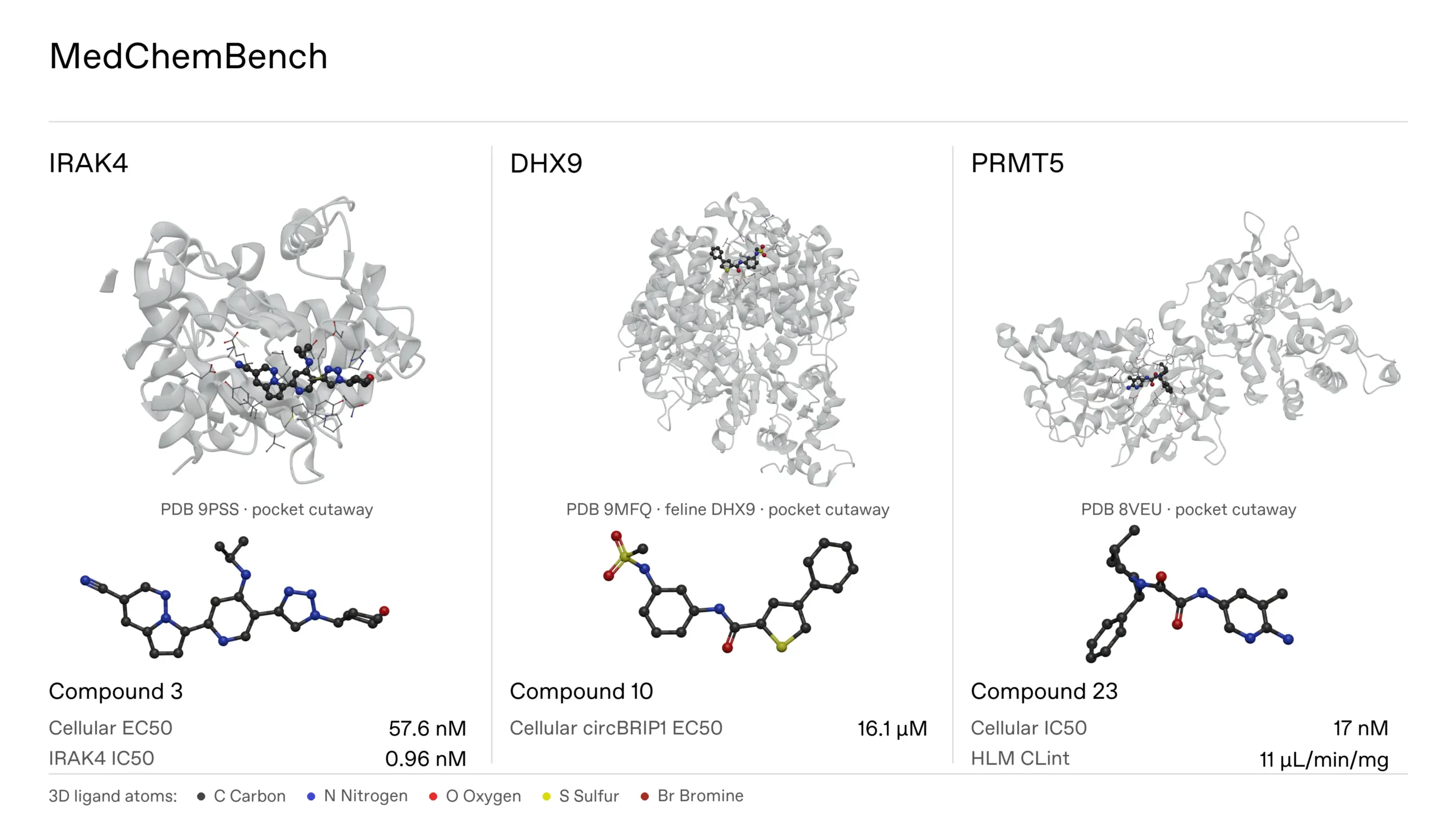
OpenAI has introduced MedChemBench, a new test of whether AI models can reason through the choices medicinal chemists make when looking for promising drug candidates. Its results show substantial progress on reading molecular structures and explaining research evidence, but they do not demonstrate that an AI system has discovered a new medicine.
The benchmark announced on 20 November consists of 99 problems drawn from 117 published papers and patents. It includes 761 distinct molecular structures. Rather than simply asking a model to name a compound, the test gives it information available at a particular stage of a research programme and asks it to interpret findings, compare candidates and predict properties.
OpenAI says GPT-6.2 Astra earned 84.5% of the available credit at its xhigh reasoning setting. GPT-6 Astra scored 83.3%, GPT-6.1 Sol 82.0% and GPT-5.6 Sol 58.2%. These are scores under OpenAI’s own benchmark conditions, not independent measurements of success in laboratories or clinical development. The differences should be read alongside the test’s methods and limitations.
The model’s performance was uneven. OpenAI says Astra earned 95.4% of available credit for reconstructing molecular structures at xhigh, yet only about half the credit for choosing compounds and predicting numerical properties. Those latter tasks are crucial because researchers have to balance competing goals. A molecule may act strongly against a biological target but be poorly absorbed or break down too quickly to become useful.
A retrospective benchmark can show whether a model makes sense of historical evidence. It cannot establish that the model can choose the right experiment in an unfamiliar live project. OpenAI explicitly says its findings do not establish that the models can discover new drugs or improve laboratory decisions. Because the source papers were published, the company also cannot rule out prior exposure to some of the material during training.
The work fits into a wider push to bring AI into life sciences. TechBooky has covered OpenAI’s GPT-Rosalind research ambitions and its acquisition of Orchestra Bio, which focuses on the workflow around drug development. MedChemBench adds a more specific way to measure the reasoning a research assistant would need. It is not a substitute for experiments, safety studies or regulatory review.
The useful question is whether models can make reliable predictions on genuinely new compounds and improve decisions when chemists test them in the laboratory. Independent evaluation, transparent comparisons and results from prospective research programmes would provide stronger evidence than a score on published cases. For now, MedChemBench is a test of scientific reasoning, with the most consequential parts of candidate selection still proving difficult.
Related Reading
More contextual TechBooky stories selected from tags, categories and article context.
We use cookies to ensure that we give you the best experience on our website. If you continue to use this site we will assume that you are happy with it.