Artificial intelligence can help scientists design new medicines, but someone still has to manufacture them safely and consistently. Multiply Labs has raised $75 million to tackle that less glamorous part of the chain, building robotic systems for complex biological therapies. The funding suggests investors see a bottleneck between promising discoveries and treatments that can reach patients at scale.
The San Francisco company announced its Series B on October 6, bringing its total funding to more than $100 million since it was founded in 2016. Patrick Soon-Shiong’s NantWorks led the round. New investors include AstraZeneca, Lingotto, Teradyne and Strange Ventures, alongside returning backers such as Lux Capital and Founders Fund. The mix is telling: the company is pitching not just an AI application, but equipment and production capability for drugmakers.
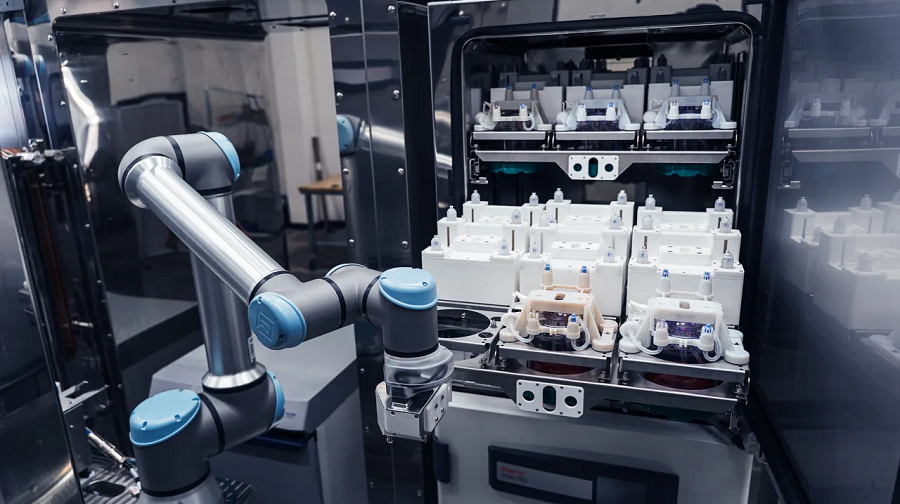
Multiply Labs builds enclosed robotic clusters designed to automate repetitive stages in making biologic medicines. It says manufacturers can install the system alongside existing instruments and validated processes rather than construct a new facility. Its initial focus on cell and gene therapies has expanded toward antibodies, viral vectors and mRNA. Those are areas where small errors, contamination or inconsistent handling can make a batch unusable and delay treatment.
The company claims its system can reduce cost per dose by 74 percent and deliver up to 100 times the throughput of manual manufacturing. Those are company figures, not an independent guarantee for every drug or factory. Actual savings depend on the therapy, the production line, regulatory requirements and whether the equipment performs reliably over time. Patients also would not automatically see a price cut simply because one manufacturing step becomes more efficient.
The company says pharmaceutical manufacturers own and operate the clusters themselves, keeping production and data in-house. That model could appeal to drugmakers reluctant to outsource sensitive processes, but it places a high bar on installation, training and support. Multiply Labs says it will use the new funding to grow manufacturing capacity, accelerate product development and expand engineering, regulatory and commercial teams as it moves toward larger-scale deployments.
Much of the conversation about AI in healthcare has centred on the discovery end. New models aimed at drug discovery promise to help researchers identify targets and design experiments faster. Multiply Labs is betting that a faster research pipeline will make the physical production problem more urgent. A molecule proposed by software is not a medicine in a patient’s hand. The difficult work of making it reproducibly, under strict quality controls, may become one of the most important parts of the AI health story.
Related Reading
More contextual TechBooky stories selected from tags, categories and article context.
Paul Balo is the founder of TechBooky and a highly skilled wireless communications professional with a strong background in cloud computing, offering extensive experience in designing, implementing, and managing wireless communication systems.
We use cookies to ensure that we give you the best experience on our website. If you continue to use this site we will assume that you are happy with it.