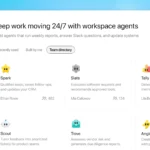
SAP is putting a more demanding proposition behind its enterprise AI pitch. At its TechEd conference on 27 October, the company announced new tools for building AI agents, connecting them to business information and governing what they do across corporate systems. The announcement is less about another chatbot and more about whether businesses can safely let software carry out a sequence of real tasks.
According to SAP’s TechEd announcement, Joule Studio will allow business users and developers to build or extend agents with no-code and pro-code tools and select from more than 70 AI models. Its wider Business AI Platform is meant to provide the context and controls those agents need when they work with SAP software and third-party services.
A useful enterprise agent cannot stop at drafting a response. Consider a purchasing request that involves checking inventory, comparing suppliers, obtaining an approval and updating a finance record. Each step may sit in a different system with different access rules. SAP says new Joule Work capabilities will plan and coordinate such multistep workflows, while supporting open connection standards including Model Context Protocol and Agent2Agent.
The central difficulty is context. A model may understand the words in a request while misunderstanding what a customer, order or approval means in that particular company. SAP is extending its Knowledge Graph to include more customer-specific information from both SAP and non-SAP sources. The company argues that agents grounded in those relationships can make more accurate decisions. That remains a product claim, and organisations will need to test it against their own processes and data quality.
SAP also says early adopters can design and run n8n workflows inside Joule Studio, with broader availability to follow. That distinction matters. Not every feature described on stage is immediately open to every customer, and the value of an integration depends on how reliably it handles exceptions, permissions and handoffs in production.
Agents become more consequential when they can act rather than merely suggest. An incorrect summary can be corrected before use. An incorrect purchase, record change or customer action can be harder to unwind. SAP’s platform pitch therefore puts monitoring, model choice and business controls alongside agent creation. Companies evaluating it should ask who approves high-impact steps, what the audit record shows and whether an agent can be stopped or rolled back when a task goes wrong.
The company says customer data is not shared to train or improve large language models. That is an important assurance, but buyers will still need to assess where their information flows through integrations, which models are chosen for specific tasks and how long logs are retained. The competitive race for enterprise agents is increasingly about those operational questions, not just benchmark scores. TechBooky recently examined Meta’s move into enterprise AI, another sign that large technology groups see business workflows as a major market.
SAP’s announcement also includes SAP-RPT-2.0, a model for structured business data with planned support for anomaly and outlier detection. A separate time-series model is intended to help forecast business measures. SAP and HPE say a version of the tabular model is planned to run aboard the International Space Station to analyse mission data locally. That is an unusual demonstration of where structured-data AI can operate, but it should not be confused with proof that the wider enterprise-agent suite is already producing comparable outcomes for customers.
The larger test is practical. SAP sits close to the finance, supply-chain and human-resources systems that many organisations depend on every day. If it can give agents reliable context and clear limits, its tools could move AI from isolated experiments into routine work. If permissions, integration gaps or uncertain returns get in the way, a more polished interface alone will not make that transition happen.
Related Reading
More contextual TechBooky stories selected from tags, categories and article context.
Paul Femi Balo is the founder and publisher of TechBooky. He covers artificial intelligence, African technology, digital infrastructure, enterprise technology and the global digital economy.
We use cookies to ensure that we give you the best experience on our website. If you continue to use this site we will assume that you are happy with it.