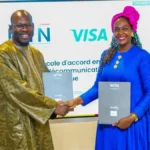
Visa and Transsion have agreed to explore payments built into the phone ecosystem behind TECNO, Infinix and itel. For Africa, where these brands have a large presence, the most interesting possibility is straightforward: a compatible handset could help its owner pay at a shop or let a small merchant accept a contactless payment without a separate terminal. But this is a plan for collaboration, not an announcement that either service is now available across the continent.
The companies announced their memorandum of understanding on 19 November. According to Transsion’s announcement, their work will cover consumer contactless payments, Visa Tap to Phone for merchant acceptance and AI-assisted commerce. They have not named the first African launch market, a participating bank, a handset model or a consumer roll-out date. Those missing details matter more to a buyer or trader than the breadth of the partnership’s ambitions.
Visa describes Tap to Pay as a way to make contactless payments with a phone or wearable. Tap to Phone addresses the other side of a sale: a merchant uses a compatible smartphone to accept a payment. In principle, a shopkeeper could avoid buying a dedicated card terminal, while a customer could pay with a supported device. The word compatible is doing important work. The feature needs suitable hardware, software, banking and payment-network support, and local acceptance arrangements before it can become an everyday option.
This is why Transsion is a notable partner. Its TECNO, Infinix and itel phones reach buyers at several price points and have established distribution across African markets. TechBooky has previously examined the scale of Transsion’s African phone business. Putting payment tools into that ecosystem could reach people and merchants who are less likely to buy expensive premium devices. It could also give Transsion a larger role in services after the handset sale.
Still, device reach is not the same as payment adoption. An affordable phone without the required contactless capability cannot simply become a tap-to-pay device through a partnership announcement. The companies will need to show which models qualify, what an upgrade costs, which financial institutions will support the service and how much merchants will pay. Reliability, fraud controls and a clear route to resolving failed transactions will also shape trust.
The agreement also covers agentic commerce, in which software may help a customer discover a product and complete an authorised purchase. Transsion says the partners have completed technical integration with Visa Intelligent Commerce and validated agentic payment transactions in a live environment. That is evidence of a technical test, not proof that an AI shopping assistant is available on TECNO, Infinix or itel phones today. Consumer consent, spending limits, identity checks and dispute handling would be central to any wider release.
Visa has pursued other African payment partnerships, including a separate agreement with Senegal on public-service payments. Those deals show interest in expanding acceptance and use cases, but each has its own timetable and conditions. The Transsion memorandum should be judged on the products and markets it eventually delivers, not treated as a finished payment network.
The next useful announcement would identify a country, participating issuers or acquirers, eligible devices and a launch schedule. For small merchants, the most revealing figures would be the total cost of accepting a payment and how quickly proceeds arrive. For consumers, the test is whether paying by phone becomes easier and more dependable than the methods they already use.
Visa and Transsion have a credible combination of a payments network and widely used devices. Their agreement opens a potentially important route to digital payments in Africa and other emerging markets. Whether it changes behaviour at the checkout will depend on execution at the affordable end of the smartphone market, where both convenience and cost are decisive.
Related Reading
More contextual TechBooky stories selected from tags, categories and article context.
We use cookies to ensure that we give you the best experience on our website. If you continue to use this site we will assume that you are happy with it.