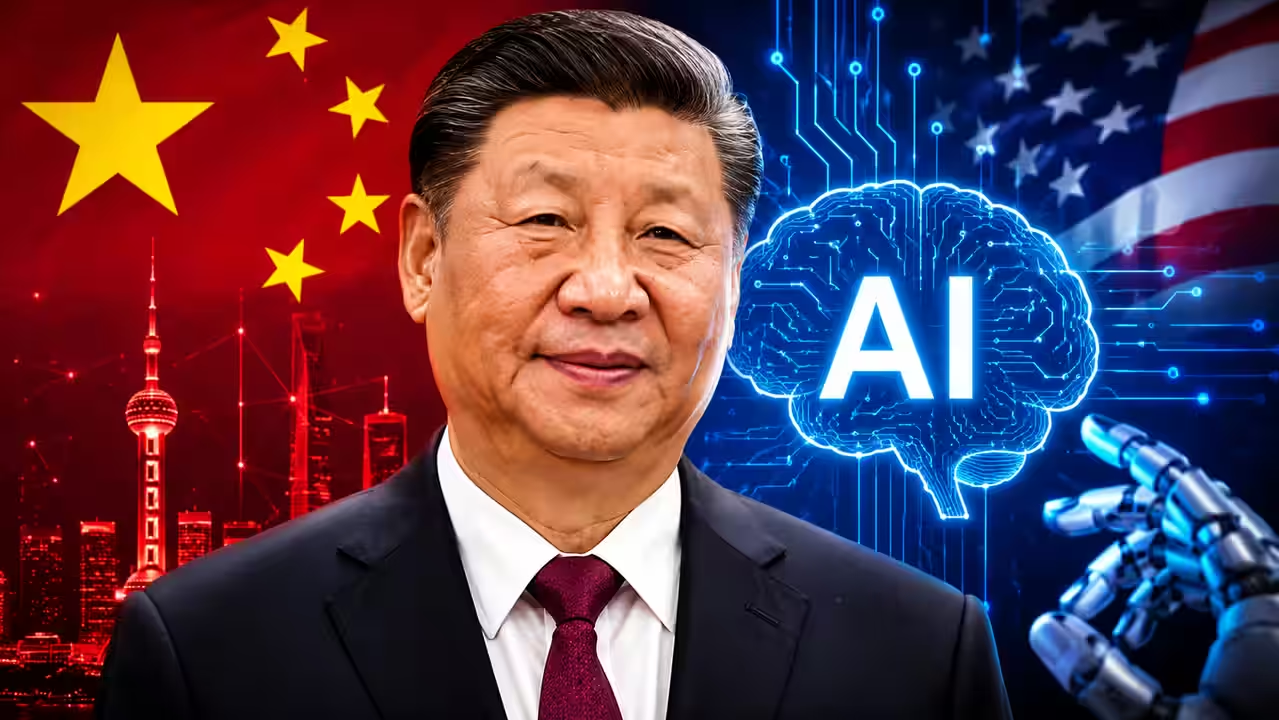
The US-China AI fight has entered a sharper phase, and this time the argument is not only about chips. It is about whether Chinese AI companies are learning too much from American models and whether that learning crosses a line.
China has rejected US allegations that several Chinese AI firms carried out aggressive and malicious distillation of advanced American models. The claim reportedly names companies including DeepSeek, Alibaba, Moonshot AI and Z.ai, while accusing them of extracting capabilities from systems such as OpenAI’s GPT models and Google’s Gemini.
Distillation is not automatically illegal or unusual. In AI, it generally means training a smaller or cheaper model to imitate the behaviour of a stronger model. Done with permission and proper data rights, it can make AI cheaper and more efficient. Done secretly against a rival model’s terms, it becomes a serious commercial and national-security argument.
That is why this accusation matters. The US has spent years restricting Chinese access to advanced AI chips. China has responded by investing in domestic chips, local data centres and cheaper model architectures. If Chinese labs can use distillation to narrow the capability gap without needing the same volume of Nvidia hardware, then Washington’s chip controls become less decisive.
Moonshot AI’s Kimi K3 is part of that wider story. We have already looked at how Kimi K3 became a headache for the AI market and how Chinese open-weight models are forcing the US to rethink what leadership really means. The debate is no longer just frontier performance. It is cost, access, speed and developer adoption.
China says the allegations are groundless and has accused the US of trying to monopolise AI. That response is predictable, but the politics around it are important. Both countries want to present themselves as defenders of innovation while accusing the other side of unfair advantage.
For developers and businesses, the practical issue is that AI models are becoming harder to separate from each other. Models are trained on public data, synthetic data, user interactions, benchmark traces, generated answers and outputs from other systems. The more the industry uses AI to create training material for AI, the harder it becomes to prove where one model’s capability truly came from.
This is also why open-weight AI is becoming strategically important. As we argued in our explainer on open-weight models, open releases can expand access and transparency, but they also make model ecosystems more difficult to police once powerful capabilities spread.
The US still has the strongest AI companies, cloud platforms and chip ecosystem. China has scale, urgency, price discipline and a fast-growing pool of competitive models. If distillation becomes the next big battlefield, the AI race will shift from who owns the biggest model to who can legally, cheaply and quickly reproduce useful intelligence.
That makes this dispute bigger than one advisory or one denial. It is a preview of how messy the global AI race may become as models turn into strategic assets, training data becomes contested and the line between learning and copying gets harder to draw.
Related Reading
More contextual TechBooky stories selected from tags, categories and article context.
Paul Femi Balo is the founder and publisher of TechBooky. He covers artificial intelligence, African technology, digital infrastructure, enterprise technology and the global digital economy.
We use cookies to ensure that we give you the best experience on our website. If you continue to use this site we will assume that you are happy with it.