India’s AI infrastructure race has picked up a major new signal just as Nvidia prepares to report earnings later today.
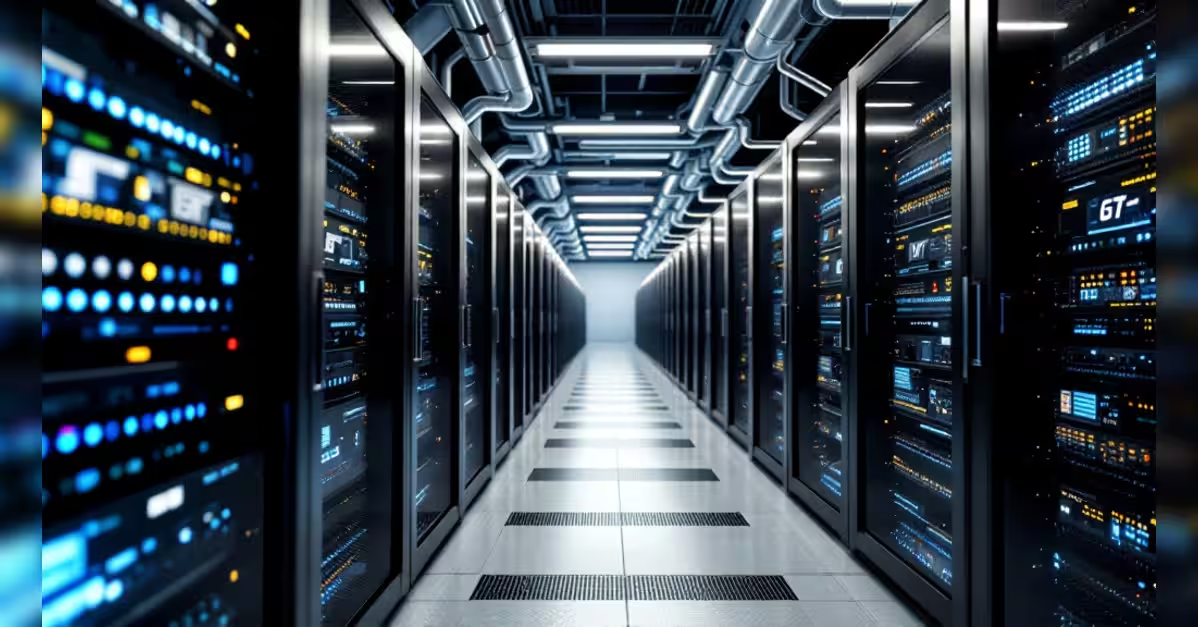
AM Intelligence, an AI infrastructure platform backed by the promoters of Greenko, has placed a binding order for about 9,000 Nvidia Vera Rubin GPUs for its first AI factory in Hyderabad. Economic Times DataCenters says the deployment is part of an initial 200 MW facility and a wider plan involving more than $8 billion in capital expenditure.
The company wants to build 1 GW of compute-as-a-service capacity across India, the United States, Finland and Malaysia, while also developing a broader 5 GW AI data-centre pipeline. The Hyderabad site is expected to be one of Asia’s early large-scale deployments of Nvidia’s next-generation Vera Rubin architecture, with delivery expected in the first quarter of 2027.
This matters because AI infrastructure is becoming a national competitiveness issue. Countries no longer want to depend entirely on foreign cloud regions for advanced AI workloads. They want local or allied compute capacity, domestic data control, lower latency and the ability to support startups, enterprises and public-sector AI projects without waiting in someone else’s queue.
India already has a large software talent base, a fast-growing digital economy and a government that wants the country to be more than a back office for global technology. What it has lacked is the same scale of advanced AI compute available to the largest American and Chinese players. AM Intelligence is trying to close part of that gap from the infrastructure side.
The Vera Rubin angle is important. Nvidia’s Rubin platform is expected to succeed the Blackwell generation and is designed for the next wave of large-scale AI training and inference. That means AM Intelligence is not only buying today’s capacity. It is trying to position Hyderabad for the next phase of trillion-parameter models, agentic AI systems and heavy enterprise workloads.
The power numbers are just as important as the chip numbers. AI factories are becoming energy projects as much as technology projects. Greenko’s background in energy gives AM Intelligence an interesting advantage because the companies that can connect power, cooling, land, chips and customers will have a stronger claim in the AI infrastructure market.
The announcement also lands at a sensitive moment for Nvidia. Investors are waiting for tonight’s earnings because the market wants proof that AI infrastructure demand remains strong beyond the biggest American hyperscalers. We already looked at that pressure in Nvidia earnings week putting the AI boom on trial.
A large Indian order does not answer every question about Nvidia’s growth, but it supports the argument that demand is spreading geographically. India, the Gulf, Europe and parts of Asia are all trying to build more sovereign or local AI capacity. That could make Nvidia’s next growth phase less dependent on a small group of U.S. cloud giants.
For India, the test will be execution. Ordering GPUs is the easy headline. Bringing enough power, cooling, networking, security, customers and operational reliability together is the harder work. If AM Intelligence delivers, Hyderabad could become one of the more important AI compute hubs outside the usual U.S.-China axis.
Related Reading
More contextual TechBooky stories selected from tags, categories and article context.
Paul Balo is the founder of TechBooky and a highly skilled wireless communications professional with a strong background in cloud computing, offering extensive experience in designing, implementing, and managing wireless communication systems.
We use cookies to ensure that we give you the best experience on our website. If you continue to use this site we will assume that you are happy with it.