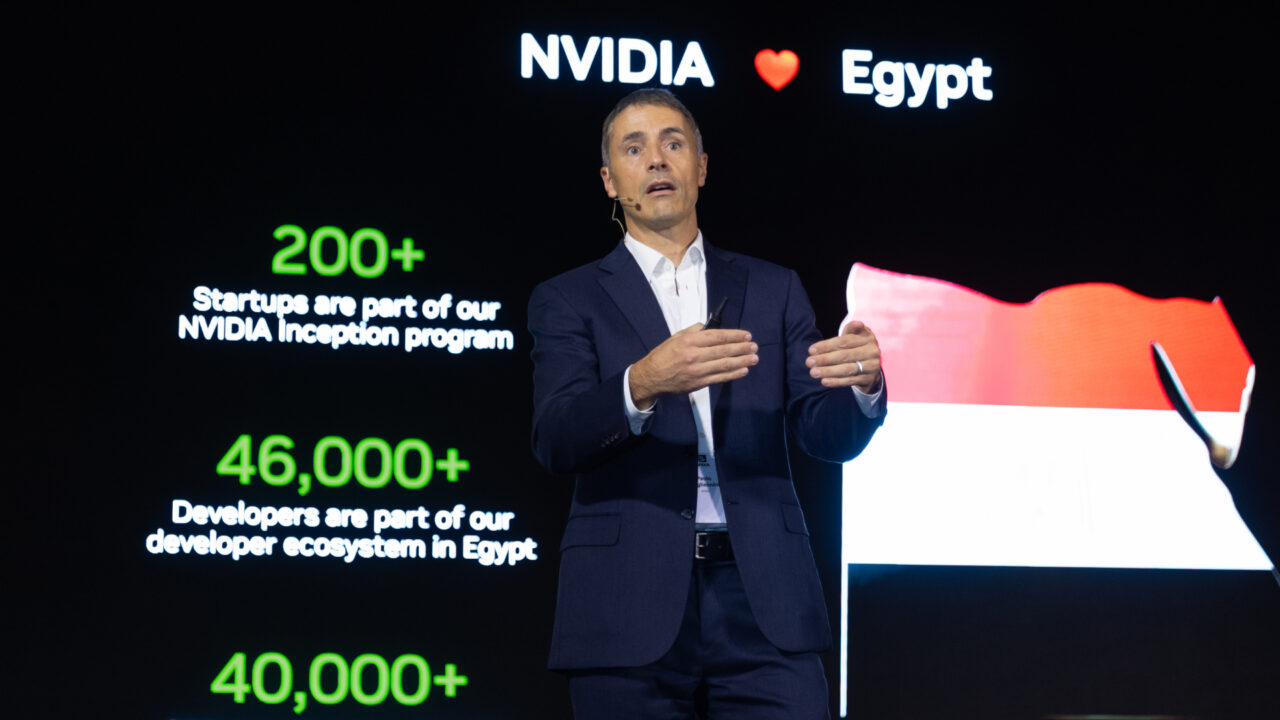
Africa’s AI conversation is beginning to move from applications to infrastructure. At an event in Egypt, Nvidia outlined how local partners are building the computing facilities that could let more African companies train and run AI closer to their users. The Nvidia Africa AI factories story is potentially important, but it is still a story about projects at different stages, not a continent already covered in GPU capacity.
In its September 21 announcement, Nvidia highlighted Cassava Technologies and Vodafone Egypt’s plans for an AI factory in Egypt. Cassava has also brought an AI factory online in South Africa and is pursuing facilities in Kenya, Nigeria and Morocco. Nvidia says four African AI factories have been announced or come online within a year. That wording matters. An announced site is not the same thing as a running facility taking paying customers.
An AI factory is effectively a data centre designed around powerful chips, fast networking and software for AI training or inference. For a local bank, hospital, telecoms operator or startup, domestic access can mean lower latency and more control over sensitive data. It can also reduce dependence on overseas cloud regions, although price, uptime and the availability of skilled operators will determine whether customers actually switch.
Nvidia points to a 656MW pipeline linked to the broader buildout. A pipeline is a measure of ambition, not installed capacity. Turning that power into useful AI services requires grid connections, reliable electricity, cooling, fibre, financing and customers willing to pay for the GPUs. In markets where those ingredients are scarce, a new building alone will not close the compute gap.
The stakes are clear for African developers. A model for local languages, farming advice or financial fraud can be built anywhere, but serving millions of users from distant infrastructure can add cost and complicate data governance. We have looked at the same issue through Africa’s sovereign AI cloud push. More regional competition could give businesses a better choice of where their data and workloads live.
There is a commercial reason Nvidia is interested, too. Most advanced AI compute has been concentrated in a small group of US and Asian buyers. Expanding the market to African telecoms companies, governments and enterprises opens another growth channel for Nvidia’s systems. But a healthy local AI economy cannot be measured by chip orders alone. It will be measured by affordable access, home-grown services and whether facilities stay reliable after the launch photographs are taken.
Related Reading
More contextual TechBooky stories selected from tags, categories and article context.
Paul Balo is the founder of TechBooky and a highly skilled wireless communications professional with a strong background in cloud computing, offering extensive experience in designing, implementing, and managing wireless communication systems.
We use cookies to ensure that we give you the best experience on our website. If you continue to use this site we will assume that you are happy with it.