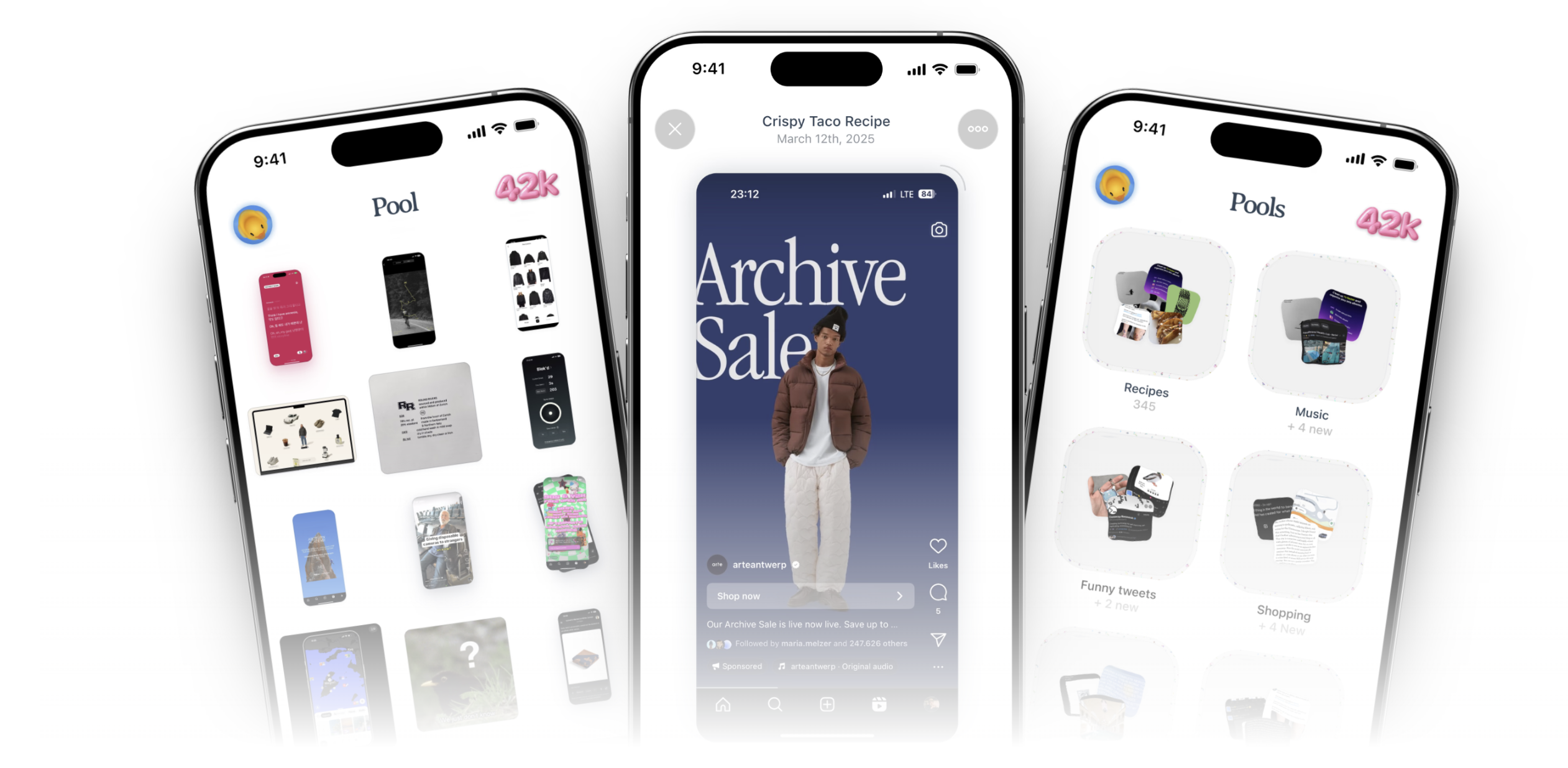
The camera roll on the user’s phone has been used for two purposes for many years. It has not only made it easier for users to relive great experiences, but it has also functioned as an archive, a library, for a variety of online content, including product recommendations, recipes, fashion inspiration, vacation ideas, intriguing quotes, humorous tweets, and more. A brand-new app called Pool is coming out today to help every user finally sort through this digital chaos.
Pool, a new AI-powered tool, turns your disorganized camera roll into a searchable, useful personal library. The program, which was created by Random Access Memories Co. and backed by General Catalyst, focuses on the “emotional data” like recipes, shopping preferences, and preserved ideas rather than typical productivity data like emails or bank reports.
To begin using Pool, all users have to do is grant it access to their images, which it then organizes into “pools.” The pools that the program creates are unique to every user because they rely solely on the goods, locations, or items that the user has stored over time.
The software is just one of many that are reimagining bookmarking in the age of artificial intelligence. Similar to applications like Captr or Sorti, startups like mymind, Fabric, and Raindrop assist users in organizing links, photographs, or other saved content. Pool, on the other hand, concentrates exclusively on screenshots and then utilizes AI to assist users in rediscovering and acting upon things they wanted to review later.
After being imported, Pool can locate the original URL linked to a specific screenshot. For example, it would connect to the retailer’s website if the screenshot showed a product you were considering purchasing. In the event that you came upon a recipe on Instagram, the ingredients and instructions published by the creator may be retrieved. And so forth.
Maxime Junique, a co-founder of Pool, claimed that the concept originated because he and Piet Terheyden, his co-founder, had experienced the similar issue: they would take screenshots of items they wanted to remember but were unable to locate them later.
In a remark from Junique, he stated that when they say it, it sounds pretty obvious right now, but it’s something they do so naturally users don’t necessarily notice it. The founders inquired about the problem with their pals after meeting in a co-working space years prior. The buddies concurred that they would frequently take screenshots and forget things, such as design concepts or other inspiration.
About three years ago, the app was really the first product to come out of Spinoff Studio, the creators’ design and product studio. The founders lived out of a van while working on the landing page, website, and initial build in Lisbon over the course of a few weeks. However, they quickly recognized that they needed to develop some profitable products first, so they shelved Pool and switched to B2B SaaS.
Later, the studio developed further products, such as the CRM program Waitless, which was purchased last year.
The development of AI was what gave Pool a second chance. Making sense of individual, mostly unstructured datasets appeared to be a viable concept all of a sudden.
Junique told members of the press that they thought it seemed like a perfect time to go after this idea. In addition to the earlier statement, he stated that it appeared to them to be an extremely unexplored and untouched dataset for AI. Emails, bank transactions, chat logs, and other productivity-focused statistics are all sought after by everyone. Who is targeting this incredibly sentimental dataset that we all possess?
Additionally, the Pool app considers the screenshots like memories, so some of them become less significant over time while others become more significant right now.
If the user snaps a screenshot of the barcode on an event ticket, for instance, it can vanish after the event.
In the meanwhile, Pool’s AI agents can assist you in locating the booking site and where to purchase tickets if you take a screenshot of an Instagram flyer about an upcoming event.
You can search for items in Pool or ask its built-in AI assistant for assistance.
The founders then intend to develop this idea into a second, independent software that functions as a kind of personal assistant. The small rubber duck that you press and drag across the screen to access Pool at launch will be incorporated into the brand of the agentic AI software that Pool is developing.
When we spoke, the founders were in Lisbon, no longer in a van, but they were on their way to San Francisco in late May to meet with investors. Winston Du, Julian Blessin, Thomas Ricouard, General Catalyst, Kima Ventures, Paris-based Source Ventures, and other angels contributed somewhat more than $2 million to the startup’s initial pre-seed round.
PoolLink’s key features include recovery that traces original retailer links, Instagram recipes, or ticket sites from flat images; automatic categorization that organizes your content into customizable collections called “pools”; smarter semantic search that interprets the contextual meaning of your queries while handling fuzzy spelling and intent; and time-sensitive memory that treats items as physical memories, so event ticket barcodes or temporary flyers naturally fade or disappear after they occur.
Pool is now fully open to the public after being invite-only and available exclusively on iOS (requiring iOS 18.0 or later), and users may now download it for free on iOS or from the App Store.
Related Reading
More contextual TechBooky stories selected from tags, categories and article context.
We use cookies to ensure that we give you the best experience on our website. If you continue to use this site we will assume that you are happy with it.