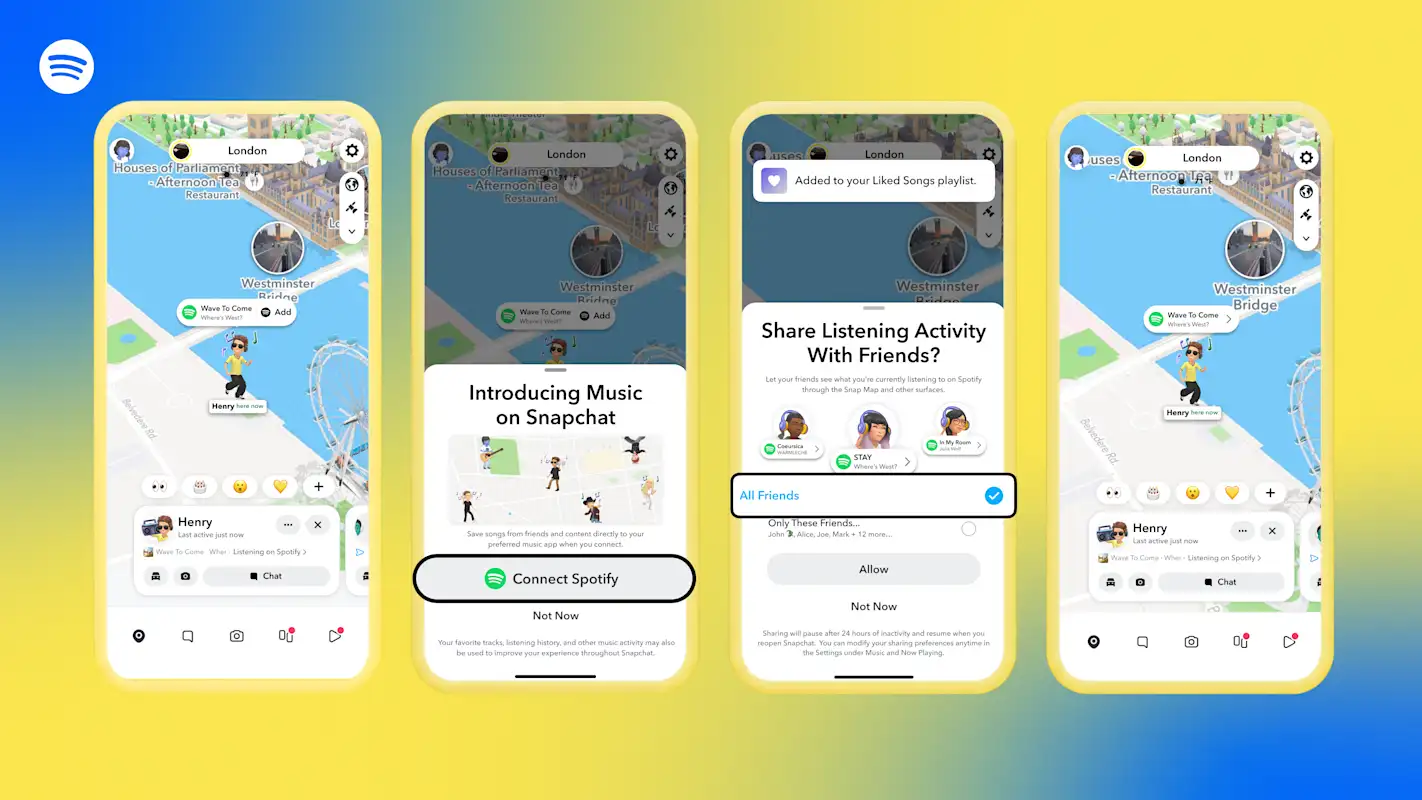
Snapchat is adding music to one of its most important social surfaces. The company is rolling out Now Playing on Snap Map, a new feature that lets users share what they are listening to in real time with friends, starting with Spotify. It is a consumer update, but it also points to a larger fight over music discovery and social identity inside mobile apps.
Users can link their streaming account and show their current song on Snap Map. Snap’s own announcement says Now Playing is designed to help friends share the soundtrack to their day. The rollout begins with Spotify, and Snap says it will be available in regions where both Snapchat and Spotify are supported, with Canada coming later.
The privacy controls are important. Users can choose who sees their listening activity. The feature does not show listening history or the last-played song, and sharing pauses automatically if the user has not opened Snapchat within 24 hours. Users can also pause sharing manually for three hours, 24 hours or indefinitely. That matters because Snap Map already deals with a sensitive layer of user behaviour: location and presence.
The move puts Snapchat into a familiar but still competitive space. TikTok has turned songs into viral distribution engines. Instagram lets users share what they are listening to through Notes. Spotify has been trying to make listening more social again with friend activity and real-time sharing features. Snap’s advantage is that Snap Map already has more than 450 million monthly users and is built around what friends are doing in the moment.
Snap is also connecting the feature to Spotlight, its short-form video product. If users discover a song in a Spotlight video, they can save it directly to Spotify or open the track page. That creates a cleaner loop between music discovery, video and streaming. It also gives Snapchat a way to participate in the music influence economy without trying to become TikTok.
TechBooky’s earlier report on Snapchat’s AI Clips Lens showed how Snap keeps using creative tools to make its app feel more expressive. Now Playing works in the same direction, but with music instead of generated video. Another TechBooky piece on Spotify’s social messaging push also showed that streaming platforms are trying to own more of the conversation around music sharing rather than leaving it entirely to social networks.
For Snap, the business logic is straightforward. Snap Map becomes more useful if it shows not just where friends are, but what they are doing, watching or listening to. Music is personal enough to make the map feel alive, but lightweight enough that users may share it without thinking too hard. The challenge is to keep the feature fun without making it feel invasive.
The update is unlikely to change Snapchat on its own. But it shows Snap’s continued effort to make the app feel more real-time and more tied to close friends than the broader creator-feed model. In a market where social platforms keep copying each other’s video features, Now Playing is a smaller idea, but a sensible one: it turns music taste into another ambient signal between friends.
Related Reading
More contextual TechBooky stories selected from tags, categories and article context.
Paul Femi Balo is the founder and publisher of TechBooky. He covers artificial intelligence, African technology, digital infrastructure, enterprise technology and the global digital economy.
We use cookies to ensure that we give you the best experience on our website. If you continue to use this site we will assume that you are happy with it.