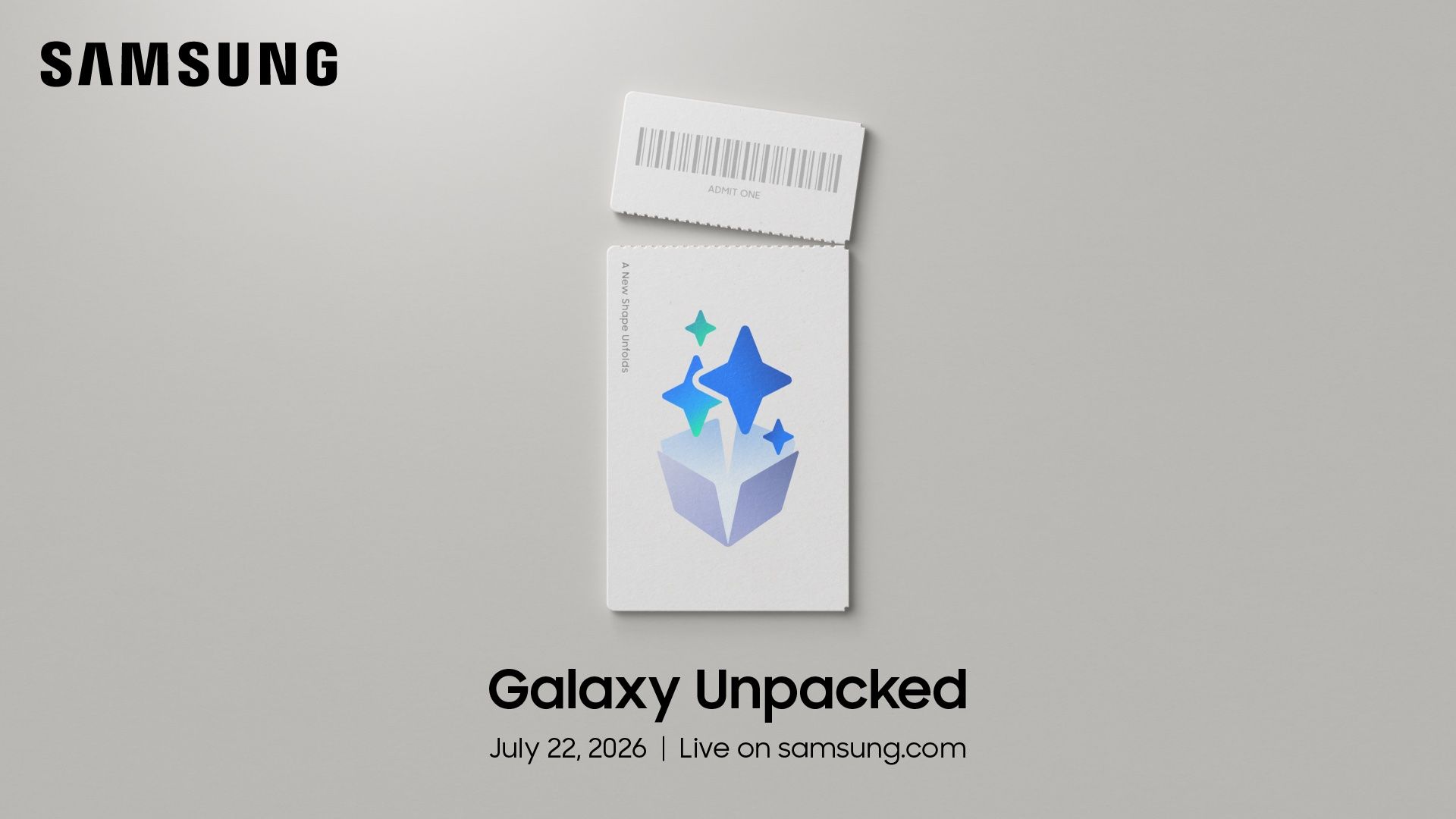
Samsung is holding Galaxy Unpacked in London today, and the stakes are unusually high. The company is expected to unveil its next generation of foldables, including the Galaxy Z Fold 8 and Galaxy Z Flip 8, at a time when competition in the foldable market is intensifying and Apple’s first foldable iPhone is widely expected to arrive soon.
Samsung’s own Unpacked invitation promised that “a new shape unfolds” on July 22 in London. The event is expected to focus on new foldables, with rumours pointing to a wider Fold design, upgraded batteries, new Galaxy Watch models and possible AI smart-glasses teasers.
The event is more than a normal phone refresh. Samsung built the mainstream foldable category, but the market has become more crowded. Huawei, Honor, Oppo, Google and others have all pushed the form factor forward, and Apple’s eventual entry could reset consumer expectations overnight.
The Galaxy Z Fold line has always had one basic challenge: it must be a good phone when closed and a useful tablet when open. Earlier Fold models were impressive, but the narrow outer screen made them feel awkward for some users. A wider, more passport-like Fold 8 would directly address that problem.
That design shift matters because foldables need to feel natural, not experimental. If a Fold is frustrating as a normal phone, most people will not care how impressive the inner screen is. Samsung appears to be moving toward a shape that better matches how people actually hold and type on phones.
Durability, crease visibility, battery life and app continuity will also matter. Foldables have matured, but buyers still worry about whether a moving-screen phone can survive years of daily use.
Samsung has enjoyed years of lead time in foldables, but Apple changes categories differently, as seen again in the way its reported Apple Upgrade programme could reshape device ownership. It rarely enters first; it enters when it believes it can make the product feel mainstream. If Apple launches a foldable iPhone, Samsung will suddenly be defending the market it created against the company with the strongest premium-phone ecosystem.
That is why today’s Unpacked matters. Samsung cannot simply iterate gently. It needs to show that its foldables are no longer niche experiments, but polished premium phones with a clear reason to exist.
This is also where AI features may become part of the pitch. A larger foldable screen could make on-device assistants, multitasking, photo editing, translation and productivity workflows more useful. But Samsung has to avoid making AI feel like decoration on top of hardware that still needs to win on design.
The Galaxy Z Flip 8 is expected to remain the more lifestyle-focused foldable, with a smaller body and lower barrier to entry than the Fold. If Samsung improves battery life and the cover-screen experience, the Flip could remain the easier sell for mainstream buyers.
Wearables are also expected, including updated Galaxy Watch models and possibly a Watch Ultra refresh. Health tracking, battery life and AI coaching will likely be the main angles, especially as Apple, Google and Garmin keep pushing harder into health data.
The most intriguing possibility is smart glasses. Samsung has already been working with Google and Qualcomm on Android XR, and any teaser would signal that the company wants a role in the next computing interface beyond phones.
Foldables are still a small slice of the smartphone market, but they are strategically important because they are one of the few areas where phone hardware can still feel meaningfully new. Most slab phones are now mature. Foldables still have room to surprise.
That gives Samsung a chance to define the next premium upgrade cycle before Apple arrives. But it also means the company has to prove that foldables are more than expensive engineering flexes.
The best outcome for Samsung today would be simple: a wider Fold that feels natural, a Flip that lasts longer, watches that make health features more useful, and AI features that genuinely fit the hardware. If it delivers that, Samsung can remind the market why it still leads the foldable conversation.
Related Reading
More contextual TechBooky stories selected from tags, categories and article context.
Paul Femi Balo is the founder and publisher of TechBooky. He covers artificial intelligence, African technology, digital infrastructure, enterprise technology and the global digital economy.
We use cookies to ensure that we give you the best experience on our website. If you continue to use this site we will assume that you are happy with it.