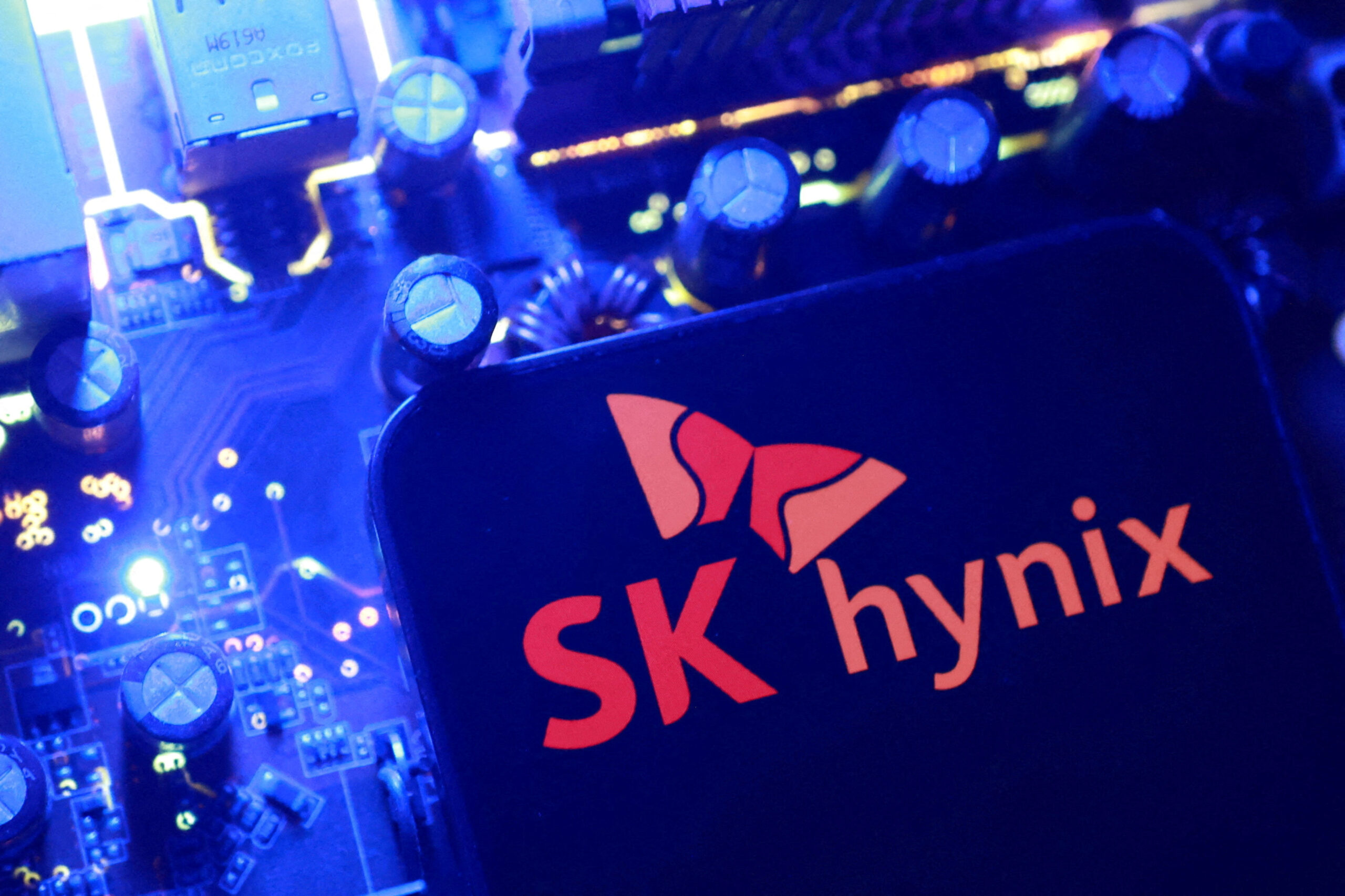
FILE PHOTO: SK Hynix’s logo is seen in this illustration created on June 11, 2026. REUTERS/Dado Ruvic/Illustration/File Photo
SK Hynix plans to spend 1.4 trillion won, about $1.05 billion, over five years to support South Korean suppliers of semiconductor materials, components and equipment. The company announced the programme on Monday, 16 November, as competition to supply memory for artificial intelligence systems intensifies.
The figure is a planned multi-year commitment, not money already spent. Reuters reported that the support will extend across research and development, testing, mass production and sales. The approach aims to help smaller companies get new products through the difficult path from laboratory prototype to a dependable part of chip manufacturing.
AI demand has made memory production a strategic bottleneck. High-bandwidth memory is used alongside advanced processors in AI servers, while conventional server memory and storage are also in demand. Even a chipmaker with strong designs needs reliable chemicals, tools, parts and process expertise from a broad network of suppliers. A weakness at any point can delay capacity expansion or reduce production yields.
SK Hynix is trying to make that network more resilient at home. According to Reuters, the company will contribute 443.2 billion won to the supplier programme, with 373.6 billion won from the central government and 57.7 billion won from local governments in a specified funding component. Those figures should not be mistaken for the full 1.4 trillion won commitment or added to it as though they described a separate programme.
Support at the testing stage matters particularly in semiconductors. A promising material or machine cannot simply be installed at scale. Chipmakers must establish that it works consistently, meets quality thresholds and integrates with complex manufacturing processes. Suppliers may need years of validation and capital before winning large-volume orders. Help with trials and commercialisation could therefore strengthen the local ecosystem, although the success of individual projects remains to be seen.
The programme follows a strong period for SK Hynix. In its third-quarter results, the company said it expected high-bandwidth memory demand to remain strong and planned to expand HBM4 production. TechBooky covered the record AI-memory profit and its warning about constrained supply. The new supplier initiative addresses a different question: whether the surrounding industrial base can keep pace with chipmakers’ expansion.
This is also an industrial-policy story. South Korea wants more of the value in the AI hardware chain to be created by domestic firms, rather than allowing a handful of large manufacturers to carry the entire burden. Public participation in the programme points to the importance Seoul attaches to materials, machinery and components that are less visible than headline chip brands but essential to output.
The measure does not guarantee more HBM supply or lower prices on its own. Its impact will depend on which suppliers qualify, whether projects pass testing and how much of the planned funding reaches production. Those are the milestones to watch over the next five years. For now, SK Hynix has outlined a substantial plan to build capacity beyond its own factory walls.
Related Reading
More contextual TechBooky stories selected from tags, categories and article context.
Paul Femi Balo is the founder and publisher of TechBooky. He covers artificial intelligence, African technology, digital infrastructure, enterprise technology and the global digital economy.
We use cookies to ensure that we give you the best experience on our website. If you continue to use this site we will assume that you are happy with it.