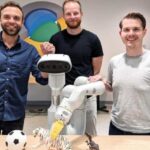
Lupa Robotics, a startup founded by South African engineering student Nureldin Mohamed, has raised $1.67 million in seed funding to develop AI that helps robots handle objects with greater dexterity. The round was reported by TechCabal on 23 November. The company has not disclosed a valuation or a date for commercial pilots.
Robots can identify objects with cameras, but understanding how much pressure to apply when picking something up is a different problem. A paper cup, a soft piece of fruit and a metal component each need a different grip. Lupa wants to train models on what human hands do in those situations, including movement, touch and force.
The company uses sensor-equipped gloves and cameras to record how people manipulate objects. Those recordings are intended to become training data for software that predicts useful gripping behaviour. A robot-specific controller would still have to translate that prediction into movements its own hardware can perform. The distinction is important because robot hands vary widely in shape, sensors and physical ability.
Mohamed told TechCabal that Lupa’s goal is to make lessons about handling an object transferable across different machines. In theory, that could reduce the amount of task-specific programming needed for routine work in factories, warehouses or other controlled environments. In practice, the company still has to demonstrate that models trained on human touch data perform reliably when they encounter unfamiliar objects and real-world variation.
According to the report, Long Journey Ventures led the seed round, with other investors also taking part. Lupa plans to use the money to hire engineers, improve its tactile sensing and data collection, build a larger set of recorded human interactions and train and validate its models. The company remains in research and development, so the investment should not be mistaken for evidence of a commercially deployed robotics platform.
African technology funding is often discussed almost entirely in terms of payments and consumer software. Lupa’s raise points to a different kind of venture, one built around sensors, robotics and physical AI. Its South African founder is working on a problem with global industrial applications, even though the product and its market are still at an early stage.
The challenge is also technically demanding. Vision alone may lose information when a hand covers an object, which is one reason tactile measurements are attractive. Yet collecting consistent touch and force data at scale is expensive, and a model that works in one controlled test may fail when objects, lighting or robot hardware change. Independent performance results will matter more than a broad claim of human-like dexterity.
Lupa’s next milestones, as described in the reporting, are larger data collection, validation across robotic platforms and progress towards pilots. The $1.67 million round provides resources to pursue those steps. The bigger question is whether the startup can turn human-hand data into a repeatable capability that customers will pay to deploy.
Related Reading
More contextual TechBooky stories selected from tags, categories and article context.
We use cookies to ensure that we give you the best experience on our website. If you continue to use this site we will assume that you are happy with it.