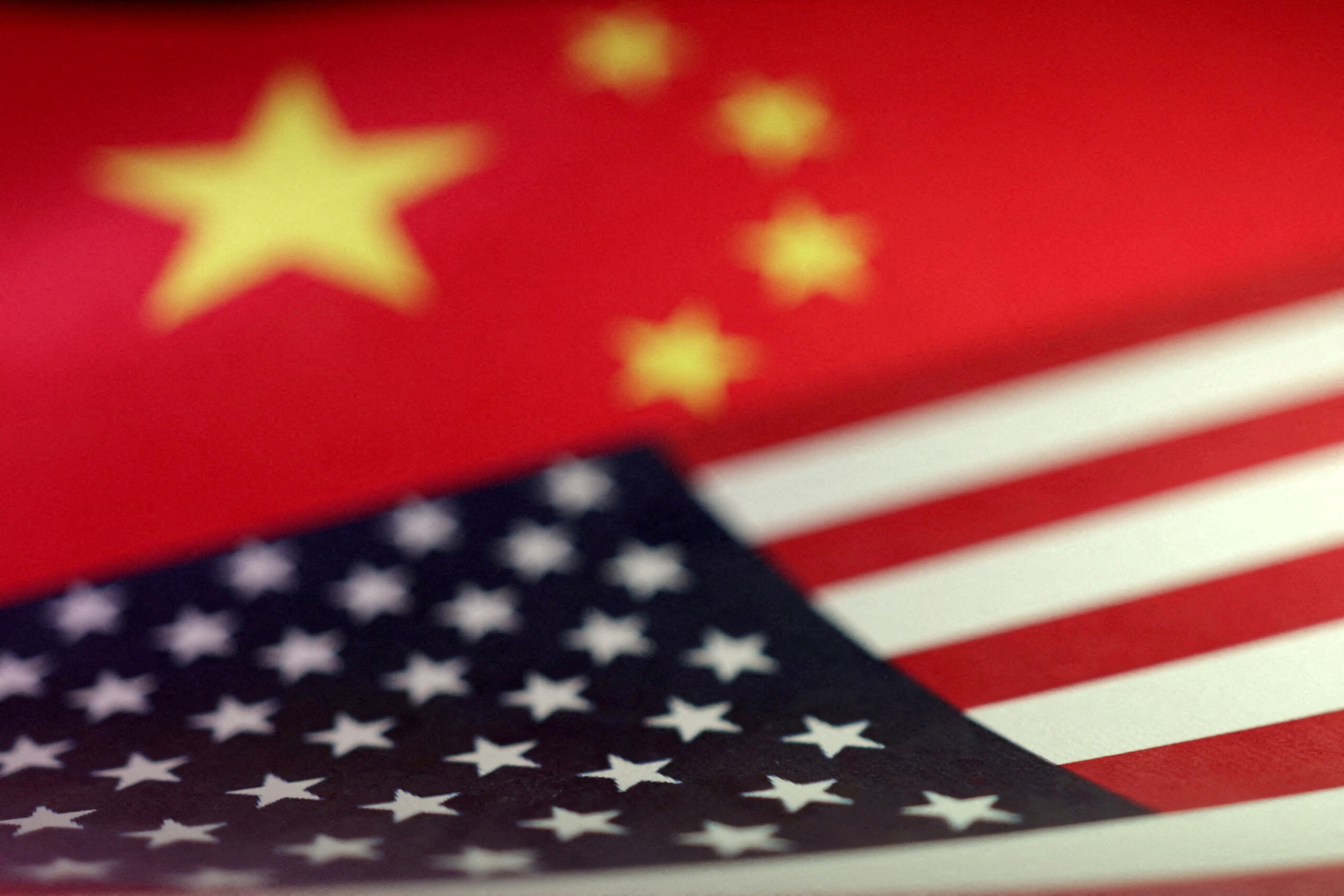
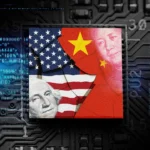
FILE PHOTO: U.S. and Chinese flags are seen in this illustration created on April 10, 2025. REUTERS/Dado Ruvic/Illustration/File Photo
The AI race between the United States and China is becoming less like a technology contest and more like a diplomatic loyalty test.
Reuters reports, through The Business Standard, that Washington is preparing to tell partner countries they must avoid joining China’s rival AI governance framework if they want to remain inside the U.S.-led AI coalition. The message is expected to be delivered to countries that have been trying to stay close to both powers.
That is a major shift in tone. Until recently, AI diplomacy was mostly framed around safety, innovation, model risk, compute access and standards. Now the conversation is moving closer to bloc politics: choose the U.S. framework or risk being seen as part of China’s AI orbit.
The U.S. fear is not hard to understand. AI governance is not only about writing principles. It can shape export rules, cloud access, model deployment, cybersecurity, surveillance standards, data sharing and who gets to define what responsible AI means. If China builds a competing framework and countries sign on, Beijing gains influence over the rules of the next computing platform.
China’s own pitch is different. Beijing has argued for a more inclusive global AI governance structure and has positioned itself as a champion of developing countries that do not want AI rules written only by Washington and its allies. That message can resonate in parts of Africa, Asia, the Middle East and Latin America, where governments often want access to cheap technology without being forced into geopolitical alignment.
This is where the issue becomes complicated. Many countries use U.S. cloud platforms, Chinese telecoms equipment, local data centres, open-source models and imported chips all at the same time. Their digital economies are already mixed. Asking them to pick one AI camp may sound clean in Washington, but it may be messy on the ground.
We recently argued that China has a real chance of winning important parts of the AI race, especially as Chinese labs push cheaper models and open-weight releases. DeepSeek, Kimi and Z.ai have shown that China can compete on cost and speed, even under chip restrictions.
That makes U.S. pressure more understandable, but also riskier. If Washington asks countries to choose sides while offering only expensive cloud access and limited chip availability, some partners may quietly drift toward cheaper Chinese AI infrastructure anyway. Influence in AI will not be won only through warnings. It will also be won through affordability, reliability, training, local partnerships and compute access.
Africa should watch this closely. The continent cannot afford to be treated only as a market where outside powers export their models, rules and platforms. African governments and companies need access to AI infrastructure, but they also need room to build local capacity, protect data, support local languages and avoid becoming dependent on one geopolitical supplier.
The U.S. still has a strong hand. It has the leading AI labs, cloud giants, chip ecosystem, research universities and enterprise software companies. But China has momentum in lower-cost models, open weights and rapid deployment. A diplomatic split over AI governance may therefore become one of the defining issues of the next few years.
The real question is whether the world wants an AI internet divided into camps. If countries are forced to choose one framework, innovation may become more fragmented, compliance may become more complex and smaller economies may lose bargaining power. The U.S. may be right to worry about China’s AI influence, but winning trust will require more than telling partners which side to pick.
Related Reading
More contextual TechBooky stories selected from tags, categories and article context.
Paul Balo is the founder of TechBooky and a highly skilled wireless communications professional with a strong background in cloud computing, offering extensive experience in designing, implementing, and managing wireless communication systems.
We use cookies to ensure that we give you the best experience on our website. If you continue to use this site we will assume that you are happy with it.