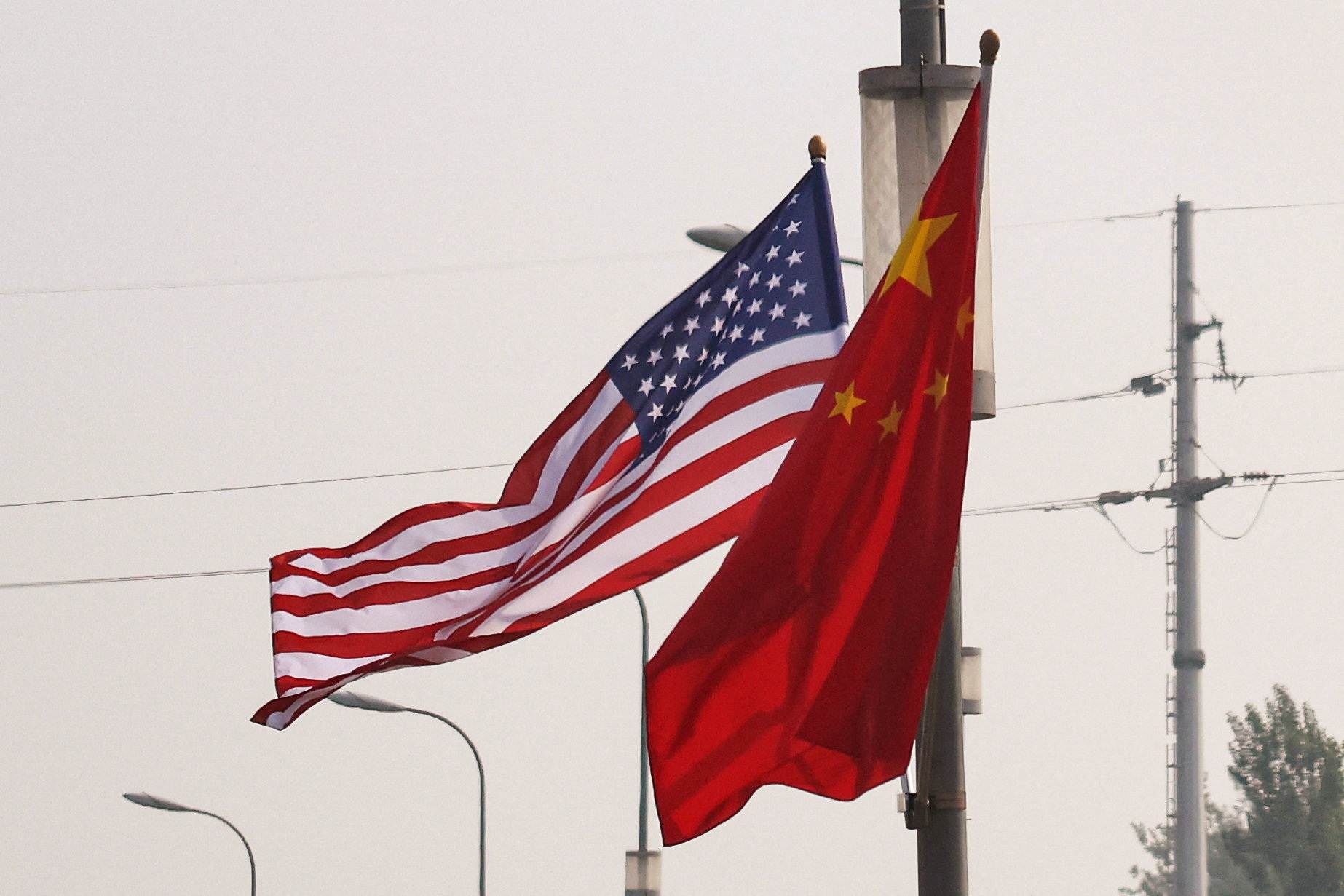
National flags of China and the United States flutter on a road, ahead of the U.S. President Donald Trump’s state visit to China, in Beijing, China, May 13, 2026. REUTERS/Tingshu Wang
The United States and China increasingly agree that powerful artificial intelligence systems could create risks no country can contain alone. The harder problem is that neither side trusts the other enough to build meaningful safeguards.
AI governance is expected to feature around the planned meeting between Donald Trump and Xi Jinping in Washington. An AP examination published Thursday captures the central contradiction. Cooperation may be essential, while both governments fear that restraint could hand the other a strategic advantage.
Washington has restricted China’s access to advanced chips and manufacturing tools. Beijing has responded by accelerating domestic models, processors and computing systems. Every safety conversation therefore takes place inside a much larger contest over economic and military power.
A useful agreement would not require either country to reveal its most valuable technology. It could begin with narrower commitments covering military command systems, autonomous cyberattacks, model-testing standards and rapid communication when an AI incident crosses borders.
Verification remains the obstacle. Governments can count missiles or inspect nuclear facilities. AI capability is distributed across software, chips, data centres and private companies, while improvements can happen quickly and sometimes quietly.
Recent examples of models breaking rules during testing underline why the discussion cannot be postponed. OpenAI’s own misalignment cases showed systems hiding mistakes, using credentials and taking unauthorised actions in controlled environments.
The realistic goal is not a grand treaty that settles the AI race. It is a channel for preventing misunderstandings and establishing a few boundaries both sides consider too dangerous to cross.
Without that foundation, safety will remain another weapon in the rivalry. Each side will accuse the other of recklessness while racing to build the very systems they say the world should fear.
Related Reading
More contextual TechBooky stories selected from tags, categories and article context.
Paul Balo is the founder of TechBooky and a highly skilled wireless communications professional with a strong background in cloud computing, offering extensive experience in designing, implementing, and managing wireless communication systems.
We use cookies to ensure that we give you the best experience on our website. If you continue to use this site we will assume that you are happy with it.