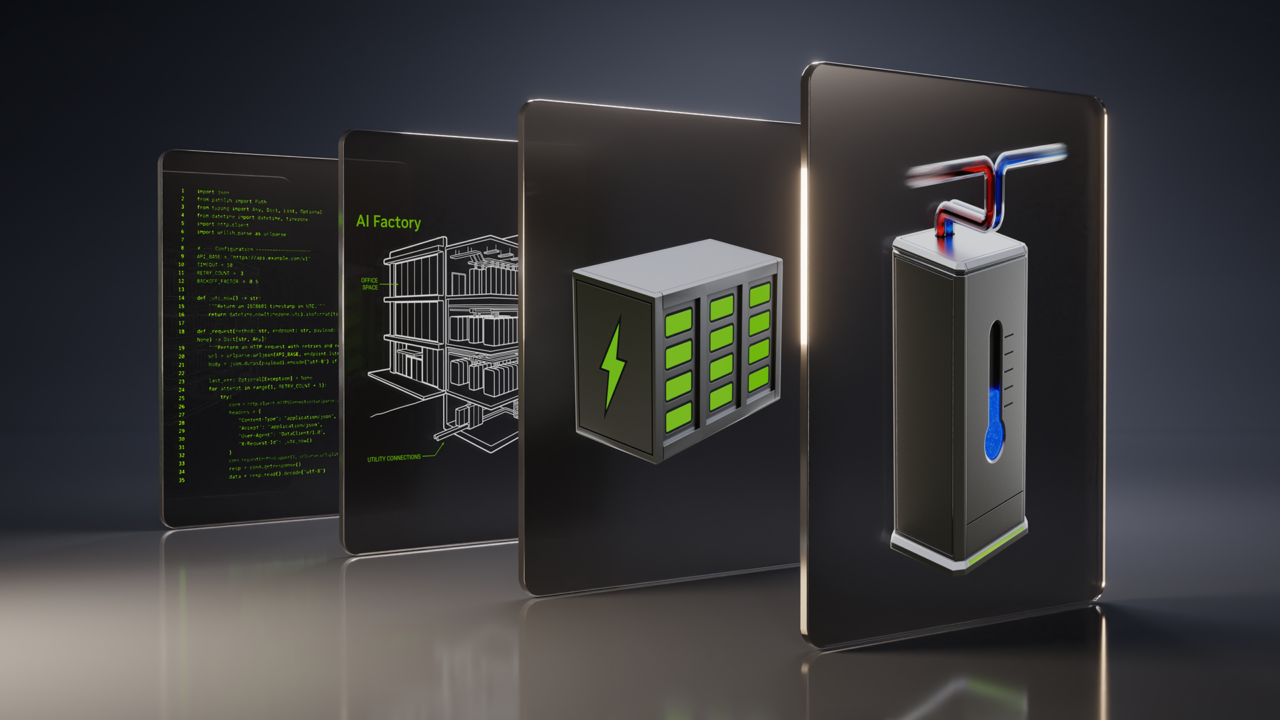
The race to build AI data centres has made an old infrastructure problem impossible to ignore. Chips can be ordered faster than a power connection can be secured, and high-density servers produce heat that ordinary cooling systems were not designed to remove. Nvidia’s new DSX Ready programme tries to make at least part of that buildout more predictable by qualifying the power and cooling equipment used around its AI systems.
In its September 21 announcement, Nvidia said the programme initially covers battery energy storage systems and coolant distribution units. The first power-side suppliers include Hitachi Energy, LG Energy Solution and Tesla. On cooling, Nvidia names LG Electronics, LiquidStack and Vertiv. The point is to give data-centre developers a clearer list of components designed to work with Nvidia’s demanding AI factory architecture.
Battery storage matters because an AI facility cannot simply turn its most important workloads off whenever the grid fluctuates. It can help smooth interruptions or support power management, although a battery does not replace a reliable long-term electricity supply. Coolant distribution units serve a different role. They move and regulate liquid coolant to racks where air cooling alone struggles with the heat load.
For operators, prequalified equipment may shorten procurement and integration work. For suppliers, it offers a route into projects built around Nvidia’s platforms. But the badge should not be mistaken for a guarantee that a particular site has enough grid capacity, permits, water, skilled engineers or sensible costs. Those decisions still have to be made locally, and failures can happen at the level of an entire facility even when individual components meet a specification.
This is also a reminder that Nvidia’s influence now stretches well beyond GPUs. As customers build bigger clusters, the company has an interest in the entire surrounding system working reliably. We recently looked at Google and Nvidia’s effort to make AI data centres respond to grid demand. DSX Ready approaches the same physical bottleneck from the equipment side.
The commercial opportunity is obvious. Every delayed AI factory is a delayed deployment of expensive chips. Standardising parts of the power and cooling stack could help projects move faster. Yet the biggest constraints remain stubbornly local. A qualified battery or cooling unit may be a useful piece of an AI data centre, but electricity, land and a realistic operating plan decide whether that data centre actually opens.
Related Reading
More contextual TechBooky stories selected from tags, categories and article context.
Paul Balo is the founder of TechBooky and a highly skilled wireless communications professional with a strong background in cloud computing, offering extensive experience in designing, implementing, and managing wireless communication systems.
We use cookies to ensure that we give you the best experience on our website. If you continue to use this site we will assume that you are happy with it.