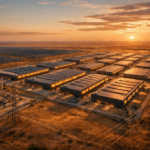
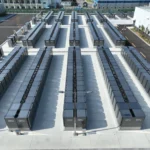
The AI infrastructure boom is starting to look less like ordinary real-estate development and more like a tightly woven financial machine. The latest example is SB Energy, the SoftBank-backed power and data-centre developer tied to OpenAI’s future compute needs.
The Wall Street Journal reports, based on draft IPO documents it reviewed, that OpenAI was issued warrants in SB Energy worth an estimated $5.5 billion. Reuters could not independently verify the report, but the detail is striking because it shows how far AI companies and infrastructure providers are willing to go to secure tenants, power and capital.
The basic idea is simple. SB Energy wants to build massive AI data-centre capacity. OpenAI needs enormous compute. Nvidia wants its systems deployed at scale. SoftBank wants a larger role in the AI economy. Warrants, leases, investments, guarantees and software commitments then become the glue holding the arrangement together.
Nvidia has already confirmed a major piece of the story. In August, the chipmaker said it would invest $1.5 billion in SB Energy and support the PORTS-Pike Technology Campus in Ohio, where OpenAI is expected to be the customer for 8 IT-GW of AI capacity under a 20-year lease. Nvidia said the project is designed to host Nvidia AI compute exclusively.
That is not a normal landlord-tenant relationship. It is AI industrial policy, corporate finance and compute strategy in one package. The customer is also an investor. The chip supplier is also a financial backer. The power and data-centre developer is preparing for an IPO while leaning heavily on future OpenAI demand.
This is why the word circular keeps appearing around AI finance. If Nvidia invests in infrastructure that hosts Nvidia systems for OpenAI, and OpenAI receives valuable warrants from the infrastructure company it will use, investors have to ask how much of the demand is pure end-user demand and how much is being accelerated by financial engineering.
That does not mean the demand is fake. OpenAI genuinely needs compute. Nvidia’s latest earnings show that AI infrastructure spending is still enormous. But circular structures can make the market harder to read. Money, guarantees and strategic investments can help capacity get built faster, but they can also obscure where the risk ultimately sits.
The risk is simple: if AI revenue grows fast enough, these deals will look visionary. If AI revenue disappoints, the same structures could look fragile. Long leases, power commitments, warrant liabilities, debt financing and hardware concentration can become a problem if utilization falls short or if model costs decline in ways that change compute demand.
For investors, this makes SB Energy’s reported IPO particularly interesting. A company with little operating data-centre history but huge contracts and strategic backers may attract high valuations. It may also face tough questions about concentration risk, power delivery, construction timelines, OpenAI dependency and the true economics of AI factories.
For the wider industry, the lesson is that AI is now being financed like infrastructure. The bottleneck is no longer only model talent or software. It is land, power, chips, cooling, grid connections and long-term capital. That is why AI cloud deals, African sovereign AI cloud projects and Nvidia’s own financing moves all belong to the same story.
The uncomfortable question is whether this is sustainable. AI companies are racing to build capacity before demand is fully proven at the consumer and enterprise revenue level. That can work if AI becomes the next universal computing layer. It can fail if the industry overbuilds before customers are willing to pay enough to support the capital stack.
OpenAI, SoftBank, Nvidia and SB Energy may be building the next generation of industrial infrastructure. They may also be showing how much financial creativity is needed to keep the AI boom moving. Either way, this is the part of the AI race that readers should watch closely: not the chatbot interface, but the contracts and incentives underneath it.
Related Reading
More contextual TechBooky stories selected from tags, categories and article context.
Paul Femi Balo is the founder and publisher of TechBooky. He covers artificial intelligence, African technology, digital infrastructure, enterprise technology and the global digital economy.
We use cookies to ensure that we give you the best experience on our website. If you continue to use this site we will assume that you are happy with it.