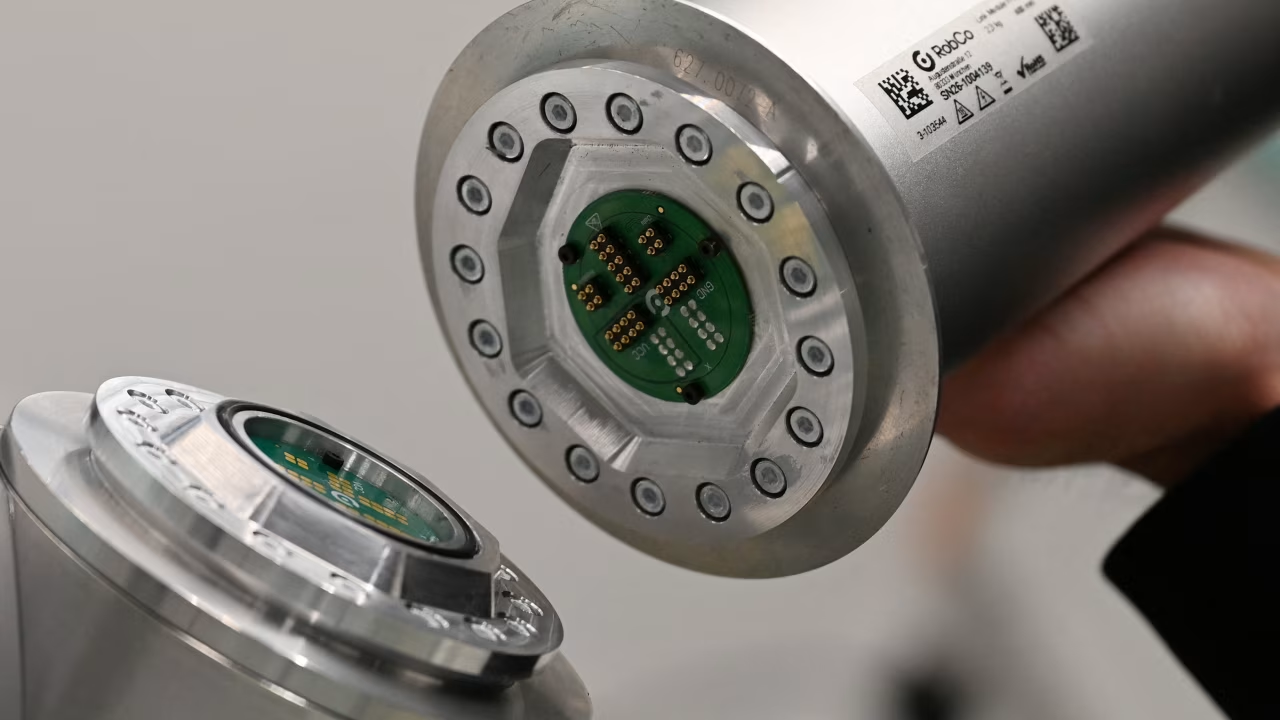
RobCo has joined the billion-dollar startup club, but its announcement is about more than a valuation. The Munich-founded robotics company says a transaction combining new investment with a sale of existing employee shares has valued it above $1 billion. Long-serving staff can realise some of the value they helped create while the business brings in money for its next phase.
According to RobCo’s October 5 announcement, the valuation has doubled in nine months. Existing backers including Sequoia, Lightspeed, Greenfield, Kindred, Lingotto and Promus Ventures participated, alongside new investors Cherry Ventures and European Tech Collective. RobCo did not disclose the transaction size or the price paid for individual employee shares, so the headline valuation should not be mistaken for a $1 billion cash raise.
That distinction matters. A secondary sale puts proceeds in the hands of shareholders selling stock, whereas a primary investment funds the company itself. RobCo says this deal does both. For employees who have held shares through years of product development, liquidity can be meaningful even before an IPO or outright sale. For investors, the deal is a bet that industrial AI will become more valuable as robots move beyond repetitive factory routines.
RobCo builds automation systems for manufacturers dealing with labour shortages, cost pressure and workplace safety. Its next product, Alfie, is designed to handle variable, unstructured tasks that have been hard to automate with conventional equipment. The company describes a system combining perception, reasoning and physical execution, rather than a machine programmed to repeat only one fixed motion.
Alfie is not yet a broadly available commercial product. RobCo says it will launch the robot at its first RobCoN summit in Munich on March 4, 2027. Until then, the more important question is how reliably it can work across different factories, tasks and safety conditions. A compelling demonstration is one thing; repeatable deployment at a price manufacturers can justify is another.
The company is also leaning further into the United States, which it calls its fastest-growing market. It says customers now operate across more than a dozen states, with manufacturing and assembly in Austin and a lab in San Francisco. Co-founder and chief executive Roman Holzl has relocated to the US to lead that expansion. RobCo was founded in Munich in 2020, so the move is a sign of where it sees near-term demand, not an abandonment of its European base.
Physical AI is attracting capital because the potential market extends well beyond chatbots and software subscriptions. Other robotics-focused AI companies have also drawn billion-dollar-scale investor interest. Yet the economics of hardware are less forgiving than those of a digital service: deployment, maintenance, training and safety all have to work in the real world.
RobCo’s new valuation gives it momentum and rewards some of the people who built it. The harder milestone lies ahead. If Alfie can perform useful work reliably in messy industrial settings, the company will have something more durable than unicorn status. If it cannot, a large valuation alone will not automate a factory.
Related Reading
More contextual TechBooky stories selected from tags, categories and article context.
Paul Balo is the founder of TechBooky and a highly skilled wireless communications professional with a strong background in cloud computing, offering extensive experience in designing, implementing, and managing wireless communication systems.
We use cookies to ensure that we give you the best experience on our website. If you continue to use this site we will assume that you are happy with it.