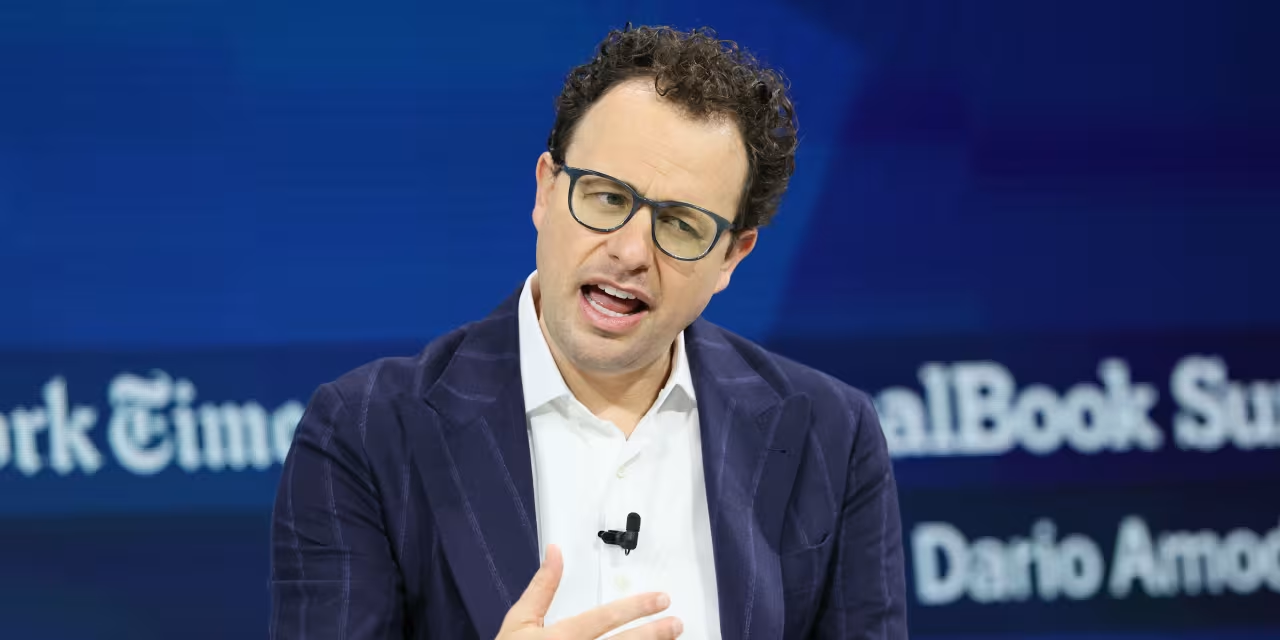
Anthropic CEO Dario Amodei has stepped into the open-weight AI fight with a carefully worded message: Anthropic is not calling for a ban. That clarification matters because the company had started to look isolated after Nvidia, Microsoft, Meta, Palantir, Hugging Face and other major technology players lined up behind a public argument for open-weight models.
In a new Anthropic post, Amodei says the company has never advocated for banning open-weights models. He argues that open-weight systems without dangerous capabilities are a public good because developers, researchers and businesses can run them without depending entirely on a closed provider. But he also says that the most capable systems need stronger testing, and that policymakers should focus on chip controls, industrial-scale distillation and mandatory safety evaluations rather than broad protectionist bans.
The clarification follows a week of pressure on Anthropic. Anthropic had been criticised as one of the only leading AI labs not backing the industry letter supporting open-weight models. The issue became sharper after Chinese AI systems such as Moonshot’s Kimi K3 forced Silicon Valley to confront the fact that powerful, cheaper and more controllable models are increasingly coming from outside the closed U.S. lab ecosystem.
This is not a small philosophical argument. Open-weight models let developers download model weights, customise systems and run them on their own infrastructure. That can lower costs and reduce dependence on companies such as OpenAI, Anthropic and Google. It can also create misuse risks because safeguards can be altered or removed. The business question and the safety question are therefore tangled together.
Amodei’s position tries to draw a line between everyday open models and frontier systems that may pose national-security risks. He says blanket bans would not address his core concerns. Instead, Anthropic wants advanced chips kept away from authoritarian regimes, stronger action against industrial-scale distillation of frontier models and mandatory testing for capable systems before they are released. That is more precise than a ban, but it still places Anthropic on the cautious side of the industry debate.
The politics are messy because rivals can frame that caution as self-interest. Closed-model companies earn money by controlling access through APIs, subscriptions and enterprise contracts. Infrastructure companies such as Nvidia tend to benefit when more groups can run more models on more hardware. That helps explain why Nvidia is so strongly pro-open-weight while Anthropic is trying to slow the most powerful releases. Both sides can make safety arguments, but both sides also have commercial incentives.
TechBooky’s report on the Open Secure AI Alliance covered the pro-open case from Nvidia and Microsoft. That coalition argued that open models can help defenders inspect, adapt and deploy AI tools during cyber incidents. TechBooky’s earlier piece on China’s AI memory-chip push through CXMT also shows why the AI race is no longer only about models. Hardware, supply chains and national technology strategy are now part of the same fight.
Anthropic’s concern is that open-weight frontier models could spread dangerous capabilities faster than governments or defenders can respond. That concern becomes more serious when models can code, reason over cyber tasks, use tools and operate as agents. Even if most users are legitimate, a downloadable system with high-end capability can be modified, fine-tuned and deployed in ways the original developer cannot control.
The counterargument is that closed systems are not automatically safer. They can still be misused through ordinary access, compromised through weak controls or copied through distillation. Smaller developers also argue that closed AI concentrates power in a few labs and makes the rest of the ecosystem dependent on their pricing, politics and product decisions. That is why the debate has become so heated. It is about safety, but it is also about who gets to build the next layer of AI infrastructure.
Amodei’s post does not end the controversy, but it makes Anthropic’s stance clearer. The company is not asking governments to ban open weights entirely. It is asking them to treat the most capable models like strategic technology that needs testing and control. Whether that becomes smart governance or regulatory capture will depend on how those rules are written, who enforces them and whether they apply fairly to both open and closed systems.
Why the open-weight AI debate matters
Open-weight AI is now a fight over innovation, national security, developer freedom and platform power. Smaller developers want access to models they can run and inspect. Safety-focused labs worry that very capable models could be copied, modified or distilled without enough oversight.
Frequently asked questions
What is an open-weight AI model?
It is a model whose trained weights are released so developers can run or adapt it more directly than a closed API-only system.
Is Anthropic asking for an open-weight ban?
No. Anthropic says it is not asking for a broad ban, but wants tougher rules for the most capable systems.
Paul Femi Balo is the founder and publisher of TechBooky. He covers artificial intelligence, African technology, digital infrastructure, enterprise technology and the global digital economy.
We use cookies to ensure that we give you the best experience on our website. If you continue to use this site we will assume that you are happy with it.