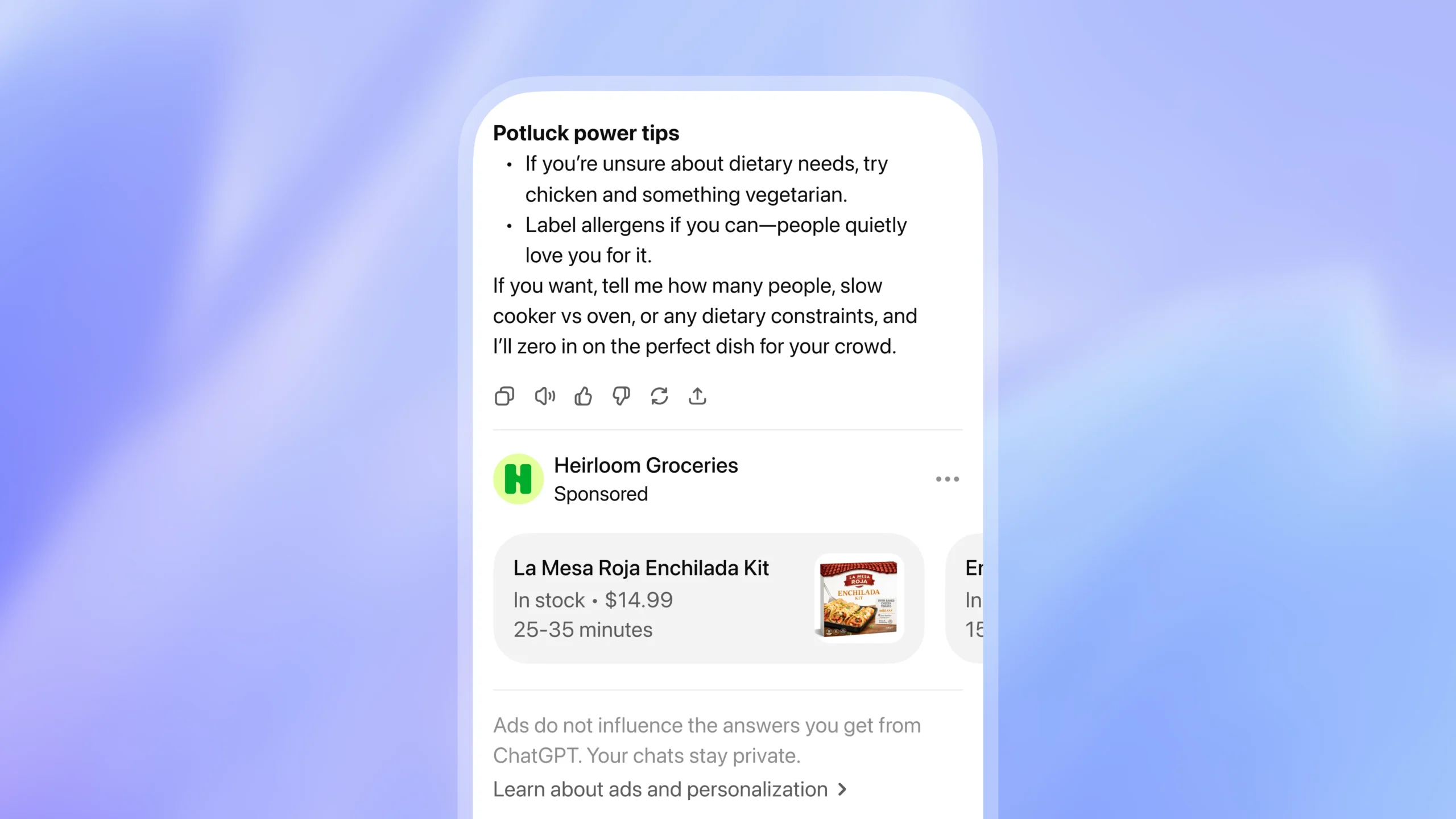
ChatGPT is no longer only a subscription product, an enterprise tool or an API gateway. OpenAI says ChatGPT Ads has reached $1 billion in annualized revenue run rate less than 200 days after launch, turning advertising into a serious new pillar of the company.
That number matters because OpenAI has spent years trying to answer one hard business question: how do you pay for frontier AI at global scale without making the product too expensive for ordinary users? Ads now look like one answer.
According to OpenAI, ChatGPT Ads is used by tens of thousands of advertisers and is expanding globally. Starting today, advertisers can buy ChatGPT ads directly through Ads Manager across India, Europe, the Middle East and North Africa. That pushes the product beyond a U.S.-led test and into a much broader commercial market.
This builds on the European expansion that moved ChatGPT Ads into 31 European markets last week. At the time, the bigger point was that OpenAI was quietly becoming a media company inside an AI assistant. The $1 billion run rate now makes that point harder to ignore.
The pitch is simple. People come to ChatGPT with intent. They are choosing software, planning trips, comparing products, learning skills, looking for jobs or trying to make business decisions. In old internet advertising, intent lived mostly in search boxes. In the AI era, it may increasingly live inside conversations.
That is why ChatGPT ads could become valuable quickly. A search ad catches a user at the moment they type a query. A ChatGPT ad may catch the user while they are framing the problem, comparing options and moving toward a decision. For advertisers, that is a very tempting place to appear.
OpenAI is also trying to reassure users that the model and the ad system remain separate. Its ads help page says ads appear below responses, are clearly labelled, do not influence answers and do not give advertisers access to private conversations, chat history, memories or personal details.
Those assurances are important because the trust issue is bigger in AI than it is in normal search or social media. If a user believes a ChatGPT answer is being shaped by an advertiser, the product becomes less useful. OpenAI’s advertising principles therefore put answer independence, conversation privacy and user control at the centre of the rollout.
Still, this is a delicate line. OpenAI says ads are separate from answers, but the company also says the ad system can use the context of the current conversation and, depending on country and settings, broader ChatGPT activity to make ads more relevant. That is where regulators, users and privacy advocates will pay close attention.
There is also a strategic reason OpenAI needs this to work. Building and running frontier models is extremely expensive. Subscriptions, enterprise deals and API usage are strong revenue lines, but consumer AI usage can be costly, especially when hundreds of millions of people expect powerful tools to remain free or cheap.
That connects to the wider company story. OpenAI has been moving like a company preparing for public markets, from product expansion to leadership changes and commercial discipline. Recent signs around OpenAI moving into IPO mode make the ad business look less like an experiment and more like part of the financial architecture investors will eventually judge.
For users, the practical question is whether the ads feel helpful or intrusive. OpenAI says paid plans such as Plus, Pro, Business and Enterprise remain ad-free, while the free and low-cost Go tiers carry the ad experience in supported markets. There is also a free ads-free option, but with lower usage limits.
That trade-off is the real story. OpenAI is effectively saying users can pay with money, limits or attention. That is not new on the internet, but it feels different inside an AI assistant because people use ChatGPT for more personal, complex and decision-heavy tasks than they use many traditional ad-supported services.
The opportunity for OpenAI is massive. If ChatGPT becomes a place where shopping, software discovery, travel planning, hiring, education and business research begin, ads could become one of the most profitable parts of the company. CNBC also highlighted the broader revenue angle, but the official numbers already show that this is no longer theoretical.
The risk is just as clear. The more OpenAI depends on ads, the more it must prove that ChatGPT’s answers are still independent and that user trust is not being quietly converted into ad inventory. If it gets that balance right, ChatGPT Ads could help fund broader access to AI. If it gets it wrong, the world’s most important chatbot may start to feel like the old internet with a smarter interface.
Related Reading
More contextual TechBooky stories selected from tags, categories and article context.
Paul Balo is the founder of TechBooky and a highly skilled wireless communications professional with a strong background in cloud computing, offering extensive experience in designing, implementing, and managing wireless communication systems.
We use cookies to ensure that we give you the best experience on our website. If you continue to use this site we will assume that you are happy with it.