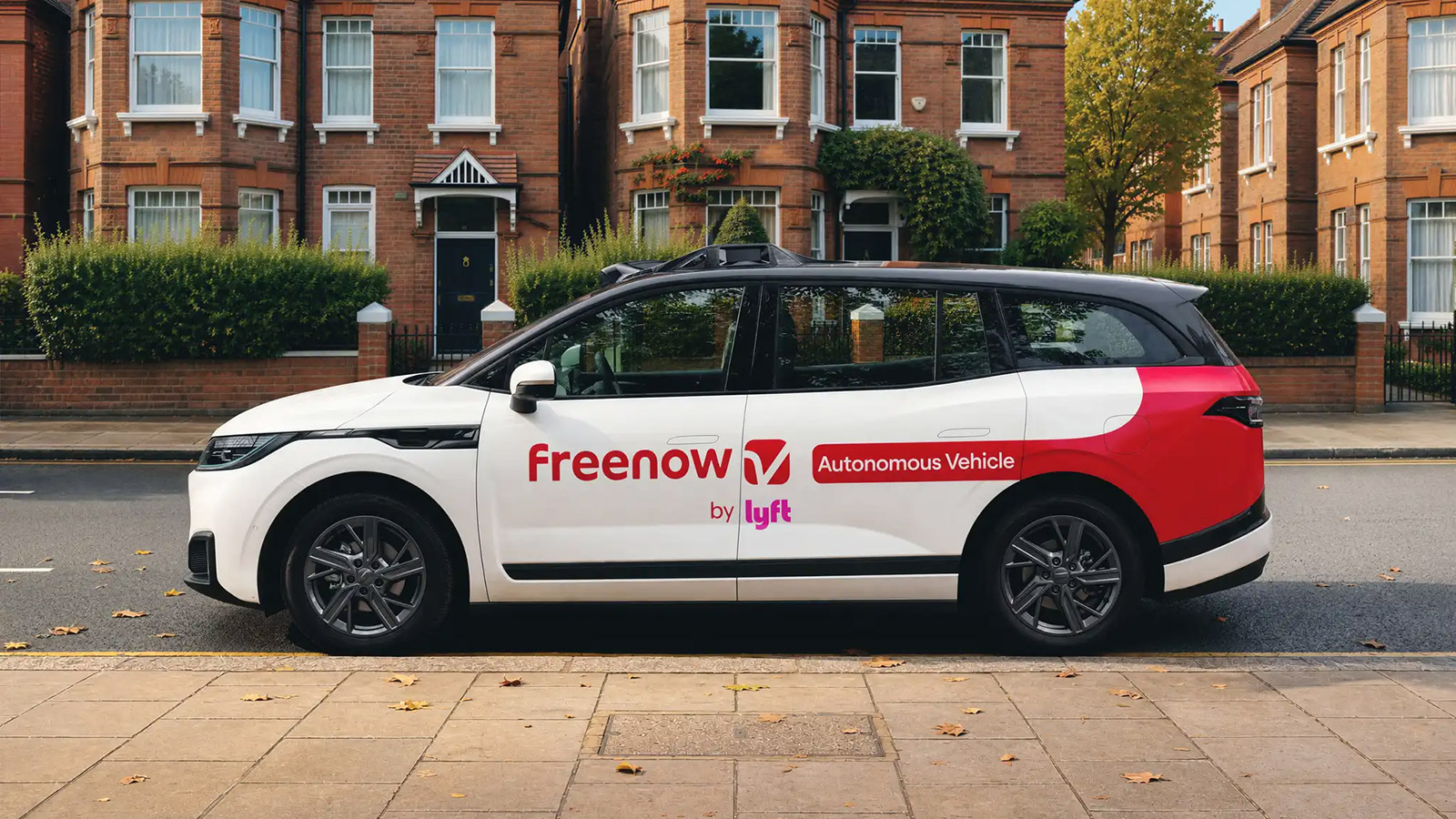
London’s robotaxi race is getting more crowded. Baidu has started testing autonomous vehicles in the UK capital through its partnership with Lyft and Freenow, putting one of China’s strongest self-driving platforms into a European market that is already attracting Uber, Waymo, Wayve and other autonomous-vehicle players.
Baidu’s Apollo Go RT6 vehicles are now being tested in London with safety drivers onboard. Lyft will use Freenow, the German taxi and mobility app it acquired, to handle the local booking layer when public rides begin. The companies expect members of the public to reserve rides sometime in 2027 if testing and regulatory approvals move as planned.
The partnership is a useful shortcut for both sides. Baidu brings the autonomous-driving technology. Lyft brings a transport network and, through Freenow, a European taxi footprint. That matters because robotaxis do not win only by having good software. They need local licensing, fleet operations, maintenance, charging, cleaning, insurance, mapping, customer support and a way for people to actually book rides.
London is also a serious test market. It has dense traffic, older roads, cyclists, buses, delivery vans, roundabouts, weather and complicated street behaviour. A robotaxi system that can operate reliably there has a stronger claim to being ready for Europe than one that only works in cleaner, wider or more predictable urban environments. It also gives Baidu a chance to prove that Chinese autonomous technology can travel outside China at a time when Chinese EVs and software platforms are under closer political scrutiny.
This is why the story is bigger than one test fleet. Robotaxis are becoming another front in the global technology rivalry. Waymo has built a lead in several U.S. cities. Tesla is still trying to prove its camera-heavy robotaxi approach can scale safely. Uber is partnering rather than building everything itself. Baidu’s move into London shows that Chinese AV companies want to be part of the Western mobility market too, not only domestic deployments.
TechBooky’s earlier report on SpaceX and Starlink’s public-market pressure touched on a wider point that applies here as well: transport technology becomes much harder when it moves from demo to real operating system. The same is true for robotaxis. A few smooth rides are not enough. The business has to work at fleet scale, under regulation, with normal passengers and normal city messiness.
The London tests will not immediately change how people move around the city. Safety drivers are still involved, and commercial service is still expected next year at the earliest. But it is an important signal. Europe is becoming a battleground for robotaxi partnerships, and Baidu is no longer watching from the sidelines. If the tests go well, London could become one of the places where the next phase of autonomous transport becomes visible to everyday users.
Related Reading
More contextual TechBooky stories selected from tags, categories and article context.
Paul Balo is the founder of TechBooky and a highly skilled wireless communications professional with a strong background in cloud computing, offering extensive experience in designing, implementing, and managing wireless communication systems.
We use cookies to ensure that we give you the best experience on our website. If you continue to use this site we will assume that you are happy with it.