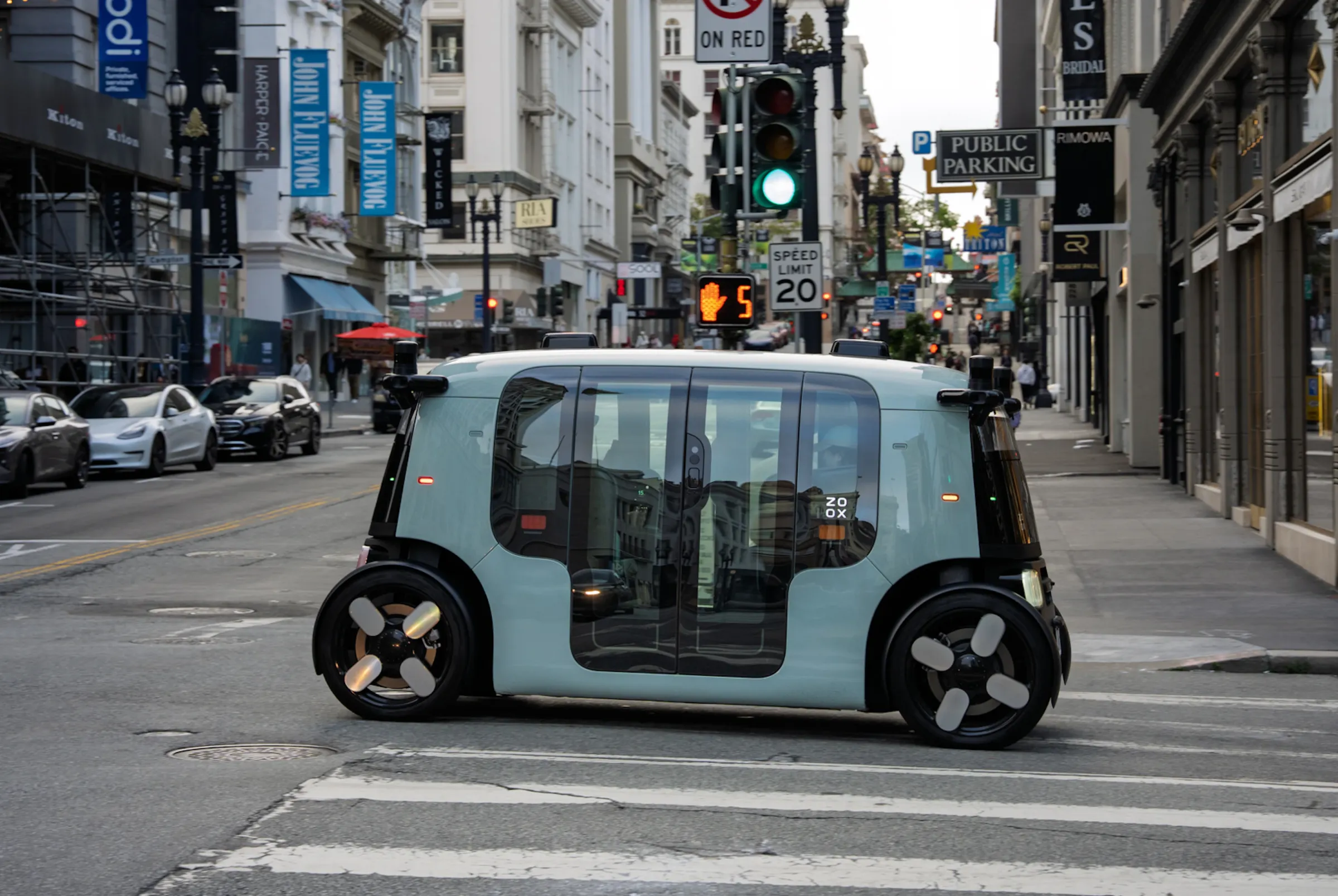
Zoox has moved closer to becoming one of the most unusual robotaxi companies on American roads because it is not just trying to remove the driver. It is also trying to remove the steering wheel, pedals and the traditional car layout entirely.
The Amazon-owned company has received a key US regulatory exemption that allows it to operate its purpose-built autonomous vehicles commercially, according to TechCrunch and The Verge. The decision clears Zoox to begin charging for rides in vehicles designed from the ground up for autonomy, rather than retrofitted from a normal passenger car.
That detail is what makes the story important. Waymo, Tesla, Baidu, Lyft partners and most other autonomous driving projects still work with vehicles that look familiar, even when the software is doing the driving. Zoox has built a small, symmetrical robotaxi with inward-facing seats and no manual driving controls. It is closer to a moving shuttle than a car with a hidden driver.
The US National Highway Traffic Safety Administration has been cautious about vehicles that do not fit older safety rules written for human drivers. Those rules assume basics like a steering wheel, pedals and a driver-facing seat. Zoox needed an exemption because its vehicle does not match that template. The approval suggests regulators are willing to make room for new designs, but only inside controlled limits.
That controlled approach matters. The exemption does not mean Zoox can flood every US city with robotaxis overnight. It allows the company to move into commercial service under specific conditions and reporting requirements. TechCrunch says the approval could cover up to 2,500 vehicles per year for two years, which is enough to build a real service but still small enough for regulators to monitor closely.
Zoox has already been testing in markets including Las Vegas and parts of California, and Las Vegas is widely expected to be one of the first cities where paid rides become available. That makes sense. The city has dense tourist movement, repeated routes, heavy ride-hailing demand and a public that is already used to trying new mobility services. If a driverless, steering-wheel-free taxi can feel normal anywhere first, Las Vegas is a strong candidate.
The timing is also interesting because the robotaxi race has become more crowded and more controversial. Lyft and Baidu are preparing robotaxi tests in London, while Tesla is trying to convince investors that its own robotaxi plans can become a major business line. At the same time, safety questions remain central, especially after recent claims that Tesla robotaxis became rolling hazards during testing.
Zoox will face the same basic challenge as everyone else. The technology has to work in the messy reality of public roads, not only in demos. It must handle pedestrians, cyclists, delivery vehicles, emergency responders, construction zones and bad human driving. A purpose-built vehicle may help with passenger experience, visibility and redundancy, but it does not remove the need for extremely reliable autonomous decision-making.
There is also a business question. Robotaxis are expensive to build and operate before they reach scale. Companies need vehicles, sensors, remote support, mapping, insurance, maintenance depots and city-level operations. Amazon can give Zoox patience and capital, but the service still has to prove that it can operate safely and eventually make economic sense against Uber, Lyft, taxis and public transport.
Even with those caveats, this is a meaningful step. Zoox is no longer only a futuristic Amazon side project. It now has a clearer path to paid rides with a vehicle that looks different from almost everything else on the road. If passengers accept it and regulators remain comfortable, the robotaxi market may soon have a serious new shape, not just another driverless version of the old car.
Related Reading
More contextual TechBooky stories selected from tags, categories and article context.
Paul Balo is the founder of TechBooky and a highly skilled wireless communications professional with a strong background in cloud computing, offering extensive experience in designing, implementing, and managing wireless communication systems.
We use cookies to ensure that we give you the best experience on our website. If you continue to use this site we will assume that you are happy with it.