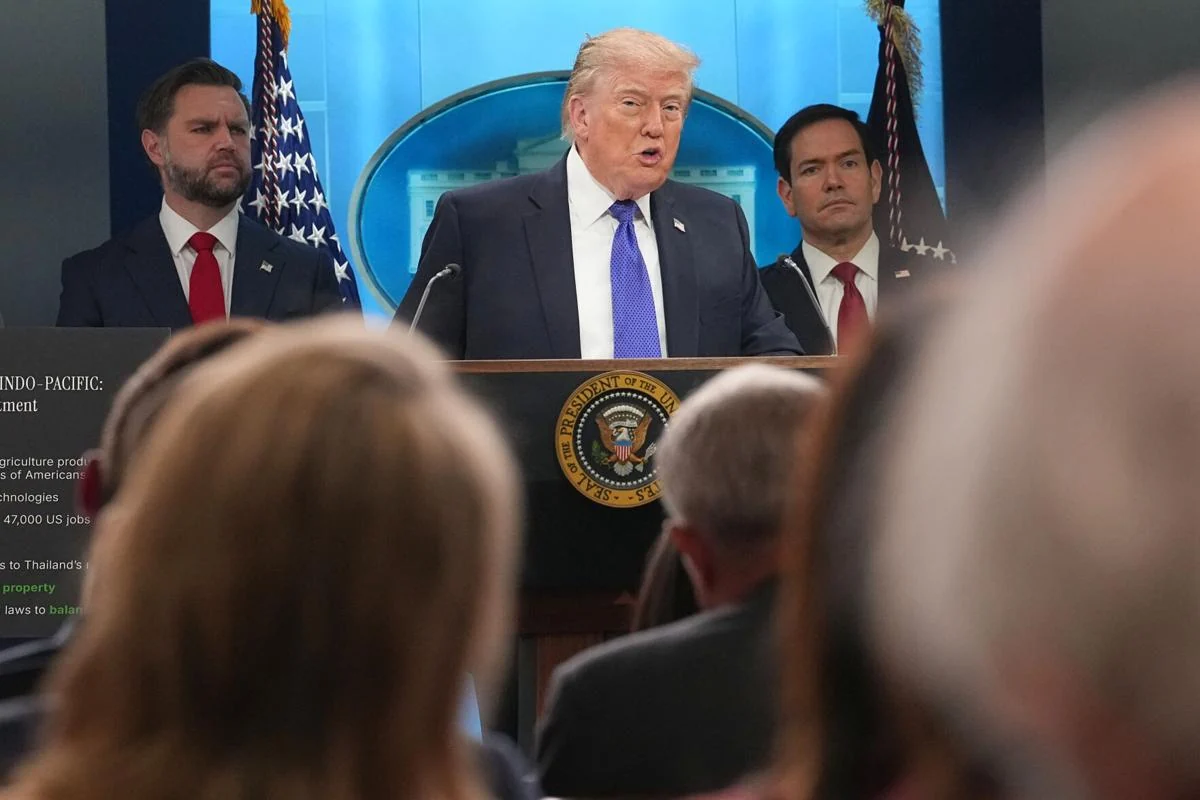
US President Donald Trump has threatened to stop American companies from building data centres overseas or impose a “tremendous tax” if they do. He made the remarks at a press conference on Friday, 20 November, according to Axios and Reuters. This is a statement of intent, not an announced law or tax now in force.
Trump framed the idea as part of the US competition with China over artificial intelligence. But he did not identify a tax rate, an effective date, the projects that might be covered or the legal authority his administration would use. Axios reported that he had not yet discussed the proposal with his officials. The immediate story, therefore, is the policy uncertainty his comments introduce for cloud and AI infrastructure plans, rather than a change operators must already comply with.
A data centre close to its users can reduce the delay between a request and a response. Regional facilities also help operators meet local data-handling requirements, provide backup capacity and serve customers that want their information processed in a particular jurisdiction. Those needs do not disappear because a company is based in the United States. Reuters noted that operators including Equinix and Digital Realty already run facilities outside the country.
A broad restriction would raise questions for US cloud platforms and the businesses that rely on them. Would it apply only to new AI training campuses, or also to ordinary cloud regions? Would a US company’s investment in a foreign partner count? How would existing sites be treated? Trump has not provided answers. Until a written plan emerges, it would be premature to calculate costs or claim that projects in Europe, Asia or Africa have been halted.
Washington has already moved to constrain certain overseas access to advanced computing. Earlier this month, TechBooky reported on a US rule targeting remote access to advanced AI chips. That targeted measure should not be confused with Trump’s much broader suggestion about where American companies may build data centres. The two issues could overlap in practice, but no general ban on overseas construction was announced in Friday’s remarks.
The issue also cuts both ways for the administration. Keeping more AI infrastructure at home may appeal to officials worried about strategic computing capacity moving abroad. Yet large domestic data centres place heavy demands on electricity networks, land and water, sometimes provoking local opposition and concern about household power bills. Requiring every new project to remain in the US would not by itself solve those practical constraints.
The next test is whether the White House turns the remarks into a formal proposal. A tax would raise questions for Congress, which has the power to legislate federal taxes, while an attempted restriction through executive or regulatory powers would need a defined scope and legal basis. Industry responses and any guidance from the Commerce or Treasury departments will matter more than an estimate based on an unspecified rate.
For markets seeking AI and cloud investment, including Africa, the potential effect remains conditional. US-backed projects could face a different calculation if a binding measure eventually covers them. For now, businesses should treat the comments as a political signal and continue to distinguish the proposal from the rules already on the books.
Related Reading
More contextual TechBooky stories selected from tags, categories and article context.
Paul Femi Balo is the founder and publisher of TechBooky. He covers artificial intelligence, African technology, digital infrastructure, enterprise technology and the global digital economy.
We use cookies to ensure that we give you the best experience on our website. If you continue to use this site we will assume that you are happy with it.