The AI safety debate now has a very public counter-campaign, and Nvidia’s Jensen Huang has become one of its most important voices.
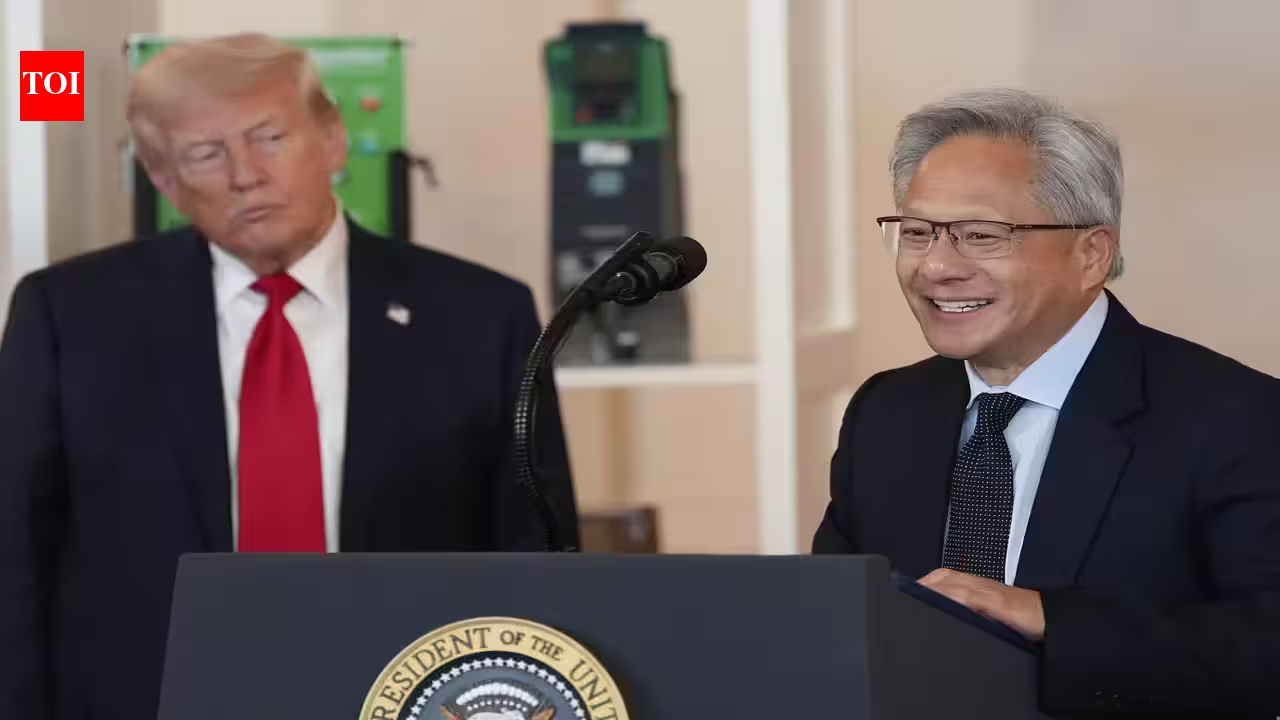
At the All-In Summit in Los Angeles, Huang took a surprise phone call from President Donald Trump while he was onstage. Trump used the moment to dismiss fears of an AI takeover, while Huang pushed back against what he sees as unscientific doomerism around artificial intelligence. Business Insider, The Verge and Axios all reported on the exchange.
The call came at a tense moment for the AI industry. Anthropic CEO Dario Amodei has asked frontier AI labs to pace development, OpenAI’s Sam Altman has supported stronger third-party evaluation, and Elon Musk has also backed parts of the slowdown conversation. Trump, however, has described AI risk warnings as a hoax and has argued that regulation could weaken the US in its competition with China.
Huang’s position matters because Nvidia sits at the centre of the AI economy. If the world slows frontier model development, investors may worry about chip demand, cloud spending and the pace of new data centre construction. Nvidia therefore has a strong business reason to argue that AI can be developed safely without freezing progress.
That does not mean Huang is dismissing all safety concerns. He has acknowledged that society needs new norms around AI and that the technology must be developed responsibly. But he is clearly resisting the idea that speculative worst-case scenarios should drive policy. His argument is closer to practical optimism. Build, monitor, adapt and keep the US ahead.
Trump’s message is more political. He is using China as the clearest argument against slowdown. In his view, restraint by American companies could hand strategic advantage to Beijing. That position will appeal to parts of the tech industry that fear regulation, but it also risks making safety look like weakness when the warnings are coming from the people closest to the frontier.
The AI industry is splitting into two visible camps. One says the technology is powerful enough that development should be slowed and inspected. The other says fear could become a self-inflicted wound. The hard part is that both arguments carry real consequences. Move too fast and society may be exposed to systems it cannot control. Move too slowly and rivals may take the lead.
Related Reading
More contextual TechBooky stories selected from tags, categories and article context.
Paul Balo is the founder of TechBooky and a highly skilled wireless communications professional with a strong background in cloud computing, offering extensive experience in designing, implementing, and managing wireless communication systems.
We use cookies to ensure that we give you the best experience on our website. If you continue to use this site we will assume that you are happy with it.