TechBooky AI Assistant
👋 Welcome to TechBooky AI Assistant

I can help with:
🔎 Tech News
🤖 AI Topics
💻 Gadgets
☁️ Cloud
✍️ Guest Posts
📢 Advertising
🔗 Backlinks
📩 Newsletter
  • AI Search
  • Cryptocurrency
  • Earnings
  • Enterprise
  • About TechBooky
  • Submit Article
  • Advertise With TechBooky
  • Contact Us
  • Data Intelligence
TechBooky
  • African
  • AI
  • Metaverse
  • Gadgets
  • Data Intelligence
  • AI Search
Generic selectors
Exact matches only
Search in title
Search in content
Post Type Selectors
Search in posts
Search in pages
  • African
  • AI
  • Metaverse
  • Gadgets
  • Data Intelligence
  • AI Search
Generic selectors
Exact matches only
Search in title
Search in content
Post Type Selectors
Search in posts
Search in pages
TechBooky
Generic selectors
Exact matches only
Search in title
Search in content
Post Type Selectors
Search in posts
Search in pages
Home Artificial Intelligence

AI Weapons Talks End Without Binding Rules as Geneva Misses Treaty Mandate

Paul Femi Balo by Paul Femi Balo
November 22, 2026
in Artificial Intelligence, Government, Policy
Share on FacebookShare on Twitter
Share this story

Send it to someone who should read it.

f Facebook X X in LinkedIn wa WhatsApp tg Telegram @ Email

In Brief
  • Governments have ended a major round of talks in Geneva without agreeing to begin negotiations on binding rules for autonomous weapons.
  • The outcome leaves a widening gap between the speed at which militaries are developing systems that can select and attack targets and the pace of international...
  • In a 21 November statement, the International Committee of the Red Cross (ICRC) urged states to establish legally binding limits.

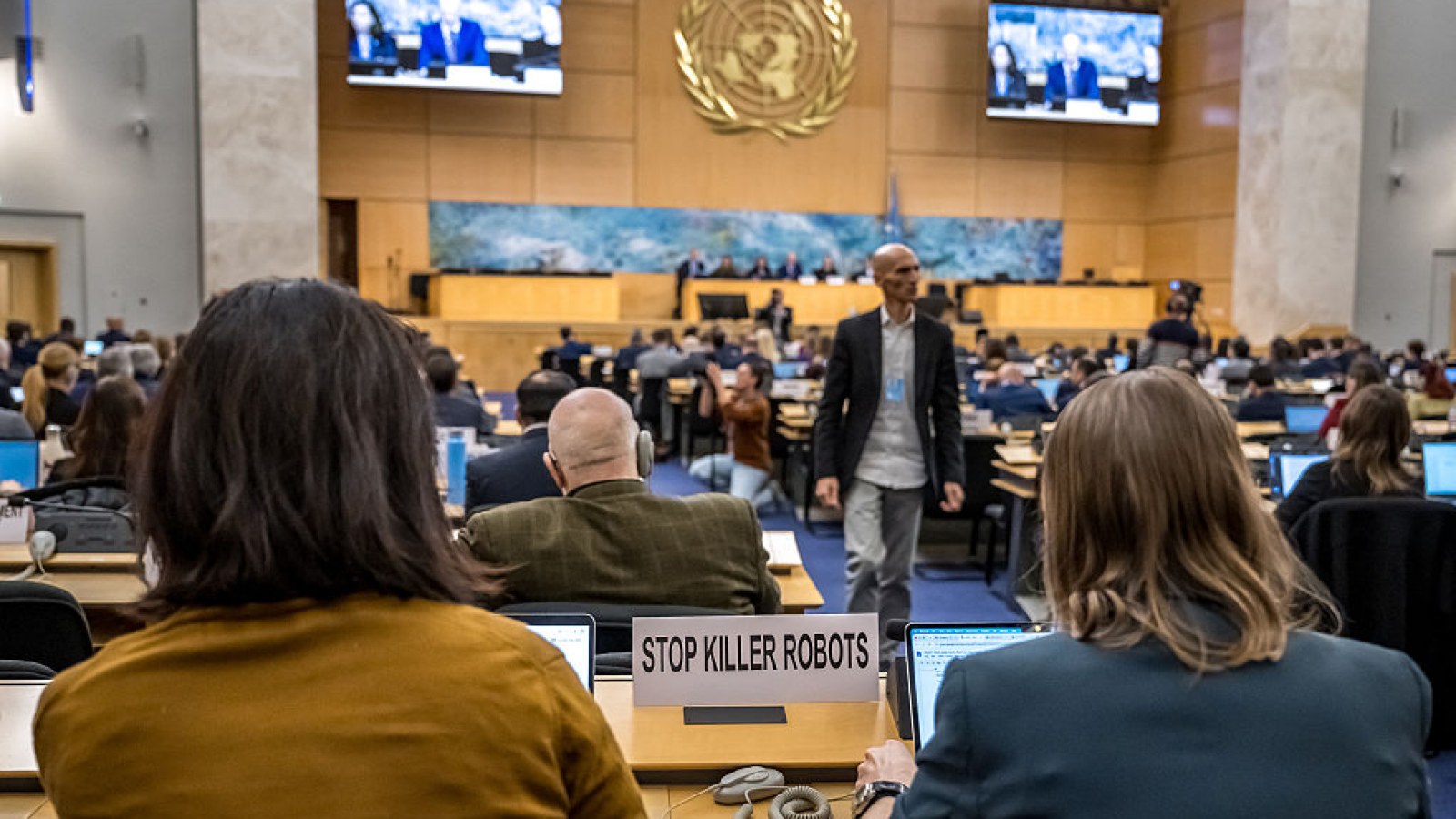
Governments have ended a major round of talks in Geneva without agreeing to begin negotiations on binding rules for autonomous weapons. The outcome leaves a widening gap between the speed at which militaries are developing systems that can select and attack targets and the pace of international diplomacy.

In a 21 November statement, the International Committee of the Red Cross (ICRC) urged states to establish legally binding limits. Its warning followed the review conference of the Convention on Certain Conventional Weapons, where governments did not agree on a mandate to negotiate an instrument. The failure to start treaty negotiations is not the same as an agreement that existing law does not apply, or a decision to ban the systems.

The conference discussed how to address autonomous weapons but stopped short of launching formal negotiations on new binding rules. States can continue discussing the subject through the convention’s processes. The ICRC argues that talks alone are no longer enough as the technology moves towards real deployment.

The organisation noted that 163 states supported a resolution in the UN General Assembly’s First Committee calling for negotiations on a legally binding instrument. That figure signals broad support for action, but it does not mean 163 countries have signed a treaty or agreed on its wording. The unresolved questions include which systems should be prohibited outright and what level of human control should be required for others.

The ICRC’s explanation of autonomous weapon systems focuses on weapons that, once activated, can select and engage targets without a person choosing each individual target. That distinction matters. A remotely piloted drone whose operator decides when and what to strike is not automatically an autonomous weapon. Nor does every autonomous weapon need to use modern generative AI.

AI can nevertheless make these systems more capable, including by helping them interpret sensor data or identify objects in complex surroundings. It can also make their behaviour harder to anticipate or explain. The policy issue is therefore not simply whether a weapon carries an AI label. It is whether a human can understand, limit and take responsibility for the choice to use force.

Also worth reading
Bill Gates Calls For AI Rules After Stark Risk Warning AI Safety Researcher Quits As Labs Ask For Rules US-China AI Safety Talks Put Agent Risk On The Table Anthropic Open-Weight AI Position: No Ban, But Tougher Rules Report: US Army Picks Bid for Autonomous AI Cyber Agent Big Tech Signs Voluntary AI Safety Accord At White House

Humanitarian law already requires parties to armed conflict to distinguish civilians from military targets, avoid indiscriminate attacks and take precautions to limit civilian harm. An autonomous system does not remove those obligations. Yet if a machine makes a target selection in an environment that changes after activation, commanders and operators may struggle to predict a specific strike or explain why it happened.

The ICRC is pressing for rules that prohibit unpredictable autonomous weapons and systems designed to target people, alongside strict limits on other systems. Critics of a binding treaty tend to favour applying existing law and developing operational guidance, while some states also worry that broad definitions could restrict defensive systems. The gap is as much about where to draw the line as whether human judgement is important.

Military AI is wider than targeting. TechBooky has reported on AI deployment in classified US defence networks, which is a separate use from allowing a weapon to select a target. Treating every military AI programme as a lethal autonomous weapon would obscure the specific legal and technical problem negotiators are trying to solve.

Governments can pursue further work under the convention, build support through the United Nations or develop national limits. For now, there is no newly agreed global treaty text from the Geneva meeting. The meaningful milestones to watch are a formal negotiating mandate, agreed definitions, proposed prohibitions and rules that specify how people retain control over the use of force.

The absence of a new agreement does not pause research or procurement. That is why the ICRC says the diplomatic timetable matters. Each year without binding rules raises the risk that weapons will be fielded before states have settled what decisions should never be delegated to machines.

Related Reading

More contextual TechBooky stories selected from tags, categories and article context.

  • GettyImages-2297764008
    Big Tech Signs Voluntary AI Safety Accord At White House
  • National flags of China and the United States flutter on a road, ahead of the U.S. President's state visit to China, in Beijing
    US-China AI Safety Talks Run Into A Trust Problem
  • 1790340610418
    Bill Gates Calls For AI Rules After Stark Risk Warning
  • pope-leo-xiv-urges-ai-rules-that-protect-people-no
    Pope Leo XIV Urges AI Rules that Protect People, not…
  • fdeac2ba6a6b331d06bbc7138c4471b9Y29udGVudHNlYXJjaGFwaSwxNzg5MjQ1NzY2-2.85794333
    OpenAI Urges UK Lawmakers To Regulate Frontier AI
  • 1773170501465
    OpenAI. Google And Anthropic Explore AI Standards Body
  • 1200x800 (4)
    US-China AI Safety Talks Put Agent Risk On The Table
  • tiktok_78b45b_20250124083458
    Oracle and Microsoft Are Reportedly in Talks to Take…
Keep Reading Smarter

Search TechBooky with AI

Use TechBooky's AI Search to explore the context behind this story and related coverage across the site.

Try AI Search
More On This Topic
Artificial Intelligence Government Policy
Follow TechBooky

Follow TechBooky for more technology stories and newsroom updates.

f Facebook X X in LinkedIn ig Instagram wa WhatsApp

Tags: ai regulationautonomous weaponsICRCmilitary AIunited nations
Paul Femi Balo

Paul Femi Balo

Paul Femi Balo is the founder and publisher of TechBooky. He covers artificial intelligence, African technology, digital infrastructure, enterprise technology and the global digital economy.

Search TechBooky
Open TechBooky AI Search Try the AI Assistant

BROWSE BY CATEGORIES

Receive top tech news directly in your inbox

subscription from
Loading

Freshly Squeezed

  • AI Weapons Talks End Without Binding Rules as Geneva Misses Treaty Mandate November 22, 2026
  • Signal Blocks Siri and Gemini From Reading Private Chats November 22, 2026
  • Trump Threatens Tax on US Firms Building AI Data Centres Abroad November 21, 2026
  • OpenAI Tests Whether AI Can Pick Promising Drug Candidates November 21, 2026
  • Anthropic Mathematician Claims Claude Helped Prove Riemann Hypothesis November 21, 2026
  • Nvidia Accounting Practices Under SEC Scrutiny, Reuters Says November 21, 2026
  • White House Names Kirsten Davies as Cyber Director Amid Outage Concerns November 20, 2026
  • Apple Job Listings Point to AI Agent That Can Work Across Apps November 20, 2026
  • Anthropic IPO Shares Give Back Early Gains as AI Stocks Sell Off November 20, 2026
  • Nigeria Selects Eight Startups for iDICE Growth Lab With Up to $100K Each November 20, 2026
  • AWS Lambda Doubles On-Demand Event Function Limit to 30 Minutes November 20, 2026
  • Alibaba AI Cloud Revenue Jumps 53% as September-Quarter Sales Reach $40.5B November 19, 2026

Browse Archives

November 2026
M T W T F S S
 1
2345678
9101112131415
16171819202122
23242526272829
30  
« Oct    

Quick Links

  • About TechBooky
  • Advertise With TechBooky
  • Contact us
  • Submit Article
  • Privacy Policy
Generic selectors
Exact matches only
Search in title
Search in content
Post Type Selectors
Search in posts
Search in pages
  • AI
  • Data Intelligence
  • AI Search
  • African
  • Gadgets

© 2025 Designed By TechBooky Elite

Discover more from TechBooky

Subscribe now to keep reading and get access to the full archive.

Continue reading

We use cookies to ensure that we give you the best experience on our website. If you continue to use this site we will assume that you are happy with it.