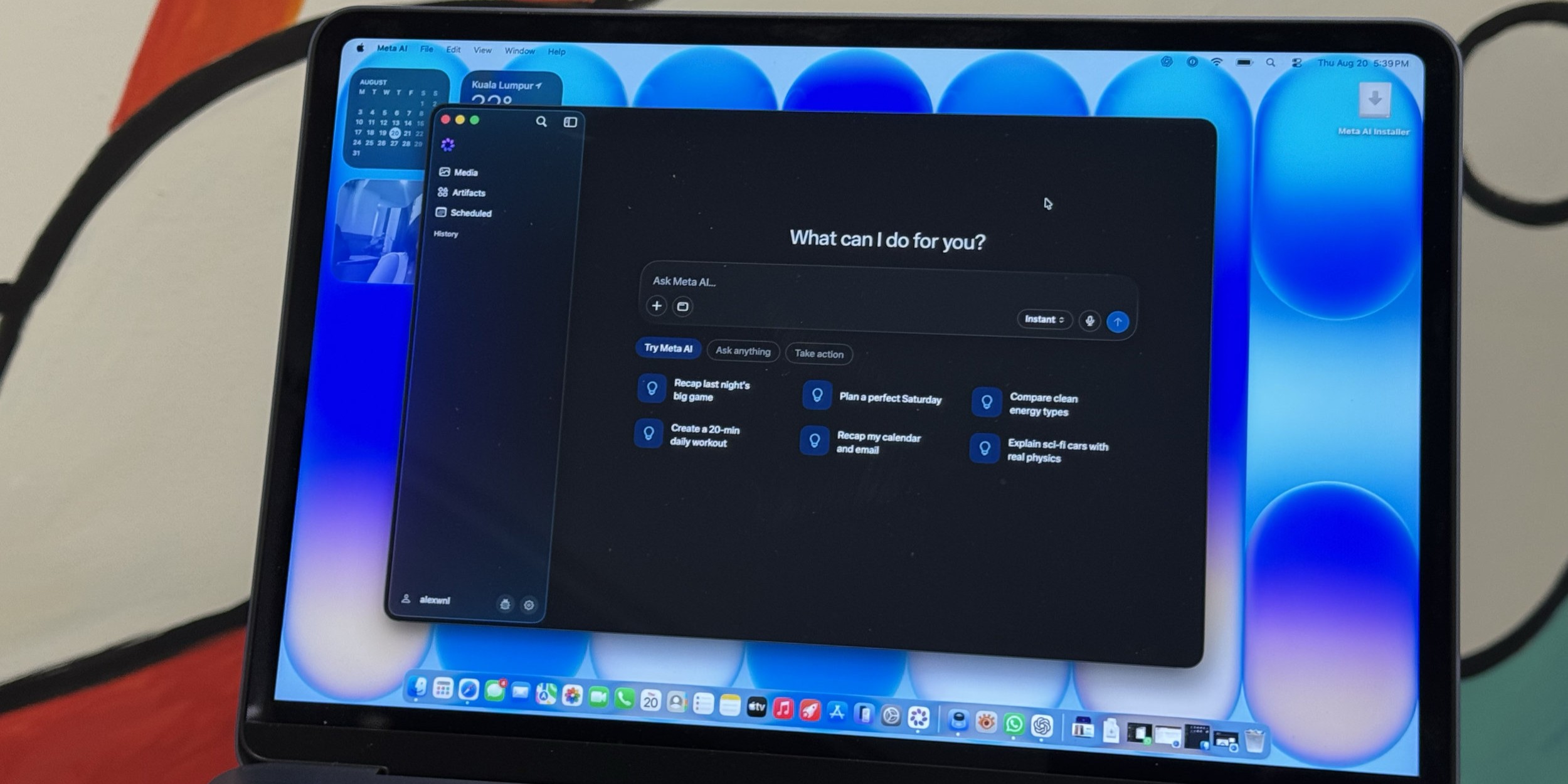
Meta AI is getting a Mac app, but the more important story is not the desktop shortcut. It is Meta’s attempt to turn its assistant into a business tool for creators, advertisers and small companies already living inside Facebook and Instagram.
Meta’s new AI Mac app gives users a dedicated desktop home for the assistant, with screen or window sharing so the AI can answer questions about what is visible. It also supports dictation across apps, making it feel closer to a system-level assistant than a web chatbot.
The business integrations are the sharper angle. Meta AI can now connect with professional Facebook and Instagram accounts, Meta ad campaigns and Google Workspace. That gives it access to the kinds of data small businesses already use every day: posts, engagement metrics, campaign performance, documents, spreadsheets and planning materials.
For a small business owner, that could be useful. Instead of exporting numbers from one dashboard, writing captions in another app and building reports manually, the assistant can analyse account performance and suggest what to publish next. It can also help generate presentations, documents and recurring reports.
This is Meta playing to its strength. OpenAI, Google and Anthropic may have stronger general assistant brands in some markets, but Meta controls the platforms where many small businesses actually find customers. If an AI assistant understands Facebook posts, Instagram engagement and ad campaigns directly, it has context that a generic chatbot may not have.
There is also a privacy and trust issue. When an assistant connects to business accounts, ad systems and Google Workspace, it may see commercially sensitive information. Businesses will need to understand what data is being accessed, how it is used, what permissions can be revoked and whether any connected data may influence model training or ad targeting.
That tension is not unique to Meta. Every AI assistant that becomes more useful does so by seeing more context. The more context it sees, the more important permission design becomes. We recently wrote about OpenAI’s Zero Data Retention and Private Safety Processing push, and Meta’s business assistant strategy belongs in the same trust conversation.
The Mac app also shows how the AI assistant race is moving onto the desktop. ChatGPT, Gemini, Claude and Meta AI all want to sit closer to the user’s actual work. The assistant that can see the screen, understand the task and connect to the relevant business tools has a better chance of becoming part of the daily workflow.
The commercial logic is clear. If small businesses use Meta AI to plan posts, analyse campaigns and generate marketing material, Meta becomes more central to how those businesses operate. That can support ad spend, subscription products and deeper platform lock-in.
The product is still early, and Meta will need to prove that the assistant can give useful recommendations rather than generic marketing advice. But the direction is clear: Meta AI is no longer only competing as a chatbot. It is being shaped into a business layer for the Facebook and Instagram economy.
Related Reading
More contextual TechBooky stories selected from tags, categories and article context.
Paul Balo is the founder of TechBooky and a highly skilled wireless communications professional with a strong background in cloud computing, offering extensive experience in designing, implementing, and managing wireless communication systems.
We use cookies to ensure that we give you the best experience on our website. If you continue to use this site we will assume that you are happy with it.