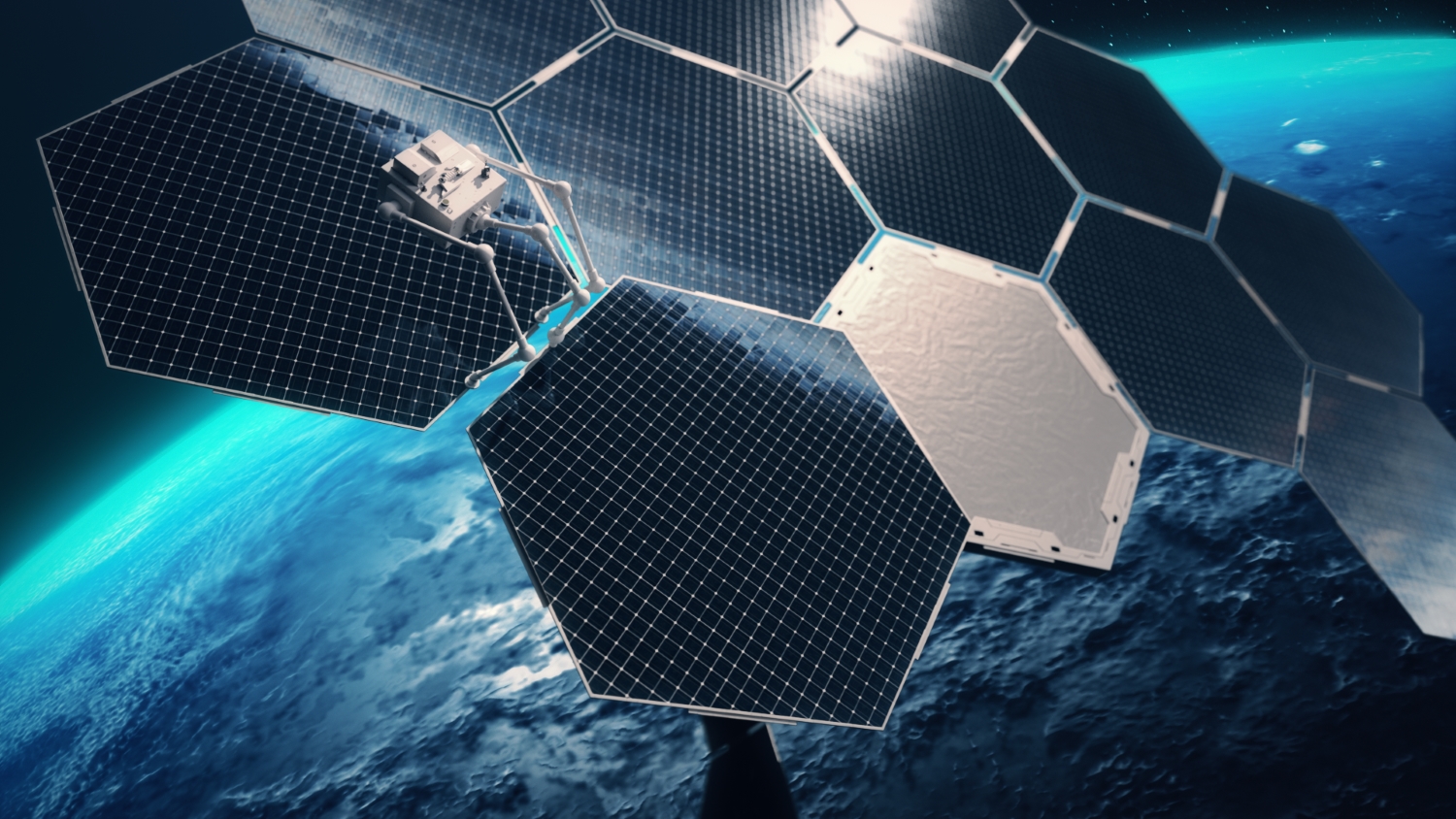
The phrase orbital data centre sounds like science fiction until you remember what the AI boom is already doing on Earth. Data centres are swallowing power, land, water, chips and political patience. AI companies are fighting for GPU clusters years in advance, a pressure visible in the reported Anthropic and Meta US$10bn compute talks. Governments are asking whether grids can cope. In that environment, Elon Musk’s pitch is simple enough to be seductive: if Earth is becoming too crowded and too power-constrained for AI compute, why not move some of it into orbit?
That idea is now being discussed with more seriousness because SpaceX has reportedly been exploring a very large orbital data-centre system in filings and industry discussions, while also building a terrestrial compute business that has reportedly attracted customers such as Google, Anthropic and the U.S. defense ecosystem. At the same time, Sam Altman has publicly mocked the near-term idea, accusing Musk of selling investors on short-term space data centres rather than solving the actual compute bottleneck on Earth.
So what are space data centres, why is Musk interested, why is Altman sceptical, and could they realistically bridge the AI compute gap? The answer is not a clean yes or no. Orbital compute is technically imaginable. It may even become useful for some workloads. But turning it into the backbone of global AI infrastructure is a much harder problem than launching servers above the atmosphere.
A normal data centre is a building full of servers, networking equipment, power systems and cooling infrastructure. An orbital data centre would move some of those servers into space, most likely in low Earth orbit, inside satellites or larger spacecraft designed to run compute workloads using solar power.
In theory, the advantages are attractive. Space has abundant sunlight, and satellites can generate solar power without clouds, land-use fights or local zoning battles. Heat can be radiated away into space. Compute could be placed close to satellite data sources, reducing the need to downlink raw data before processing. A constellation of compute satellites could also become a new kind of cloud layer for governments, space companies and AI customers.
The basic concept is not entirely new. Satellites already process data onboard, and edge computing in space is used for imaging, communications and defense tasks. What is new is the ambition to turn that into something resembling hyperscale AI infrastructure, with GPU-class compute in orbit and enough capacity to matter for large model inference or even training.
Musk has two reasons to care. The first is strategic. SpaceX already controls launch, satellite deployment, Starlink connectivity and increasingly compute infrastructure. If AI becomes the most important industrial workload of the next decade, owning the infrastructure layer becomes a massive business opportunity.
The second reason is practical. AI data centres are hitting Earth-side constraints. Power grids are under pressure. Water use is controversial. Communities are pushing back against large projects. Land and permitting are slow. The chip supply chain is tight. If SpaceX can argue that orbital compute bypasses some of those limits, it gives investors and customers a dramatic alternative to the terrestrial data-centre race.
The scepticism comes down to physics and economics. Launch is still expensive, even with reusable rockets. Servers are heavy. GPUs consume enormous power. Radiation damages electronics. Maintenance is almost impossible compared with swapping parts in a ground data centre. Cooling in space is not as simple as pointing a fan at the problem; heat must be radiated away, which requires surface area and careful engineering.
Then there is latency. A low Earth orbit satellite is not terribly far away, but moving data between Earth, orbit and other networks adds complexity. For some workloads, that may be acceptable. For interactive AI services used by millions of people, it may not be the first place you want to run everything.
The first useful orbital data centres are unlikely to look like giant ChatGPT factories in the sky. The earliest practical use cases will probably be narrower: processing satellite imagery, defense sensing, space-based communications, encrypted government workloads, remote scientific data and specialised AI inference close to where the data is created.
That is a real market. Satellites collect enormous amounts of data, and sending all of it back to Earth is inefficient. If an orbital system can process raw imagery, detect useful signals, compress results and downlink only what matters, it could save bandwidth and improve response times.
Defense is another likely early customer. The military already uses space assets for communications, surveillance and missile warning. AI models running closer to space-based sensors could be useful for classification, tracking and anomaly detection. That makes orbital compute more plausible as a defense and satellite-edge market before it becomes a mass-market AI cloud.
Consumer AI inference is harder. Running everyday chatbot queries, coding agents or video models from orbit only makes sense if cost, reliability and latency become competitive with ground infrastructure. That is a much higher bar.
Can Orbital Compute Bridge The AI Gap?
In the short term, no. The world’s AI compute gap is measured in gigawatts of terrestrial data-centre capacity, millions of GPUs, supply-chain constraints and power agreements, even as TSMC’s latest quarter shows AI chip demand remains intense. Orbital systems will not meaningfully solve that in the next few years.
In the medium term, maybe for specialised workloads. If SpaceX can launch compute satellites cheaply, manufacture them in large numbers, power them reliably, connect them through Starlink-like networking and replace them frequently, orbital compute could become a useful supplement. It may help where Earth-side permitting, power access or proximity to space data are the limiting factors.
In the long term, the idea becomes more interesting. If launch costs fall dramatically, if Starship reaches high cadence, if satellite manufacturing scales, if radiation-hardened AI hardware improves and if customers accept the reliability model, orbital data centres could become part of a broader compute mix. But that is a decade-scale infrastructure question, not a quick fix for today’s GPU shortage.
This is where the Musk-Altman fight becomes more than personality. Altman needs compute now. Musk is pitching a future where the bottleneck is solved by a vertically integrated space-and-compute stack. Both can be right in their own timeframes: orbital AI is not useful enough for OpenAI’s immediate needs, but it may still be an infrastructure bet SpaceX wants to own early.
The Safety Problems
Safety starts with debris. Low Earth orbit is already crowded. A large constellation of compute satellites would add collision risk, tracking burden and end-of-life disposal concerns. If orbital data centres are launched in huge numbers, regulators will want strong deorbit plans, manoeuvrability, collision avoidance and proof that failed satellites will not become long-term hazards.
Cybersecurity is also serious. A space data centre would be a high-value target. If it supports defense workloads, AI models or sensitive commercial data, attackers will look for ways to intercept links, compromise ground stations, manipulate onboard systems or disrupt service. Security cannot be bolted on later.
There is also AI safety. If orbital compute supports powerful models, governments will ask who controls access, how workloads are audited and whether sensitive models can be run outside normal jurisdictional oversight. Putting servers in orbit does not put them outside politics. It may make the politics more complicated.
Orbital data centres would touch multiple regulatory layers: launch licensing, spectrum rights, orbital debris rules, national-security review, export controls, data sovereignty, environmental review and possibly cloud procurement rules. The Federal Communications Commission, the Federal Aviation Administration, the Department of Defense, NASA, international space bodies and foreign regulators could all have a say depending on the system.
Spectrum may be one of the hardest constraints. Compute satellites need fast links to Earth and to one another. That requires frequencies, coordination and interference management. A data-centre constellation cannot simply assume it gets clean, unlimited bandwidth.
Data sovereignty is another thorny issue. If a company in Europe, Africa or Asia runs workloads on a U.S.-controlled orbital data centre, where is the data legally processed? Which country has jurisdiction? What happens if a government customer requires domestic processing? These questions already complicate normal cloud computing. Orbit will not magically simplify them.
When Could The First Ones Arrive?
The first meaningful orbital compute demonstrations could happen within the next few years, especially if they are small, specialised systems tied to satellite imagery, defense or communications. That is the realistic near-term version: not an orbital hyperscale cloud, but compute satellites proving that AI inference can run reliably in space.
A commercially relevant constellation could take much longer. A useful early network might arrive late in the decade if launch cadence, satellite manufacturing and customer demand all line up. A true hyperscale orbital compute layer, one that competes directly with terrestrial AI data centres, is more likely a 2030s story if it happens at all.
That timeline is why Altman is sceptical and Musk is still interested. Altman is judging the idea against the next five years of OpenAI compute demand. Musk is judging it as a long-term infrastructure market SpaceX could dominate if it starts before everyone else.
Orbital data centres are not nonsense. They are also not a near-term cure for the AI compute crisis. The concept makes sense for some space-native, defense and specialised edge workloads. It becomes much harder when applied to everyday AI cloud services at hyperscale.
Musk is delving into them because SpaceX has the launch advantage, satellite experience, Starlink networking and a growing compute business. Altman is mocking them because OpenAI needs practical compute now, not a futuristic pitch that still has to solve launch cost, radiation, cooling, maintenance, regulation and latency.
The world should expect early orbital compute pilots before it expects orbital hyperscale clouds. If SpaceX can prove reliability and economics on narrow use cases, the idea will become more credible. If not, it will remain what critics already think it is: an impressive investor story orbiting far ahead of engineering reality.
Either way, the debate tells us something important about AI. The next phase is not only about better models. It is about who controls the physical infrastructure that makes those models possible. Whether on Earth or in orbit, compute is becoming the new strategic terrain.
Related Reading
More contextual TechBooky stories selected from tags, categories and article context.
Paul Balo is the founder of TechBooky and a highly skilled wireless communications professional with a strong background in cloud computing, offering extensive experience in designing, implementing, and managing wireless communication systems.
We use cookies to ensure that we give you the best experience on our website. If you continue to use this site we will assume that you are happy with it.