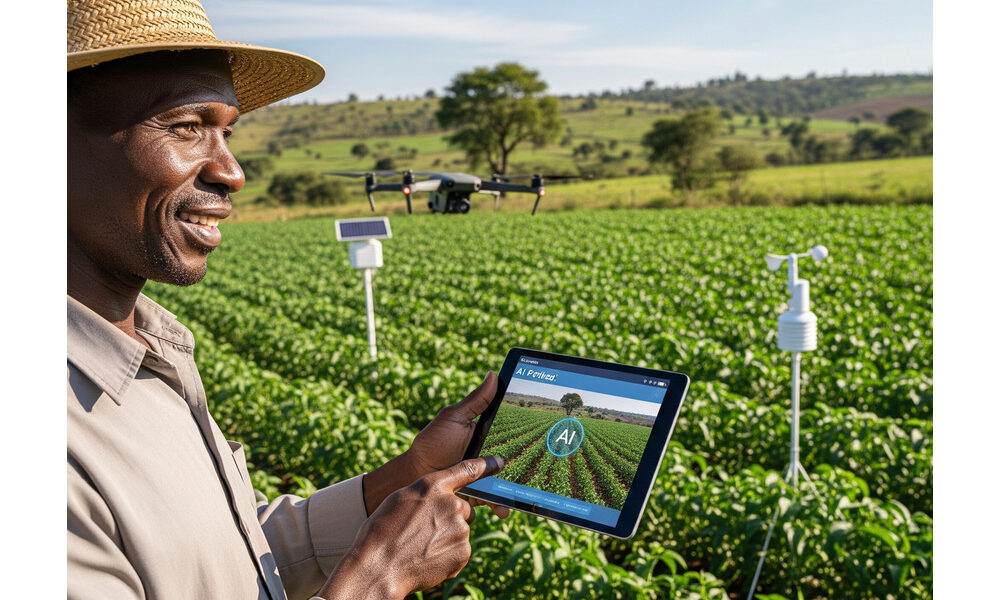
Smart Africa and the Food and Agriculture Organization are trying to move African agricultural AI beyond pitch decks and pilots. The third edition of the Innovate Africa Challenge is focused on proven AI-driven solutions for climate-smart agriculture that can be deployed in a Smart Africa member state.
The official FAO portal says the challenge seeks to identify and support one proven AI-driven solution for climate-smart agriculture and deploy it with national ministries responsible for agriculture, ICT and innovation, the Smart Africa Secretariat and FAO country offices and technical experts. TechAfrica News reports that the goal is to validate effectiveness in real farming environments and create pathways for broader adoption across Africa.
That deployment focus is important. Africa does not lack small AI experiments in agriculture. What it lacks is enough working systems that survive the messy realities of farms, weather, extension services, language, connectivity, cost and government coordination.
AI can help with crop forecasting, pest detection, water optimisation, soil intelligence, yield prediction, market planning and early warning for climate shocks. But a tool that looks impressive in a demo is not enough. Farmers need something that works in local conditions, with local crops, local languages, unreliable connectivity and business models that do not collapse when donor funding ends.
The challenge is expected to support solutions relevant to countries including Ghana, Kenya, Malawi, Rwanda and Uganda, with implementation funding, mentorship, incubation and pilot opportunities mentioned in several application summaries. The wider theme is from ideation to deployment, which is exactly where many African agritech ideas struggle.
Agriculture is one of the best places for Africa to use AI practically because the problem is not abstract. Climate change is already changing rainfall patterns, pest behaviour, planting windows and food security. Smallholder farmers often carry the risk with little data support. Better forecasts and decision tools can make a real difference if they reach the people who need them.
The hard part will be scaling beyond the winning solution. One project can prove a model. A continent-wide impact requires ministries, extension workers, telecom partners, farmer cooperatives, weather agencies, researchers and investors to keep supporting it after the competition ends.
That is why Smart Africa and FAO involvement matters. If the challenge can connect a working AI tool to national systems and real technical support, it has a better chance of becoming infrastructure rather than another forgotten pilot.
The promise is not that AI will solve African agriculture by itself. It will not. Farmers still need roads, finance, storage, irrigation, inputs, markets and fair prices. But if AI can help them make better decisions under climate pressure, then this is one of the more grounded uses of the technology on the continent. The useful AI revolution in Africa may look less like a chatbot and more like a farmer getting the right warning before the rain, pest or drought arrives.
Related Reading
More contextual TechBooky stories selected from tags, categories and article context.
Paul Balo is the founder of TechBooky and a highly skilled wireless communications professional with a strong background in cloud computing, offering extensive experience in designing, implementing, and managing wireless communication systems.
We use cookies to ensure that we give you the best experience on our website. If you continue to use this site we will assume that you are happy with it.