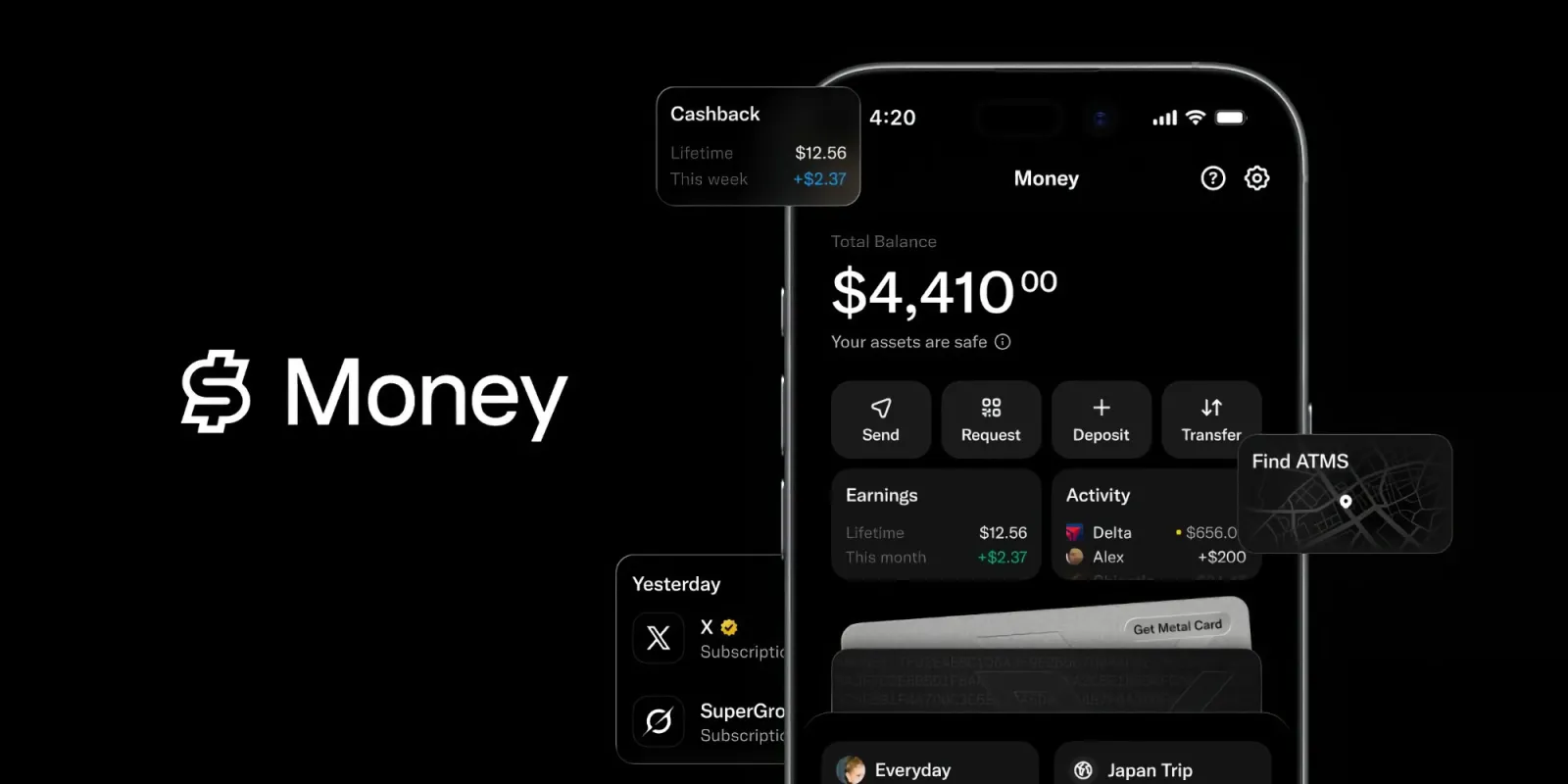
Elon Musk’s everything-app plan has crossed into real financial services. X Money is now rolling out in the United States to X Premium and Premium Plus subscribers, moving the platform beyond posts, video, messaging and creator payments into peer-to-peer money movement and banking-like features.
X Money offers a digital wallet, peer-to-peer payments, a customisable metal Visa card, Apple Wallet support and free transfers within X. The service also advertises up to 6 percent APY, though Premium Plus users are automatically eligible while standard Premium users may need to meet deposit requirements. The launch follows an invite-only beta and is initially limited to paid users in the United States.
The regulated banking infrastructure comes from Cross River. In its announcement, Cross River described X Money as the first peer-to-peer payments experience built directly into a U.S. social media platform. The company says the product brings deposit accounts, interest earnings, debit card access and payment tools into X’s main app experience.
This is one of the clearest signs yet that Musk still wants X to become something closer to China’s WeChat, where messaging, identity, commerce, payments and services live inside one app. Musk has talked about this direction since before he bought Twitter. The difference now is that X is finally putting a consumer financial product in front of paying users, not merely teasing the ambition.
The product itself is not conceptually new. Venmo, Cash App, PayPal, Apple Cash and bank apps already handle payments and wallets for millions of users. X Money’s real bet is distribution. If users already spend time inside X, follow businesses, message creators, buy subscriptions and consume live news, Musk wants the app to become a place where money can move too. That could eventually support tipping, creator payouts, commerce, ticketing, subscriptions and peer-to-peer transactions without users leaving the platform.
The difficult part is trust. Payments are different from posts. A social media account can be suspended, hacked, impersonated or caught in moderation disputes. A financial account carries a much higher expectation of reliability, customer support, fraud protection, dispute resolution and regulatory compliance. X has spent years dealing with trust and safety controversies, advertiser pullbacks and platform instability. Convincing users to connect real money to that environment will be a tougher test than getting them to buy a premium badge.
There are also political and regulatory questions. U.S. financial services rules are strict, and payments products invite scrutiny around anti-money laundering controls, consumer protection, privacy, data use and fraud. Cross River gives X a regulated partner, but the user-facing brand is still X. That means any account lockout, scam wave or data-handling controversy could quickly become a financial-services problem rather than only a social-media problem.
TechBooky’s recent article on Meta making Facebook Verified free looked at how social platforms are trying to prove identity as AI scams become harder to spot. X Money faces a related problem. If a platform wants to move money, it has to know who users are, detect fraud quickly and make users believe that the system will protect them when something goes wrong.
The timing also fits Musk’s wider push to make each part of his business universe feel connected. X is the social layer. xAI is the AI layer. Tesla and SpaceX provide the industrial mythology. X Money adds a payments layer that could eventually sit beneath commerce, subscriptions and creator economics. Whether users embrace it is another matter, but the strategic logic is obvious.
For now, X Money is a U.S.-only rollout for paid subscribers, so it is not yet the full everything app Musk has promised. But it is a meaningful step because money changes the stakes. If X can make payments feel useful and trustworthy, it could open a new business line beyond advertising and subscriptions. If users hesitate, the launch may show that building a financial network inside a social platform is easier to announce than to earn.
Related Reading
More contextual TechBooky stories selected from tags, categories and article context.
Paul Femi Balo is the founder and publisher of TechBooky. He covers artificial intelligence, African technology, digital infrastructure, enterprise technology and the global digital economy.
We use cookies to ensure that we give you the best experience on our website. If you continue to use this site we will assume that you are happy with it.