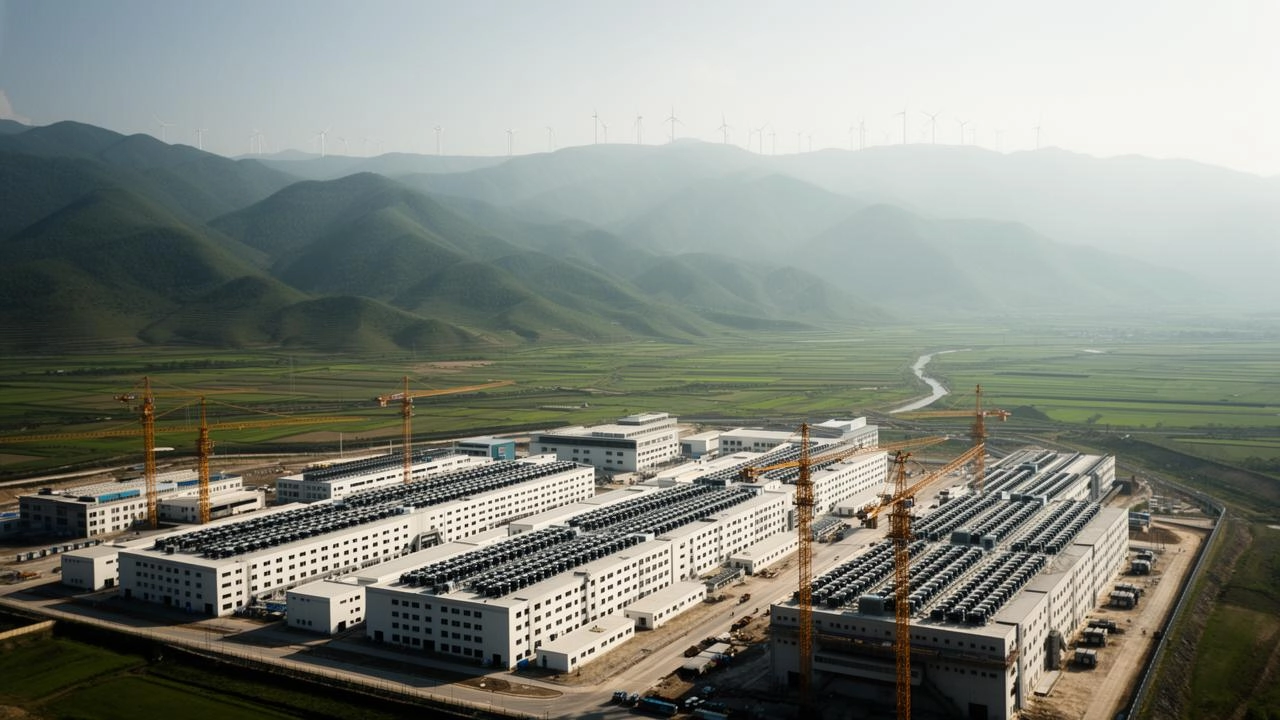
China’s AI race is not only being fought in model labs and chip factories. It is also being fought in quieter rural provinces where data centres can find cheaper land, more power and stronger policy support.
AFP, carried by Taipei Times, reports from Guizhou that China is pushing large data-centre projects into less crowded regions as part of its effort to power the AI boom. Huawei’s large Guian data centre is one visible example, sitting far from the country’s coastal technology hubs but close to the energy and land that heavy compute demands.
The logic is clear. AI data centres consume enormous amounts of electricity and need space, cooling, fibre connectivity and reliable power. Rural and western provinces can offer cheaper land and, in some cases, renewable energy that would otherwise be difficult to absorb. China’s Eastern Data, Western Computing strategy is built around that tradeoff; move computing demand away from crowded eastern cities and use western regions for capacity.
This is infrastructure policy as AI strategy. While the U.S. relies heavily on private hyperscalers racing to secure power deals, China can use planning, subsidies and state direction to steer where data centres are built. That does not make the model automatically better, but it does make it faster when the state decides a sector is strategic.
The local economic story is more complicated. Data centres bring construction, roads, power equipment, fibre links and some technical jobs. But they do not always create broad employment once they are running. Analysts cited in the report warn that heavy investment in land and equipment may not translate into strong local income growth, even when regional GDP figures improve.
That tension is not unique to China. Around the world, communities are being asked to host energy-hungry data centres because AI companies need more compute. The promise is investment and digital modernization. The risk is higher power pressure, land use, water use, public debt and relatively limited job creation after construction ends.
For Beijing, the calculation may still be worth it. China wants more domestic AI compute, more local cloud capacity and less vulnerability to U.S. technology restrictions. It is also building a wider AI stack that includes open-weight models, memory-chip growth and domestic hardware alternatives. Rural data centres are one more piece of that national strategy.
For Africa, this should sound familiar. Governments and investors are now talking more seriously about AI data centres, sovereign cloud and local compute. But the Chinese example is a warning: data-centre investment only becomes a national win if it connects to skills, local businesses, research, affordable cloud access and reliable power planning. Otherwise, it can become expensive infrastructure with limited spillover.
The AI compute race is therefore becoming geographic. Countries with land, power, fibre, political coordination and capital will attract data centres. Countries without those basics will rent capacity from others and accept whatever price, rules and latency come with that dependency.
China is betting that moving compute inland can reduce bottlenecks and support its AI ambitions. The question is whether the rural regions hosting this infrastructure will share enough of the upside. AI may need their land and power, but that does not automatically mean AI will make them richer.
Related Reading
More contextual TechBooky stories selected from tags, categories and article context.
Paul Balo is the founder of TechBooky and a highly skilled wireless communications professional with a strong background in cloud computing, offering extensive experience in designing, implementing, and managing wireless communication systems.
We use cookies to ensure that we give you the best experience on our website. If you continue to use this site we will assume that you are happy with it.